Ice Cave
An ice cave is a term used for two distinct types of natural cavities. The first type refers to tunnels formed within glaciers or snowfields by meltwater and…
What is an ice cave, and how does it differ from a glacier cave?
An ice cave is a term used for two distinct types of natural cavities. The first type refers to tunnels formed within glaciers or snowfields by meltwater and wind. The second type refers to underground caves that contain permanent ice deposits, often created when cold air becomes trapped in subterranean caverns or when moisture freezes in frigid air currents.1
The distinction between an ice cave and a glacier cave is often a matter of classification:
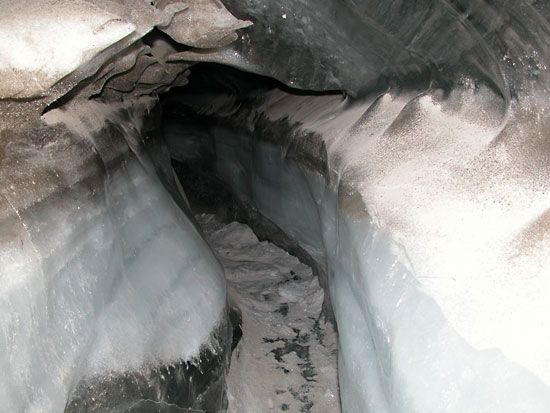
- Glacier caves are a specific subset of the first type of ice cave. They are tubular conduits formed at the base of a glacier where meltwater drains through crevasses and melts the ice against the underlying bedrock.2
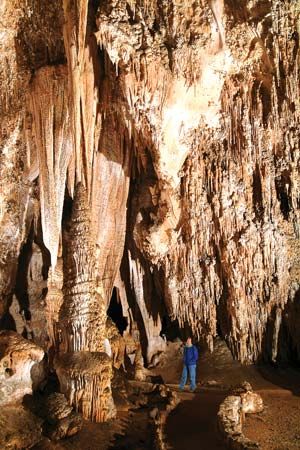
- Ice caves (the second type) are not formed by glacial processes. Instead, they are typically found in rock formations, such as limestone or lava tubes, where the internal environment remains cold enough to preserve ice year-round.1
While glacier caves are defined by their location within glacial ice, the second type of ice cave is defined by the presence of perennial ice within a rock cavern.21
How are ice caves formed in different geological settings?
Ice caves form through two distinct, unrelated geological processes depending on whether the cavity is composed of ice or rock.2
Glacial Formations
Glacier caves are formed within glaciers or snowfields. Meltwater from the glacier’s surface drains through crevasses, creating shafts that reach the base of the ice. Because this water is slightly above the melting point, it carves tubular conduits and intricate labyrinths between the glacial ice and the underlying bedrock. These caves often feature translucent, scalloped walls that transmit blue light.23
Subterranean Rock Formations
The second type of ice cave occurs within rock structures, such as limestone caverns or lava tubes. These form when cold winter air settles into downward-leading caverns and becomes trapped, preventing warmer air from entering. Alternatively, they form when moisture freezes in cold air currents. In lava tubes, roof collapses or “skylights” can create cold air traps, allowing ice to persist as ponded water, icicles, or stalagmites well into the summer months.21
What types of rock formations are commonly associated with ice caves?
Ice caves that contain permanent ice deposits—distinct from those formed within glaciers—are commonly associated with specific rock formations that facilitate the trapping of cold air. The two primary geological settings for these caves are:
- Limestone: These systems are among the most significant, often hosting extensive frozen landscapes. A notable example is the Eisriesenwelt (“Ice Giant World”) in Austria, which features a vast network of ice deposits within a limestone cavern system.2
- Lava Tubes: These volcanic caves are formed by flowing lava that crusts over and eventually drains. When segments of the roof collapse to form “skylights,” particularly at the upper end of a tube, the cave can act as a cold air trap. This allows moisture to freeze into icicles, ice stalagmites, and ponded ice that may persist well into the summer months.24
In these settings, the rock structure acts as a thermal insulator, preventing the escape of frigid winter air and allowing ice to accumulate and remain throughout the year.24
How does meltwater shape the inside of a glacier?
Meltwater plays a critical role in shaping the internal structure of a glacier by creating complex drainage systems and conduits. As surface snow and ice melt, water percolates through the snowpack and eventually enters well-defined channels within the solid ice below.6
One of the most prominent features formed by this process is a moulin, a nearly cylindrical, vertical shaft that extends deep into the glacier. These shafts are carved by the force of meltwater and the abrasive rock debris it carries as it funnels downward.78
The internal hydrology of a glacier is dynamic and changes seasonally:
- Summer: As the snowpack thins, drainage paths become more defined, allowing meltwater to be transmitted through the glacier rapidly.6
- Winter: Surface layers freeze, halting the movement of meltwater at the top, while internal conduits often begin to close.6
Beyond creating internal channels, meltwater also influences the glacier’s base. It can contribute to hydraulic pressures that assist in glacial erosion and the transport of sediment, ranging from fine rock flour to large boulders, which further abrade the bedrock beneath the ice.96
Sources
- cave - Glacier caves — Encyclopædia Britannica
- ice cave — Encyclopædia Britannica
- cave - General characteristics — Encyclopædia Britannica
- cave - Process of formation — Encyclopædia Britannica
- cave deposit — Encyclopædia Britannica
- moulin — Encyclopædia Britannica
- glacier - Surface features — Encyclopædia Britannica
- glacial landform - Meltwater deposits — Encyclopædia Britannica
- glacial landform - Glacial erosion — Encyclopædia Britannica
- moulin — Merriam-Webster
- ice - Thermal properties — Encyclopædia Britannica
- glacier - Glacier hydrology — Encyclopædia Britannica
- glacier - Heat or energy balance — Encyclopædia Britannica
Published on · 3 min read