Mount Etna
Mount Etna has profoundly shaped Sicily’s landscape, culture, and economy for millennia.
How has Mount Etna influenced the culture and economy of Sicily?
Mount Etna has profoundly shaped Sicily’s landscape, culture, and economy for millennia.
Cultural Influence
The volcano has long occupied a central place in the Sicilian imagination. Ancient Greeks wove legends around it, describing the mountain as the workshop of Hephaestus and the Cyclops, or as the prison of the giant Typhon, whose movements were said to cause earthquakes. Its frequent eruptions have been documented by poets and historians since antiquity, cementing its status as a powerful, ever-present force in regional history.1
Economic Impact
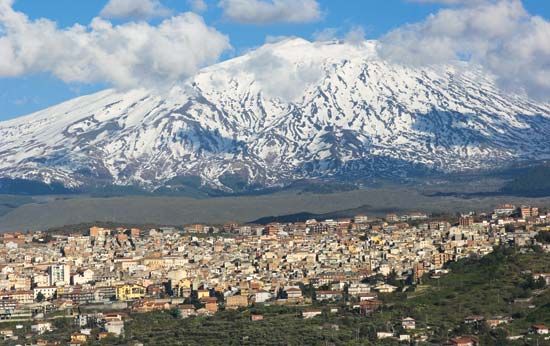
The volcano’s influence on the economy is primarily tied to its fertile slopes. The lowest ecological zone, extending up to 3,000 feet, is highly productive, supporting extensive vineyards, olive groves, citrus plantations, and orchards. While the mountain poses risks—having historically destroyed villages, orchards, and infrastructure—it remains a vital agricultural hub for the island. Additionally, the volcano is a significant site for scientific study and tourism, though its activity can periodically disrupt travel and local industry.12
How do scientists monitor and predict Mount Etna’s volcanic activity?
Scientists monitor and predict the activity of Mount Etna through a combination of systematic observation and advanced instrumentation. Because the volcano is one of the world’s most active, permanent volcano observatories—including facilities in Catania, Casa Etnea, and Cantoniera—have been established to ensure early warning and continuous study.45
Key methods used to forecast volcanic outbursts include:
- Seismic Monitoring: Researchers use seismographs to detect swarms of earthquake tremors, which are often generated by the upward movement of magma from the asthenosphere. A sharp increase in the frequency and intensity of these quakes is a primary indicator of an impending eruption.41
- Surface Deformation: Instruments such as tiltmeters are employed to detect changes in the angle of the mountain’s slope, which can occur when rising molten rock inflates the magma chambers.41
- Geophysical and Chemical Analysis: Scientists utilize laser beams to check for slope changes, along with temperature monitors, gas detectors, and instruments sensitive to variations in magnetic and gravity fields. Additionally, analyzing volcanic gases provides critical data regarding the late stages of volcanic activity.4
While these tools allow for useful forecasts, eruption prediction remains a complex challenge, as the science is still evolving and inherently involves uncertainty.1
Where is Mount Etna located and what makes it significant among volcanoes?
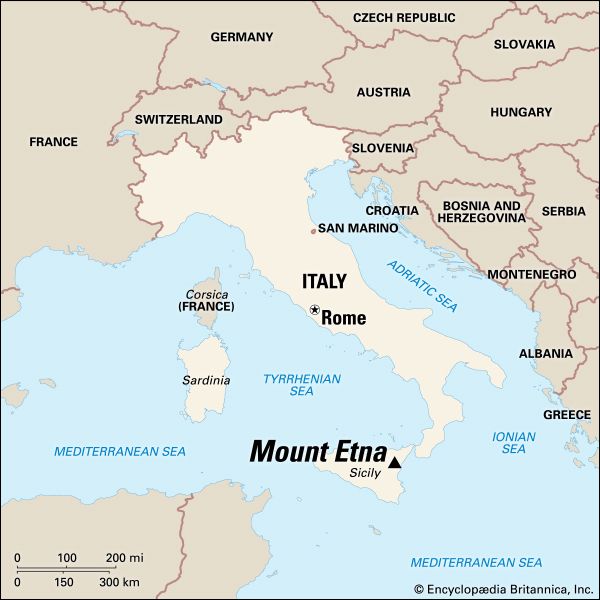
Mount Etna is an active volcano located on the east coast of Sicily, Italy.13
It holds significant status among the world’s volcanoes for several reasons:
- Highest in Europe: Standing at approximately 10,900 feet (3,320 meters), it is the tallest active volcano on the European continent.16
- Historical Longevity: Etna has been active for roughly 2.6 million years, with a recorded eruptive history spanning millennia. Its activity has been documented since antiquity, including references by ancient Greek poets and historians like Hesiod, Pindar, and Aeschylus.1
- Cultural Significance: The volcano has long been a fixture of human culture and mythology. Ancient legends identified it as the workshop of Hephaestus and the Cyclops, or as the prison of the giant Typhon, whose movements were said to cause earthquakes.1
- Scientific Importance: It has been the subject of systematic study since the mid-19th century, with multiple observatories established on its slopes to monitor its frequent and varied eruptive activity.1
What types of volcanic hazards are associated with Mount Etna?
Mount Etna presents several volcanic hazards common to active volcanoes, primarily driven by its frequent volcanic activity and lava emissions.17
Primary Hazards
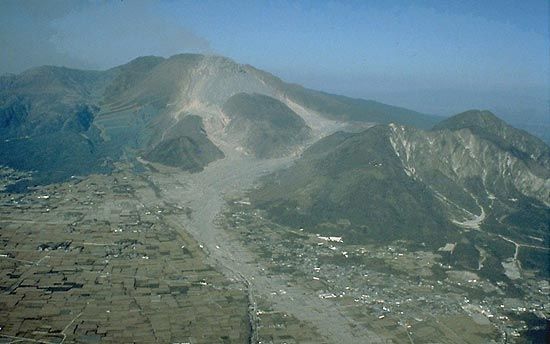
- Lava Flows: As one of the world’s most active volcanoes, Etna has produced lava flows over 150 times since 1500 BCE. These flows can destroy infrastructure, including villages, orchards, vineyards, and transportation networks, as seen in historical events like the 1669 eruption that submerged parts of Catania and the 1928 eruption that buried the village of Mascali.71
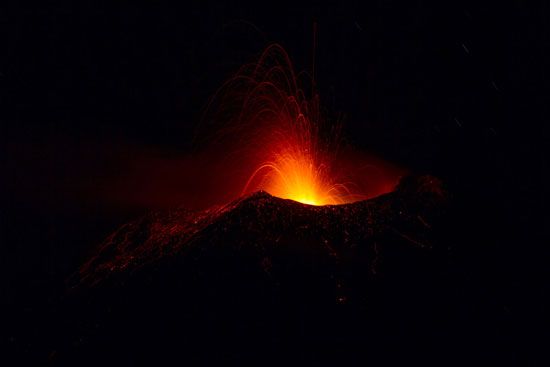
- Explosive Eruptions: Etna frequently exhibits Strombolian activity, characterized by moderate bursts of gas that eject incandescent lava clots. More intense eruptions can hurl solid fragments, sand, and ash, which may form new cones or pose risks to the surrounding area.18
- Ash Clouds: Major eruptions can send volcanic clouds to high altitudes, which pose significant risks to aviation and can disrupt local travel and tourism.1
General Volcanic Risks
Beyond these specific events, volcanic eruptions generally carry risks such as toxic gas clouds, pyroclastic flows, avalanches, tsunamis, and mudflows7. While ash falls do not typically cause direct fatalities, heavy accumulation can lead to roof collapses and widespread crop failure.9
Sources
- Mount Etna — Encyclopædia Britannica
- Sicily — Encyclopædia Britannica
- Etna, Mount — Merriam-Webster
- geology - Volcanology — Encyclopædia Britannica
- volcano - Volcano forecasting and warning — Encyclopædia Britannica
- world’s major volcanoes — Encyclopædia Britannica
- volcano - Lava , gas, and other hazards — Encyclopædia Britannica
- volcano - Ash falls — Encyclopædia Britannica
- volcano - Six types of eruptions — Encyclopædia Britannica
- volcano - Lava flows — Encyclopædia Britannica
Published on · 4 min read