Mount Ontake
Mount Ontake is a compound volcano located on the boundary of Gifu and Nagano prefectures in central Honshu, Japan. Rising to an elevation of 10,049 feet…
What is Mount Ontake?
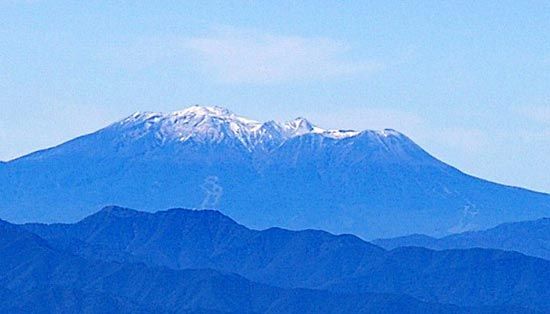
Mount Ontake is a compound volcano located on the boundary of Gifu and Nagano prefectures in central Honshu, Japan. Rising to an elevation of 10,049 feet (3,063 meters), it is the second-highest mountain in Japan after Mount Fuji and is held in high popular esteem.12
Characterized by a heavy mantle of snow during the winter months, the mountain serves as a significant site of religious importance, functioning as an object of worship for pilgrims who ascend it annually.12
How do volcanoes like Mount Ontake form?
Mount Ontake is a compound volcano, a type of landform also known as a stratovolcano. These mountains form over thousands of years through repeated eruptions that deposit layers of ash, mud, solidified lava, and pyroclastic material.3
The formation of volcanoes like Mount Ontake is driven by plate tectonics. Specifically, they are associated with subduction zones, where an oceanic plate sinks beneath a continental plate. As the oceanic plate descends, water and carbon dioxide trapped in seafloor sediments are carried into the mantle, where they act as fluxes that reduce the melting temperature of mantle rocks.13
This process creates magma, which rises due to buoyancy. As it ascends through the continental crust, the magma may undergo fractional crystallization or assimilate surrounding crustal rocks, increasing its silica content and viscosity. This high-viscosity magma, combined with trapped gases, often leads to the explosive eruptions that build the steep, conical structures characteristic of stratovolcanoes.13
What is the difference between an active, dormant, and extinct volcano?
Volcanologists classify volcanoes based on their eruptive history and potential for future activity. While these categories help assess risk, they are often subject to scientific uncertainty due to the long time scales involved in volcanic processes.7
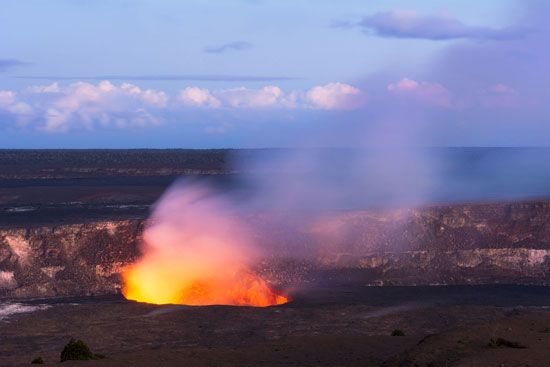
- Active Volcanoes: These are volcanoes that are currently erupting or have erupted in recent history and are expected to erupt again. Many active volcanoes, such as Kilauea or Mount Etna, are monitored by observatories using tools like seismographs and tiltmeters to track magma movement and predict potential outbursts.289
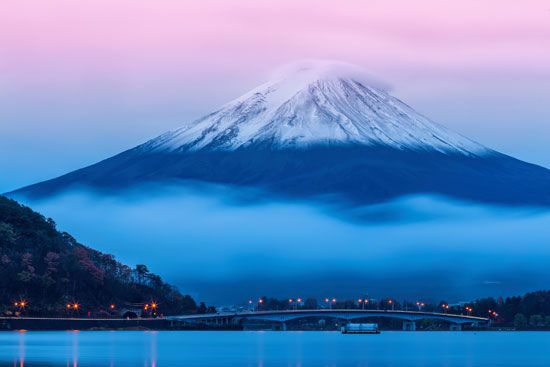
- Dormant Volcanoes: Often referred to as “sleeping” volcanoes, these are currently inactive but are considered capable of erupting again in the future. A major challenge in volcanic risk management is that many explosive volcanoes have such long “repose periods”—the time between eruptions—that nearby populations may mistakenly perceive them as extinct. For example, Mount Fuji is classified as active but has been dormant since 1707.87
- Extinct Volcanoes: These are volcanoes that are not expected to erupt again because they no longer have a supply of magma. However, distinguishing between a dormant volcano and an extinct one can be difficult, as geological history shows that some volcanoes previously thought to be extinct have returned to life.7
Why are many mountains in Japan considered sacred?
In Japan, many mountains are considered sacred due to long-standing traditions that view these peaks as powerful spiritual domains. Mountains are often perceived as “other worlds” or abodes for kami (sacred powers or gods), serving as bridges between heaven and earth.910
The reverence for these sites is rooted in several factors:
- Nature Worship: Mountains are seen as sources of life-giving rain and as the dwelling places of deities, such as the yama-no-kami, a mountain god historically associated with the hunt and later with agriculture.9
- Religious Practice: Traditions like Shugen-dō emphasize mountain retreats and pilgrimages as essential spiritual disciplines. Practitioners known as yamabushi engage in ascetic training in these isolated environments to attain spiritual power.10
- Symbolism: Iconic peaks like Mount Fuji and Mount Ontake are central to Japanese culture, attracting pilgrims who climb them as a religious act.111
These mountains remain vital centers for shrines, temples, and organized mountain cults that continue to honor the deep connection between the landscape and the divine.1110
Sources
- Mount Ontake — Encyclopædia Britannica
- world’s major volcanoes — Encyclopædia Britannica
- Japan - Geologic framework — Encyclopædia Britannica
- volcano - Subduction volcanoes — Encyclopædia Britannica
- magma — Encyclopædia Britannica
- stratovolcano — Encyclopædia Britannica
- geology - Volcanology — Encyclopædia Britannica
- volcano - Volcano forecasting and warning — Encyclopædia Britannica
- Mount Fuji: Top Questions — Encyclopædia Britannica
- Nature worship - Mountains — Encyclopædia Britannica
- Shugen-dō — Encyclopædia Britannica
Published on · 3 min read