Grass of Parnassus
Grass of Parnassus refers to any of approximately 15 species of low-growing perennial herbs belonging to the family Parnassiaceae. These plants are native to…
What is Grass of Parnassus?
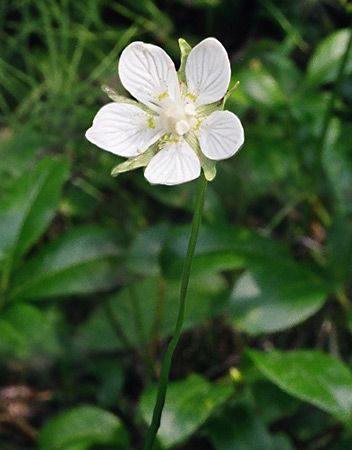
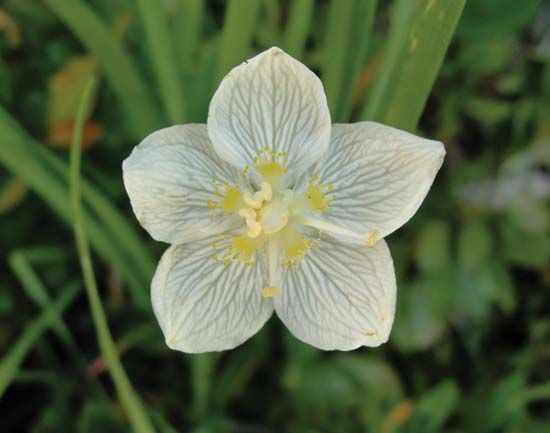
Grass of Parnassus refers to any of approximately 15 species of low-growing perennial herbs belonging to the family Parnassiaceae. These plants are native to the Northern Hemisphere and typically grow in tufts, producing white, yellow, or greenish-white flowers.1
A distinctive botanical feature of the genus Parnassia is its flower structure, which contains five fertile stamens and five sterile stamens equipped with nectar glands. Due to their preference for moisture, these plants are often cultivated in damp, shaded areas near water sources. The name is derived from Mount Parnassus in Greece.12
Why is it called a grass if it is actually a flowering herb?
It is a common misconception that the name “grass of Parnassus” implies the plant is a true grass. In botanical terms, it is actually a perennial herb belonging to the family Parnassiaceae.1
The term “grass” in this context is a misnomer, likely arising from historical or folk naming conventions rather than scientific classification. While true grasses belong to the family Poaceae, the Parnassia genus consists of flowering plants that grow in tufts, often in damp, boggy environments. The name itself is derived from Mount Parnassus in Greece, reflecting its historical association with the region rather than any biological relationship to the grass family.234
What kind of insects are attracted to its nectar glands?
While the provided search results detail the general role of nectar as a food reward for various insects and explain that the grass of Parnassus (Parnassia) possesses sterile stamens equipped with nectar glands, the specific insect species attracted to these glands are not explicitly identified in the available data.561
In general, nectaries serve to attract a wide range of pollinators, including bees, flies, and other insects, by providing a sugary food source that encourages cross-pollination. Because Parnassia flowers are adapted to provide these rewards, they likely rely on such visitors to facilitate their reproductive processes, though the specific insect partners for this genus are not detailed in the provided text.5176
What does the name Parnassus refer to in Greek mythology?
In Greek mythology, Mount Parnassus is a mountain in central Greece that held significant sacred status. It was considered the home of Apollo and the Corycian nymphs, and it featured a cave on its plateau that was sacred to the nymphs and the god Pan.13
The mountain is perhaps most famous as the site of the Delphic oracle, the most renowned oracle in the ancient world. Located on the slopes of Parnassus above the Corinthian Gulf, the site was originally associated with the earth goddess Gaea before becoming the seat of Apollo’s prophecy.14
Additionally, Parnassus held a prominent place in literature. Roman poets often regarded the mountain’s Castalian spring as a source of poetic inspiration and favored Parnassus over Mount Helicon as the traditional home of the Muses.13
Sources
- grass of Parnassus — Encyclopædia Britannica
- grass-of-parnassus — Merriam-Webster
- Celastrales — Encyclopædia Britannica
- parnassia — Merriam-Webster
- Pollination - Beetles and flies — Encyclopædia Britannica
- Nectar — Encyclopædia Britannica
- parnassian butterfly — Encyclopædia Britannica
- Stamen — Encyclopædia Britannica
- Major types of pollinators - Beetles and flies — Encyclopædia Britannica
- Asteraceae - Pollination — Encyclopædia Britannica
- Major types of pollinators - Bees — Encyclopædia Britannica
- Cross-pollination — Encyclopædia Britannica
- Mount Parnassus — Encyclopædia Britannica
- oracle — Encyclopædia Britannica
- Parnassus — Merriam-Webster
Published on · 2 min read