Mount Kātrīnā
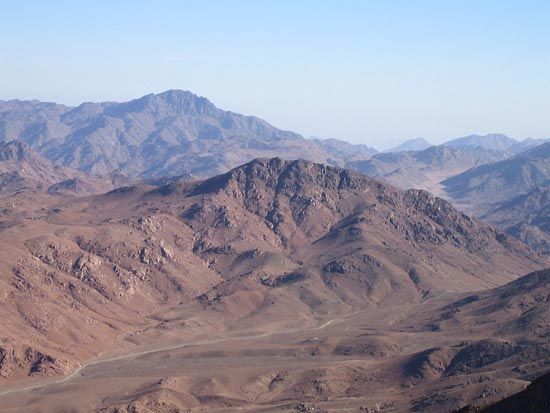
Mount Kātrīnā is a mountain peak located in the Sinai Peninsula of Egypt. Standing at 8,668 feet (2,642 meters), it is the highest point in the country. The…
What is Mount Kātrīnā?
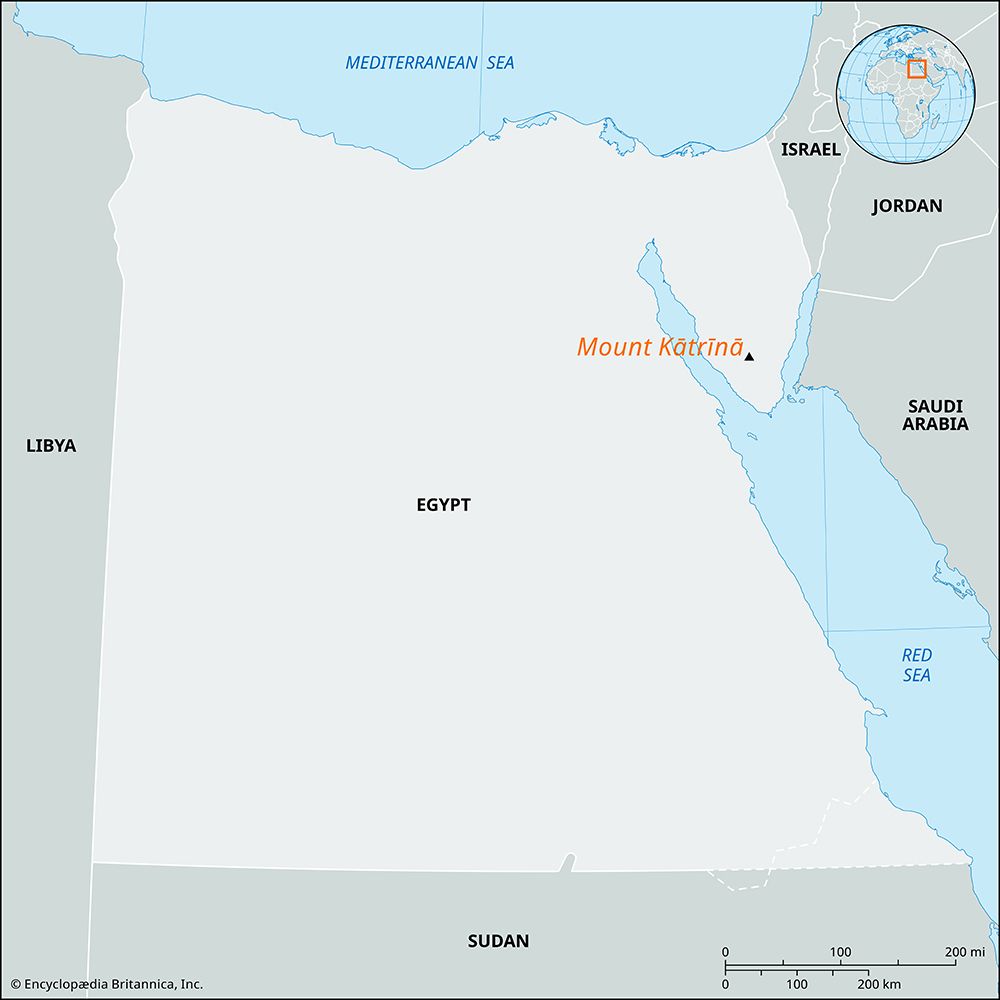
Mount Kātrīnā is a mountain peak located in the Sinai Peninsula of Egypt. Standing at 8,668 feet (2,642 meters), it is the highest point in the country. The summit features a meteorological station and a chapel. It is situated just 2 miles (3 km) south of Mount Sinai, which is the site of the historic Saint Catherine’s Monastery.1
What is the historical significance of Saint Catherine’s Monastery?
Saint Catherine’s Monastery is historically significant as one of the world’s oldest continuously inhabited Christian monasteries, with an unbroken history dating back to its founding by the Byzantine emperor Justinian I in 527 CE.23
Built to fortify the traditional site of the burning bush observed by Moses, the monastery serves as a vital repository of religious and historical artifacts. Its library houses an invaluable collection of ancient manuscripts, including the 4th-century Codex Sinaiticus, which has been essential for biblical scholarship. The site also preserves early Byzantine icons and a 6th-century mosaic of the Transfiguration.23
Beyond its religious role, the monastery is a symbol of interfaith coexistence; it has historically maintained a protective relationship with local Bedouin tribes and features a mosque within its walls, erected to preserve the site during the rise of Islam. Designated a UNESCO World Heritage site in 2002, it remains a center of Eastern Orthodox tradition.2
How does the geography of the Sinai Peninsula affect its climate?
The geography of the Sinai Peninsula significantly influences its climate, which is characterized by aridity and distinct regional variations based on terrain and elevation.4
Regional Climatic Differences
- Northern Region: This area consists of low-relief plateaus sloping toward the Mediterranean Sea. Its climate is marked by relatively higher winter precipitation (averaging about 5 inches or 125 mm) and dry, intensely hot summers. During spring and autumn, the region is affected by dry southern khamsin winds and occasional torrential rains.4
- Southern Region: The climate here is dictated by the rugged, mountainous terrain, which includes peaks like Mount Catherine. These high elevations result in cooler nights despite intense daytime summer heat. The peaks are frequently cloud-covered throughout the year and experience winter ice. Precipitation occurs in winter, while rare monsoon winds from the southeast can bring heavy rainfall during the summer months.4
Overall, the peninsula falls within a major arid climatic belt, with high relative humidity levels along the coasts—reaching 74 percent along the Mediterranean and 60 percent along the Red Sea.4
What are some other famous mountain peaks in Egypt?
Beyond the well-known peaks of the Sinai Peninsula, Egypt features several significant mountain ranges and summits, particularly within the Eastern Desert (also known as the Arabian Desert).
Notable Mountain Peaks in Egypt
- Mount Catherine (Jabal Kātrīnā): Located in the Sinai Peninsula, this is Egypt’s highest mountain, reaching an elevation of 8,668 feet (2,642 meters).48
- Mount Sinai: Also situated in the Sinai Peninsula, this granitic peak rises to 7,497 feet (2,285 meters) and is historically and religiously significant as a site of divine revelation.1
- Mount Shāʿib al-Banāt: The highest peak in the Red Sea Hills, located in the Eastern Desert. It reaches an elevation of 7,175 feet (2,187 meters).3
- Al-Jalālah al-Qibliyyah Uplands: A range in the Eastern Desert that features a peak rising to 4,839 feet (1,475 meters).9
- Jalālah al-Baḥriyyah Uplands: Located in the Suez governorate, these uplands reach an elevation of 4,183 feet (1,275 meters).9
The mountains of the Eastern Desert are geologically complex, consisting of ancient igneous and metamorphic rocks, and they form a series of interlocking systems that trend north–south along the Red Sea coast.93
Sources
- Mount Kātrīnā — Encyclopædia Britannica
- Saint Catherine’s Monastery — Encyclopædia Britannica
- Mount Sinai — Encyclopædia Britannica
- Egypt - Sinai Peninsula — Encyclopædia Britannica
- Egypt - Climate — Encyclopædia Britannica
- Sinai Peninsula — Encyclopædia Britannica
- Mediterranean Sea - Hydrology — Encyclopædia Britannica
- Al-Baḥr al-Aḥmar — Encyclopædia Britannica
- Egypt - The Eastern Desert — Encyclopædia Britannica
Published on · 3 min read