Mount Koussi
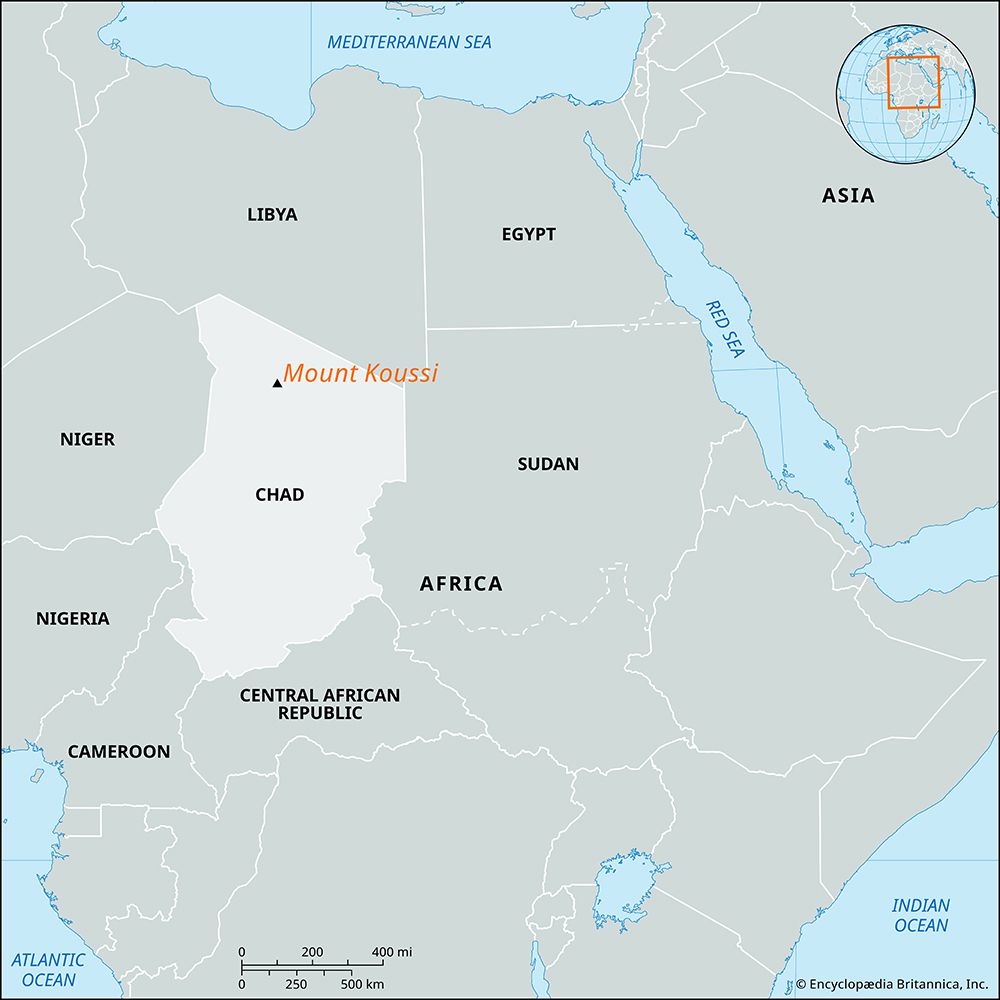
Mount Koussi is an extinct volcano located in the Tibesti massif of northwestern Chad. Standing at 11,204 feet (3,415 meters), it serves as the highest…
What is Mount Koussi?
Mount Koussi is an extinct volcano located in the Tibesti massif of northwestern Chad. Standing at 11,204 feet (3,415 meters), it serves as the highest summit in the Sahara. The mountain is characterized by a massive crater that measures approximately 12 miles (19 km) in width and reaches a depth of 4,000 feet (1,200 m).1
What is the Tibesti massif?
The Tibesti massif is a prominent volcanic mountain range located in the central Sahara. Situated primarily in northwestern Chad, the formation extends into parts of northeastern Niger and southern Libya.2
Spanning approximately 300 miles (480 km) in length and up to 175 miles (280 km) in width, the range is composed of eruptive rocks that emerged through a base of crystalline rocks and sandstone. Its highest point is Emi Koussi, an extinct volcano that reaches 11,204 feet (3,415 meters) and stands as the highest summit in the Sahara.21
The region is characterized by deep, dry watercourses—evidence of a historically more humid climate—and is rich in mineral resources, including tungsten, tin, oil, and uranium. The area is home to the Teda and Daza peoples, who are primarily nomadic.2
How do extinct volcanoes differ from active ones?
Volcanoes are categorized based on their eruptive history and potential for future activity. The primary distinction between active and extinct volcanoes lies in the timing of their last eruption and the likelihood of future events:
- Active volcanoes are those that have erupted within the past 10,000 years. This category includes volcanoes that are currently erupting as well as those that are considered “dormant,” meaning they have the potential to erupt again in the future. Because of this potential, active volcanoes require monitoring of earthquake activity and surface deformation to help forecast potential outbursts.45
- Extinct volcanoes are defined as those that have not erupted in over 10,000 years and are considered unlikely to erupt again. Consequently, they pose virtually no threat to human life or property.4
While active volcanoes present ongoing risks—including the potential for sudden eruptions or secondary hazards like lahars (mudslides)—extinct volcanoes are generally stable landforms.4
What is the climate like in the Sahara desert?
The Sahara is defined by two primary climatic regimes: a dry subtropical climate in the north and a dry tropical climate in the south.9
Northern Subtropical Climate
This region is dominated by stable high-pressure cells centered over the Tropic of Cancer. It experiences extreme temperature fluctuations, with daily highs reaching 104 °F (40 °C) in summer and nighttime lows dropping to 25 °F (–3.9 °C) in winter. Precipitation is scarce, averaging about 3 inches annually, primarily occurring between December and March or during August thunderstorms.9
Southern Tropical Climate
The southern zone is influenced by the interaction between continental subtropical air masses and unstable maritime tropical air. While winter temperatures are similar to the north, the diurnal range is more moderate. This area experiences a hot season in late spring and early summer, with temperatures occasionally reaching 122 °F (50 °C). Rainfall is slightly higher, averaging 5 inches per year, often arriving as summer thunderstorms.9
Across the desert, local winds like the ghibli and the haboob frequently transport dust and sand.9
Sources
- Mount Koussi — Encyclopædia Britannica
- Tibesti — Encyclopædia Britannica
- Sahara - Physiography — Encyclopædia Britannica
- volcano - Six types of eruptions — Encyclopædia Britannica
- Are Volcanoes Dangerous When They’re Not Erupting? — Encyclopædia Britannica
- geology - Volcanology — Encyclopædia Britannica
- volcano - Volcano forecasting and warning — Encyclopædia Britannica
- What Causes a Volcano to Erupt? — Encyclopædia Britannica
- Sahara - Climate of the Sahara — Encyclopædia Britannica
Published on · 2 min read