Nemrut Dağ
Nemrut Dağ is a prominent mountain in the Taurus Mountains near Adıyaman, Turkey, famous for the 1st-century-BCE mausoleum of Antiochus I of Commagene. This…
What is Nemrut Dağ?
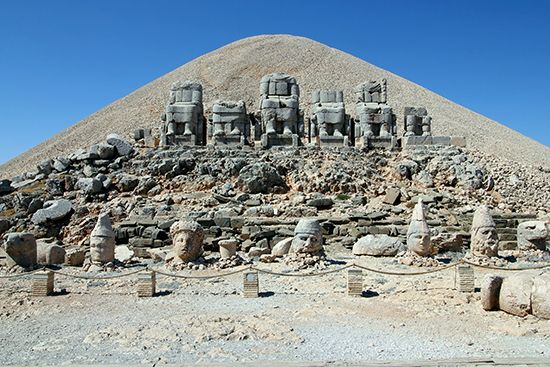
Nemrut Dağ is a prominent mountain in the Taurus Mountains near Adıyaman, Turkey, famous for the 1st-century-BCE mausoleum of Antiochus I of Commagene. This World Heritage site features a massive 165-foot-high tumulus surrounded by terraces containing colossal statues of Greek and Persian deities, including Zeus-Oromasdes, Apollo-Mithra, and Heracles-Artagnes-Ares.1
The site reflects the unique cultural synthesis of the Commagene kingdom, which bridged Persia and Macedonia. While the original statues were enormous, their heads have since fallen to the ground, where they remain as striking archaeological features. Scientific investigation of the site began in 1953, and ongoing preservation efforts continue to protect this historical landmark.1
Who was King Antiochus I of Commagene?
Antiochus I of Commagene (reigned c. 69–c. 34 BCE) was the ruler of the small kingdom of Commagene, located in modern south-central Turkey. He is best known for bringing his kingdom to its zenith by skillfully navigating the geopolitical tensions between the Roman and Parthian empires.2
Antiochus claimed royal lineage from both Persia, through Darius the Great, and Macedonia, through Seleucus I Nicator. This dual heritage profoundly influenced the culture and religious syncretism of his realm. He is famously remembered for constructing a massive 165-foot-high tumulus and temple complex on the peak of Nemrut Dağ, which features colossal statues of himself alongside various Greek and Persian deities, including Zeus-Oromasdes and Apollo-Mithra.12
It is important to distinguish him from other historical figures of the same name, such as the Seleucid kings Antiochus I Soter and Antiochus II Theos, who ruled over different territories and time periods.34
Why did the statues on Mount Nemrut lose their heads?
The colossal statues at Nemrut Dağ lost their heads due to the natural forces of time and the environment, rather than a single specific event. While the statues were originally constructed as towering, seated figures reaching approximately 30 feet in height, the heads have since fallen to the ground.1
The site is located on a high, exposed mountain peak in the Taurus Mountains, where the statues are subjected to extreme weather conditions, including significant temperature fluctuations and seismic activity, which have contributed to their structural degradation over the centuries. Although the heads are now detached, they remain remarkably well-preserved, standing over 6 feet tall.1
How did Persian and Greek cultures influence the kingdom of Commagene?
The kingdom of Commagene served as a unique cultural bridge, shaped by its strategic location between the Roman and Parthian empires and the dual heritage of its rulers. Because the kings of Commagene claimed descent from both Darius the Great of Persia and Seleucus I Nicator of Macedonia, the region developed a distinct syncretic identity that blended these two powerful traditions.21
This cultural fusion is most vividly expressed in the religious monuments at Nemrut Dağ. King Antiochus I commissioned colossal statues that merged Greek and Persian deities, such as:
- Zeus-Oromasdes: Combining the king of the Greek gods with the supreme Persian deity, Ahura Mazda.1
- Apollo-Mithra: Linking the Greek god of light and prophecy with the Persian divinity associated with the sun and covenants.1
- Heracles-Artagnes-Ares: Merging the Greek hero and god of war with the Persian deity of victory.1
These representations demonstrate how Commagene intentionally synthesized diverse cultural and religious elements to legitimize its rule and define its place in the ancient world.1
Sources
- Nemrut Dağ — Encyclopædia Britannica
- Commagene — Encyclopædia Britannica
- Antiochus II Theos — Encyclopædia Britannica
- Antiochus I Soter — Encyclopædia Britannica
Published on · 2 min read