Mount Merapi
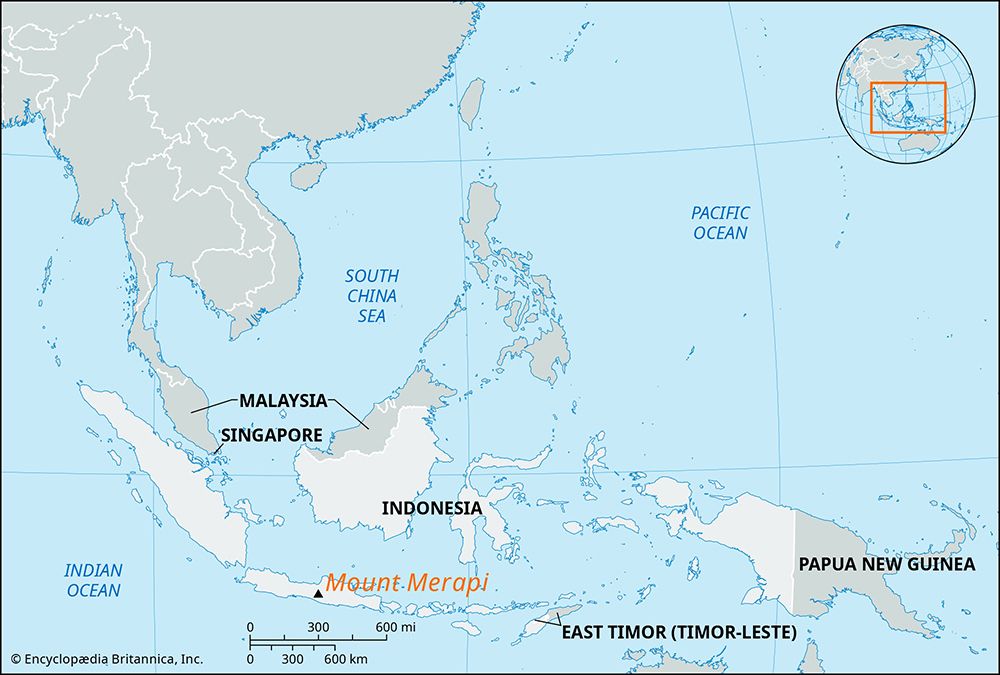
Mount Merapi, located in central Java, exerts a profound influence on the surrounding region through its frequent volcanic activity. While its eruptions…
How has Mount Merapi’s volcanic soil influenced agriculture and settlement patterns in the region?
Mount Merapi, located in central Java, exerts a profound influence on the surrounding region through its frequent volcanic activity. While its eruptions often cause significant destruction to infrastructure and settlements, they simultaneously provide a vital benefit: the replenishment of soil with nutrient-rich volcanic ash and debris.1
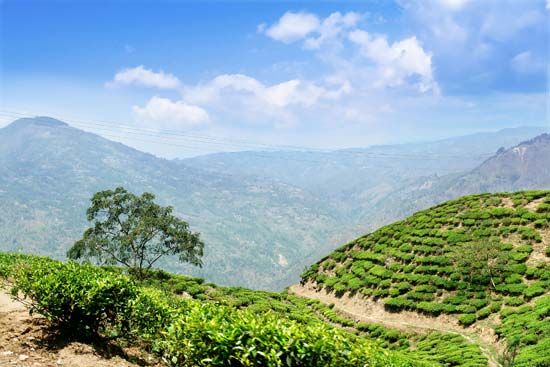
This enrichment of the land has created a strong correlation between volcanic activity and human geography. The areas to the south and east of the volcano experience some of the highest population densities in Indonesia, as the fertile, volcanic-derived soil supports highly productive agriculture, particularly wet-rice cultivation2. In the special district of Yogyakarta, for instance, coastal plains are composed of lava and ash soils frequently replenished by the Merapi massif, sustaining essential local industries like rice, rubber, and sugar production.2
Consequently, the region is characterized by a dense network of rural villages that rely on this productive land, despite the inherent risks posed by the volcano’s frequent eruptions and pyroclastic flows1.31
How does the shape and structure of Mount Merapi compare to other volcanoes in Indonesia?
Mount Merapi is a prominent example of a stratovolcano, a common volcanic structure in Indonesia characterized by steep slopes and a cone-shaped form built from alternating layers of lava and ash.13
While many Indonesian volcanoes share this composite structure, they exhibit significant variations in their geological features:
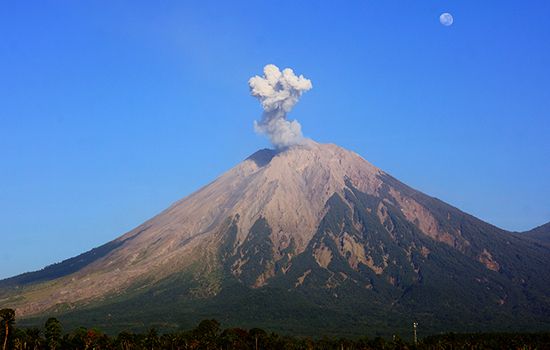
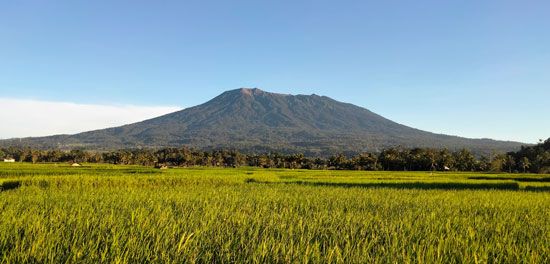
- Structural Complexity: Unlike the relatively singular cone of Merapi, some Indonesian volcanoes are part of larger volcanic complexes. For example, Mount Semeru is part of a massif that includes the Tengger caldera, a complex volcanic system. Similarly, Mount Marapi in Sumatra features a summit containing a distinct caldera with overlapping craters.56
- Eruptive Hazards: While Merapi is notorious for its frequent pyroclastic flows, other volcanoes present different primary threats. Mount Kelud, for instance, is known for its crater lake, which can be ejected during eruptions to create devastating mudflows known as lahars.7
- Scale: Mount Semeru reaches an elevation of 12,060 feet, making it significantly taller than Mount Merapi’s 9,551 feet.15
What is the geological history of Mount Merapi, and how often does it erupt?
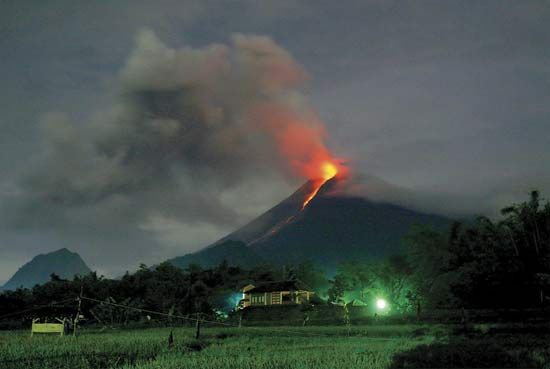
Mount Merapi, located in central Java, is a stratovolcano known as the “Mountain of Fire.” While specific details regarding its deep geological formation are limited, it is recognized as the most active of Indonesia’s 130 active volcanoes.1
Regarding its eruptive frequency, Merapi is highly active and has a long history of significant events. Major recorded eruptions occurred in 1006, 1786, 1822, 1872, 1930, and 1976. In more recent history, the volcano experienced a deadly eruption in 1994, a series of major eruptions in 2010 that caused widespread displacement, and it has erupted several times between 2013 and 2023.1
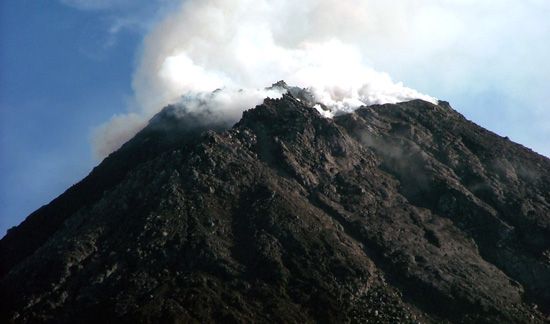
A defining characteristic of Merapi’s activity is that nearly half of its eruptions are accompanied by pyroclastic flows—clouds of superheated gases and incandescent solid particles that pose severe risks to the surrounding densely populated regions.1
What are the main types of volcanic hazards associated with Mount Merapi’s eruptions?
Mount Merapi, one of the most active volcanoes in Indonesia, presents several significant hazards during its eruptions:
- Pyroclastic Flows: Often referred to as nuées ardentes, these are the most dangerous phenomena associated with Merapi. Nearly half of its eruptions involve these clouds of superheated gases and incandescent solid particles, which move at high speeds and have caused numerous fatalities and widespread destruction in surrounding areas.1
- Ash Falls: Explosive eruptions frequently eject fine volcanic particles into high ash clouds. While these generally do not cause direct fatalities, the accumulation of ash can lead to secondary hazards such as collapsing roofs and widespread crop failure, which may result in famine and disease.19
- Lahars: These destructive mudflows consist of volcanic material, ranging from ash to large boulders. They often occur when heavy rains saturate loose ash deposits on the volcano’s slopes or when volcanic debris mixes with river water. Lahars move rapidly downslope and are a major threat to communities located in the volcano’s path.107
Sources
- Mount Merapi — Encyclopædia Britannica
- Indonesia - Rural settlement — Encyclopædia Britannica
- Indonesia - Volcanoes — Encyclopædia Britannica
- Yogyakarta — Encyclopædia Britannica
- volcano - Stratovolcanoes — Encyclopædia Britannica
- Mount Semeru — Encyclopædia Britannica
- Mount Marapi — Encyclopædia Britannica
- volcano - List of the world’s major volcanoes — Encyclopædia Britannica
- lahar — Encyclopædia Britannica
- volcano - Ash falls — Encyclopædia Britannica
Published on · 3 min read