Provence Alps
The term "Provence Alps" refers to the western spurs of the Maritime Alps located in southeastern France. This mountain range is situated between the…
What is Provence Alps?
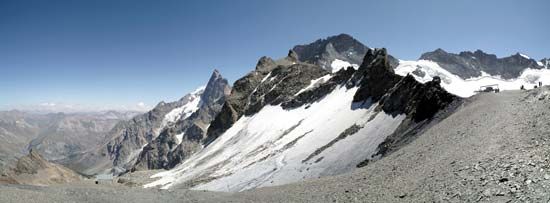
The term “Provence Alps” refers to the western spurs of the Maritime Alps located in southeastern France. This mountain range is situated between the Dauphiné Alps to the north, the lower Rhône River to the west, and the Mediterranean Sea to the south.1
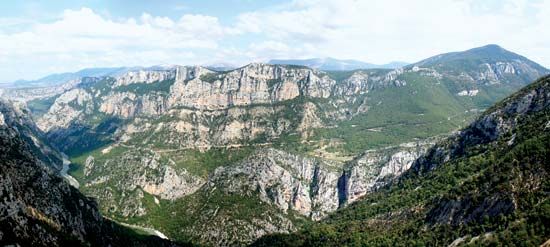
The geography of the area is characterized by the valleys of the Durance, Var, Argens, and Verdon rivers, and it includes the coastal massifs of Maures and Estérel. Notable landmarks include the Gorges du Verdon, a scenic canyon near Castellane, and the hills surrounding Grasse, which are famous for lavender cultivation. While the region has historically faced out-migration, its economy is now increasingly supported by agriculture and tourism.1
It is important to note that “Provence Alps” is a specific geographic feature, distinct from the broader administrative region of Provence-Alpes-Côte d’Azur, which encompasses a much larger area of southeastern France.2
What is the significance of the mistral wind in this region?
The mistral is a powerful, cold, and dry northerly wind that significantly impacts the climate and landscape of southern France. It originates in the highlands and gains intensity as it is funneled through the narrow Rhône River valley, often reaching speeds of 74 km (45 miles) per hour, and up to 130 km (80 miles) per hour over the Rhône delta.5
The wind’s significance includes:
- Climatic Influence: It is a defining feature of the Mediterranean region, particularly during winter, when it brings cold, dry air that contrasts with the otherwise mild Mediterranean climate.67
- Agricultural Impact: Because of its force, the mistral can cause considerable damage to crops. Its presence is a key reason why permanent irrigation systems are characteristic of the Mediterranean lowlands.57
- Meteorological Origins: The winds are driven by pressure differences, specifically when high-pressure areas from central France move toward low-pressure areas over the Gulf of Genoa.7
How did the Roman Empire influence the development of Provence?
The Roman Empire played a foundational role in shaping the development of Provence, which derives its name from the Latin Provincia—the first Roman territory established beyond the Alps first Roman territory established beyond the Alps.9
Romanization and Urban Culture
Following the Roman conquest of southeastern Gaul in the 2nd century BCE, the region became a hub for Roman traders and veterans. This influx fostered a prosperous urban culture modeled after Italy, characterized by sophisticated town planning, including forums, aqueducts, and building codes. Cities like Nîmes flourished under imperial patronage, receiving grand infrastructure such as the Pont du Gard and the Maison-Carrée, which remain among the best-preserved Roman monuments in existence.21011
Economic and Cultural Legacy
The region became a center for viticulture and olive production, supported by specialized industries in timber and metalwork. Beyond its economic prosperity, the area was a bastion of Roman culture and education, particularly in Massilia (modern Marseille). This deep-rooted Roman influence persisted long after the empire’s collapse, profoundly shaping later Romanesque architecture in the region, which often mirrored the grand, spacious, and monumental style of Roman masonry.212
What are some famous landmarks found along the Côte d’Azur?
The Côte d’Azur, or French Riviera, is home to numerous iconic landmarks and cultural sites that reflect its rich history as a premier destination for travelers.
Notable Landmarks and Sites
- Promenade de la Croisette: Located in Cannes, this famous palm-lined boulevard follows the curve of the beach and is fringed by luxury hotels and the Palais des Festivals, the site of the renowned Cannes film festival.13
- The Corniches: A three-tiered system of scenic motor roads runs between Nice and the Italian frontier. The highest, the Grande Corniche, was constructed by Napoleon I and passes the picturesque village of La Turbie, offering stunning views of Monaco.14
- Nice, Winter Resort Town: Recognized for its historical significance as a winter resort, the city of Nice itself is a landmark of the Riviera, celebrated for its unique urban development and cultural heritage.15
- Saint-Pierre Chapel: Situated in Villefranche-sur-Mer, this ancient chapel is famous for its interior, which was entirely decorated by the artist Jean Cocteau.17
- Îles de Lérins: These islands off the coast of Cannes include Saint-Honorat, home to a historic abbey, and Sainte-Marguerite, where the legendary man in the iron mask was once imprisoned.13
Sources
- Provence Alps — Encyclopædia Britannica
- Provence — Encyclopædia Britannica
- Provence–Alpes–Côte d’Azur — Encyclopædia Britannica
- list of cities and towns in France - Provence-Alpes-Cote d’Azur ( région ) — Encyclopædia Britannica
- Mistral — Encyclopædia Britannica
- Marseille - Climate — Encyclopædia Britannica
- mistral — Merriam-Webster
- France - The Mediterranean region — Encyclopædia Britannica
- Narbonensis — Encyclopædia Britannica
- Western architecture - Town planning — Encyclopædia Britannica
- Nîmes — Encyclopædia Britannica
- Western architecture - Provence — Encyclopædia Britannica
- Riviera — Encyclopædia Britannica
- Cannes — Encyclopædia Britannica
- Côte d’Azur — Encyclopædia Britannica
- list of World Heritage sites - France — Encyclopædia Britannica
- Villefranche-sur-Mer — Encyclopædia Britannica
Published on · 3 min read