Mount Tupungato
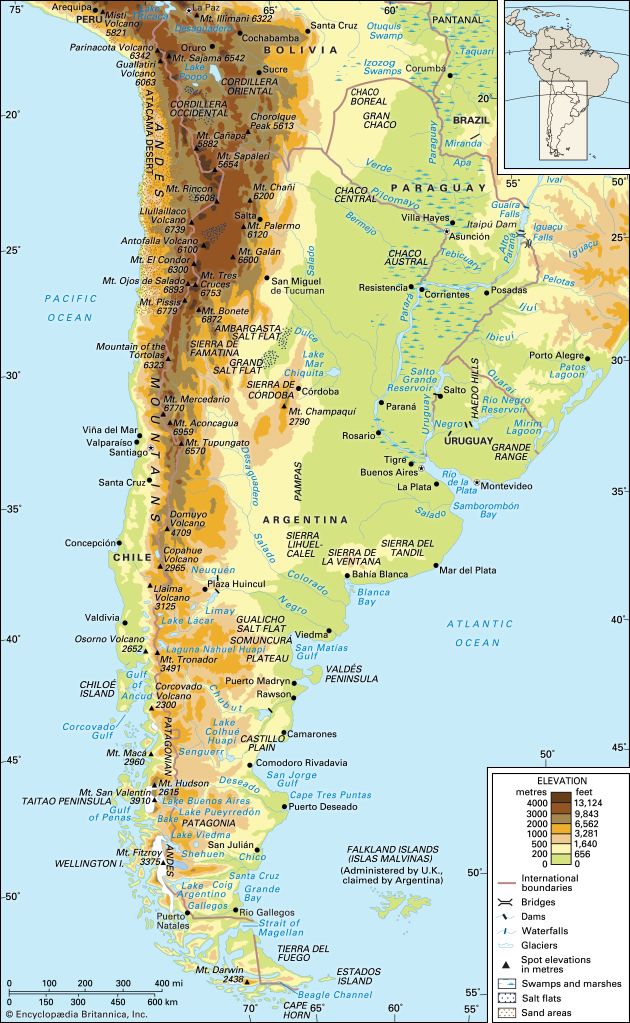
Mount Tupungato is a prominent volcanic peak located in the central Andes Mountains of South America. Situated directly on the border between Chile and…
What is Mount Tupungato?
Mount Tupungato is a prominent volcanic peak located in the central Andes Mountains of South America. Situated directly on the border between Chile and Argentina, the mountain reaches an elevation of 22,310 feet (6,800 metres). It was first successfully summited in 1897 by an expedition led by the British mountaineer Edward Fitzgerald.1
What are the tallest peaks in the Andes?
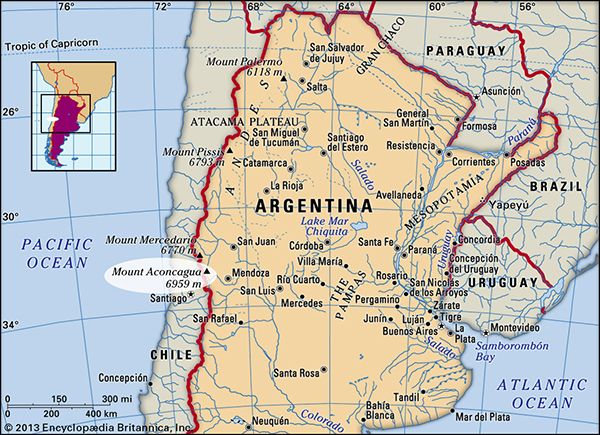
The Andes Mountains contain many of the highest peaks in the Western Hemisphere. The tallest among them is Mount Aconcagua, which reaches an elevation of 22,831 feet (6,959 metres).23
Below are some of the most notable high-altitude peaks in the Andes:
Peak
Elevation (approx.)
Mount Aconcagua
22,831 feet (6,959 metres)
Ojos del Salado
22,614 feet (6,893 metres)
Mount Mercedario
22,211 feet (6,770 metres)
Tres Cruces
22,156 feet (6,753 metres)
Mount Huascarán
22,205 feet (6,768 metres)
Llullaillaco
22,109 feet (6,739 metres)
Mount Tupungato
21,555 feet (6,570 metres)
These mountains are characterized by their extreme heights, volcanic origins, and, in many cases, permanent snowcaps that feed the region’s river systems.54
How do volcanic mountains form?
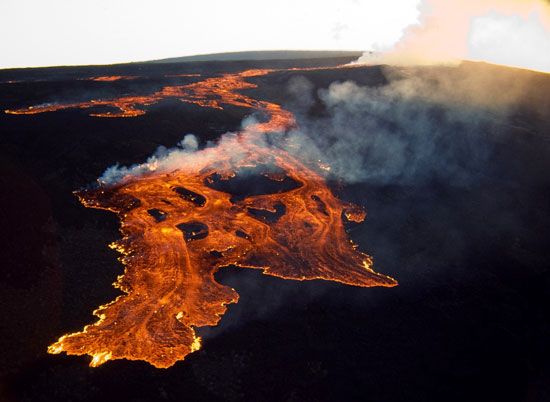
Volcanic mountains are formed through the process of volcanism, where molten rock, known as magma, rises from the Earth’s mantle through the crust to erupt onto the surface as lava and volcanic debris7. Over time, the repeated accumulation of these materials around a vent builds the landform we recognize as a volcano.7
The specific shape and height of these mountains are determined by several factors, including the composition of the volcanic products and the nature of the eruptions. For example:8
- Shield volcanoes: Formed by fluid, low-viscosity lava that flows easily, creating broad, gently sloping mountains like Mauna Loa.98
- Stratovolcanoes: Built by moderately explosive eruptions that produce alternating layers of ash and lava, resulting in steep, symmetrical cones like Mount Fuji.98
Many volcanic mountains are closely associated with plate tectonic activity, particularly at convergent margins where subduction occurs. As a tectonic plate descends, it triggers partial melting in the mantle, creating magma that rises to form volcanic arcs or island arcs.10
What is the climate like in the Central Andes?
The climate of the Central Andes is defined by extreme vertical zonation and significant regional variations in temperature and precipitation. Because of the high altitude, the region experiences cold climates, particularly above 11,500 feet (3,500 meters), where mean annual temperatures remain below 50 °F (10 °C).12
Temperature and Daily Variation
While average temperatures are low, the Central Andes are characterized by wide daily temperature fluctuations. In areas near Lake Titicaca, for instance, daytime temperatures can reach 68 °F (20 °C), only to drop to a nocturnal minimum of 5 °F (−15 °C). These marked differences between day and night, as well as between sunshine and shadow, are typical of the high-altitude environment.1213
Precipitation and Humidity
Precipitation in the Central Andes is highly variable and often seasonal. Unlike the northern Andes, which are generally damp, the region from central Peru through Bolivia and Chile experiences a long, harsh dry season. Rainfall is often concentrated during the southern summer, and the environment is frequently aggravated by continuous, violent winds that increase the overall dryness. Additionally, the region is influenced by the Peru (Humboldt) Current and high-pressure cells, which contribute to the aridity of the western slopes and the formation of the Atacama Desert at lower elevations.121415
Sources
- Mount Tupungato — Encyclopædia Britannica
- Andes Mountains: Top Questions — Encyclopædia Britannica
- Mount Aconcagua — Encyclopædia Britannica
- Andes Mountains - Physiography of the Central Andes — Encyclopædia Britannica
- list of mountains - South America — Encyclopædia Britannica
- Chile - The Chilean Andes — Encyclopædia Britannica
- mountain - Volcanism — Encyclopædia Britannica
- plate tectonics - Mountains by subduction — Encyclopædia Britannica
- plate tectonics - Island arcs — Encyclopædia Britannica
- volcano - Determinants of size and shape — Encyclopædia Britannica
- volcano — Encyclopædia Britannica
- Andes Mountains - Climate — Encyclopædia Britannica
- South America - Factors influencing climate — Encyclopædia Britannica
- South America - Cold climates — Encyclopædia Britannica
- Chile - The northern desert — Encyclopædia Britannica
Published on · 3 min read