Mount Whitney
Mount Whitney is located in eastern California along the border of Inyo and Tulare counties. It sits at the eastern edge of Sequoia National Park and serves…
Where is Mount Whitney located, and what makes it significant in the United States?
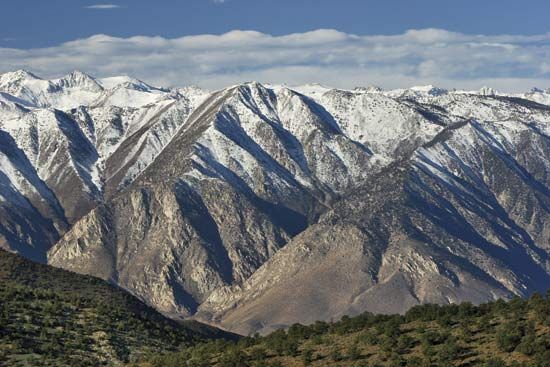
Mount Whitney is located in eastern California along the border of Inyo and Tulare counties. It sits at the eastern edge of Sequoia National Park and serves as the culminating summit of the Sierra Nevada range.1
The peak is significant primarily because it is the highest point in the 48 conterminous United States, reaching an elevation of 14,494 feet (4,418 meters) above sea level. Geologically, its summit is notable for being a gently sloping, tablelike surface that has not yet been dissected by erosion, while its rugged slopes are characterized by granite blocks and avalanche chutes. Named after geologist Josiah Dwight Whitney, the mountain was first successfully climbed in 1873.1
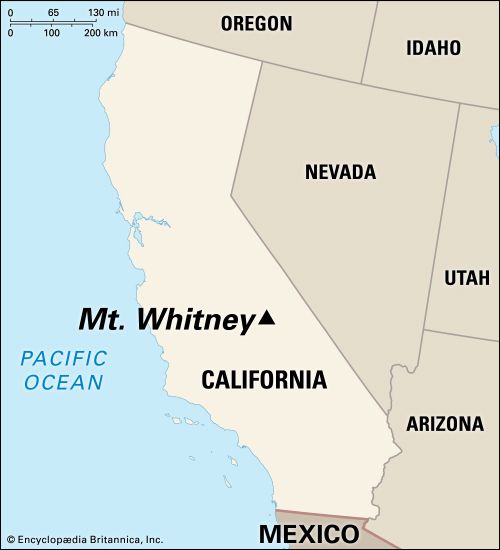
What is the elevation of Mount Whitney, and how does it compare to other peaks in the contiguous United States?
Mount Whitney reaches an elevation of 14,494 feet (4,418 meters) above sea level. It holds the distinction of being the highest peak in the 48 conterminous United States.12
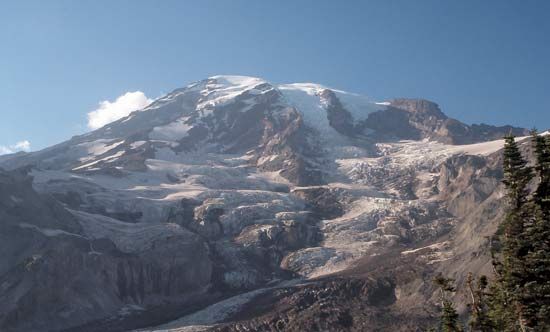
When compared to other peaks in the contiguous United States, Mount Whitney stands as the highest point, surpassing other notable high-elevation regions such as the Colorado Rockies, which feature many mountains exceeding 14,000 feet but none reaching 14,500 feet. It also stands taller than the highest peak in the Cascade Range, Mount Rainier, which reaches 14,410 feet (4,392 meters). While Mount Whitney is the highest point in the lower 48 states, it is significantly lower than the highest point in North America, Denali in Alaska, which rises to 20,310 feet (6,190 meters).23
What are the main geological features of Mount Whitney and the surrounding Sierra Nevada range?
The Sierra Nevada is an asymmetrical, upfaulted block of the Earth’s crust that has been tilted westward along a major fault zone on its eastern edge. This geological structure results in a steep, abrupt eastern escarpment and a gentler western slope.4
Geological Composition
The range is primarily composed of granite and related igneous rocks, forming a massive batholith that solidified beneath the surface. Interspersed within this granite are bands of metamorphosed sedimentary rock and, particularly in the north, areas of extrusive volcanic rock.56
Features of Mount Whitney and the Range
- Mount Whitney: As the culminating summit of the range, its peak is characterized by a gently sloping, tablelike surface that has escaped erosion. Its slopes are defined by granite blocks and avalanche chutes.1
- Glacial Erosion: During the Pleistocene Epoch, extensive ice caps and valley glaciers carved deep, U-shaped valleys and created dramatic features such as cirques and moraines5.
- Drainage: The western slope is dissected by long, stream-carved valleys, while the eastern face features steep-gradient canyons that drop sharply toward the Owens Valley.74
What is the history behind the naming of Mount Whitney?
Mount Whitney was named in honor of the American geologist Josiah Dwight Whitney. Whitney served as the state geologist of California and led the California Geological Survey during the mid-19th century, a period during which the survey conducted extensive mapping and exploration of the region’s rugged terrain.1
Sources
- Mount Whitney — Encyclopædia Britannica
- North America: Top Questions — Encyclopædia Britannica
- United States - The Western Cordillera — Encyclopædia Britannica
- Sierra Nevada - Physiography — Encyclopædia Britannica
- Sierra Nevada - Drainage and glaciation — Encyclopædia Britannica
- Sierra Nevada - Geology — Encyclopædia Britannica
- batholith — Encyclopædia Britannica
- Whitney, Mount — Merriam-Webster
Published on · 2 min read