Mudskipper
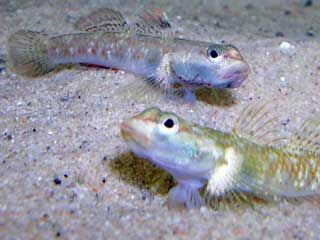
Mudskippers have evolved several remarkable adaptations that allow them to thrive in terrestrial environments like mud flats, swamps, and estuaries.
How have mudskippers adapted to living on land?
Mudskippers have evolved several remarkable adaptations that allow them to thrive in terrestrial environments like mud flats, swamps, and estuaries.1
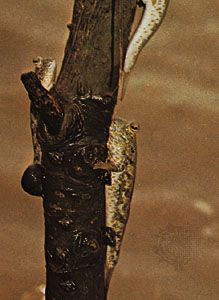
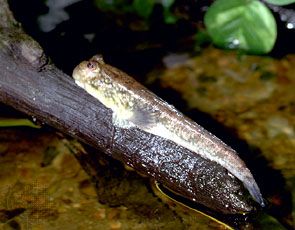
To navigate on land, they utilize their strong pectoral fins, which act as limbs to help them walk, climb, and skip across surfaces. Their pelvic fins are also specialized, being positioned forward under the body and often fused to provide stability.1
Their respiratory system is uniquely adapted for life out of water. While they are fish, mudskippers can breathe by retaining air within their enlarged gill chambers. Additionally, they are capable of cutaneous respiration, meaning they can absorb oxygen directly through their skin. These physiological traits, combined with their protuberant, movable eyes that provide a wide field of vision, allow them to effectively hunt crustaceans and other small prey while on land.1
How do mudskippers move on land and what behaviors do they exhibit?
Mudskippers are highly specialized gobies that have developed distinct physical and behavioral traits to navigate terrestrial environments like mud flats and swamps.
Locomotion on Land
Mudskippers move across land using their powerful pectoral fins, which function similarly to limbs, allowing them to walk, climb, and skip. Their pelvic fins, located forward under the body, are often partially or completely fused, providing the necessary stability for these movements.1
Behaviors and Adaptations
- Respiration: To survive out of water, they trap air within their enlarged gill chambers and can also absorb oxygen directly through their skin.1
- Sensory Perception: Their heads feature large, protuberant, and movable eyes, which provide a wide field of vision for monitoring their surroundings.1
- Foraging: They are active predators that hunt crustaceans and other small animals while on land.1
What is the evolutionary history of mudskippers?
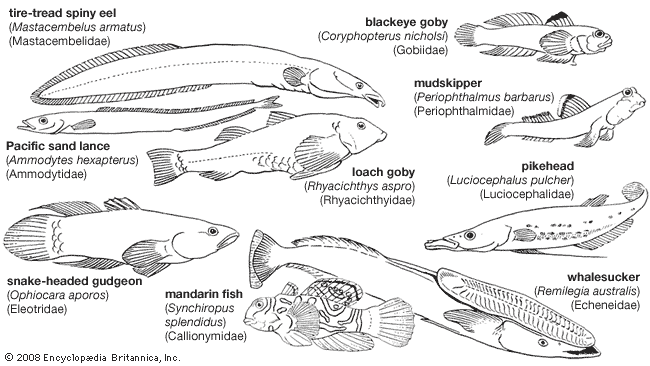
The available scientific literature does not provide a detailed account of the specific evolutionary history or ancestral lineage of mudskippers. We know that mudskippers are members of the family Gobiidae within the order Perciformes, comprising about six species of small tropical fish found in the Indo-Pacific region.13
While their unique amphibious traits—such as the ability to breathe air, move using pectoral fins, and inhabit mudflats—are well-documented, the specific evolutionary timeline or the sequence of adaptations that led to these characteristics is not detailed in the provided records. They are classified within the genera Periophthalmus and Boleophthalmus, and their existence as a distinct group has been recognized in scientific literature since at least 1860.4
What are mudskippers and how are they different from other fish?
Mudskippers are a unique group of about six species of small tropical gobies belonging to the family Gobiidae. While most gobies are strictly aquatic, mudskippers are distinguished by their remarkable amphibious nature, allowing them to spend significant time out of water on mud flats, in swamps, and in estuaries throughout the Indo-Pacific region.13
They differ from other fish in several key ways:
- Terrestrial Locomotion: Unlike typical fish that rely on swimming, mudskippers use their strong pectoral fins to walk, climb, and skip across land. Their pelvic fins are positioned forward and are often fused to provide stability.1
- Respiration: While most fish rely exclusively on gills, mudskippers can breathe out of water by trapping air in their enlarged gill chambers and absorbing oxygen directly through their skin.1
- Sensory Adaptations: They possess large, protuberant, and movable eyes set close together on top of their blunt heads, which provide a wide field of vision for hunting crustaceans and other small prey on land.1
Sources
- mudskipper — Encyclopædia Britannica
- Locomotion - Tetrapodal vertebrates — Encyclopædia Britannica
- goby — Encyclopædia Britannica
- mudskipper — Merriam-Webster
- heteropteran - Respiratory system — Encyclopædia Britannica
Published on · 3 min read