Heteropteran
Heteropteran insects, commonly known as true bugs, include both beneficial and harmful species in agricultural contexts.
Are there any heteropteran species that are considered beneficial or harmful to agriculture?
Heteropteran insects, commonly known as true bugs, include both beneficial and harmful species in agricultural contexts.1
Beneficial Heteropterans
Many heteropterans are considered beneficial because they are predacious, feeding on the eggs, larvae, and adults of injurious insects, as well as on noxious weeds. Key groups used in biological control include:21
- Assassin bugs and anthocorid bugs.21
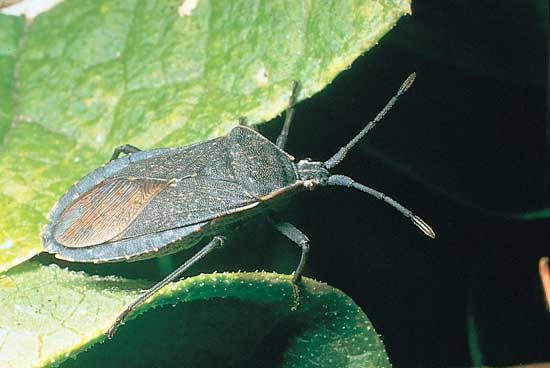
- Nabid bugs and various stinkbugs.2
- Specific species like Cyrtorhynus mundulus, which is used to control sugarcane leafhoppers.3
Harmful Heteropterans
Conversely, many species are serious agricultural pests that feed on plant sap, causing damage such as wilting, spotting, and reduced crop quality. Notable pests include:31
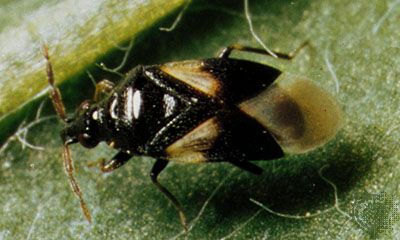
- Chinch bugs and plant bugs (family Miridae), such as the four-lined plant bug, tarnished plant bug, and cotton fleahopper.3
- Wheat bugs (Aelia and Eurygaster species), which damage grain by injecting enzymes that degrade gluten, rendering flour unsuitable for baking.4
- The tea blight bug (Helopeltis theivora), which is highly destructive in Southeast Asia.3
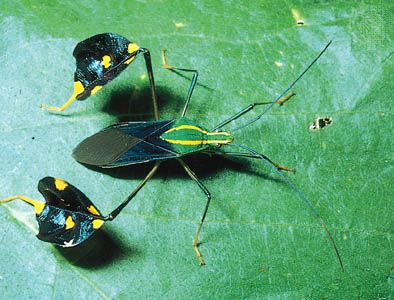
What are some common examples of heteropteran insects?
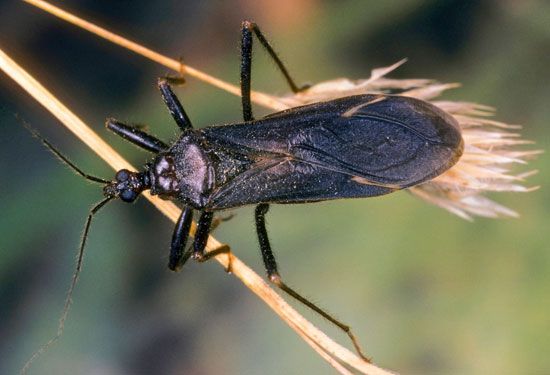
Heteropterans, commonly known as true bugs, comprise more than 40,000 species within the order Hemiptera. They are characterized by their piercing-sucking mouthparts and an X-shaped design on their backs formed by their wings when at rest.68
Common examples of heteropteran insects include:
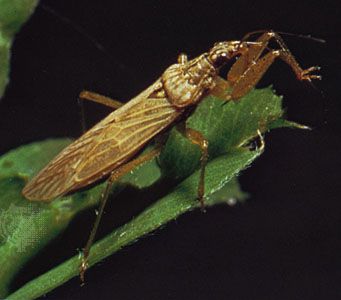
- Terrestrial bugs: Assassin bugs, bedbugs, stinkbugs, plant bugs, lace bugs, ambush bugs, flower bugs, and stilt bugs.69
- Water-dwelling bugs: Water boatmen, backswimmers, giant water bugs, water scorpions, and creeping water bugs.69
- Surface-swimming and shore-dwelling bugs: Water striders, shore bugs, marsh treaders, and velvet water bugs.69
These insects occupy diverse ecological niches, ranging from aquatic environments to terrestrial habitats, and exhibit varied behaviors, including predation and plant-feeding.6
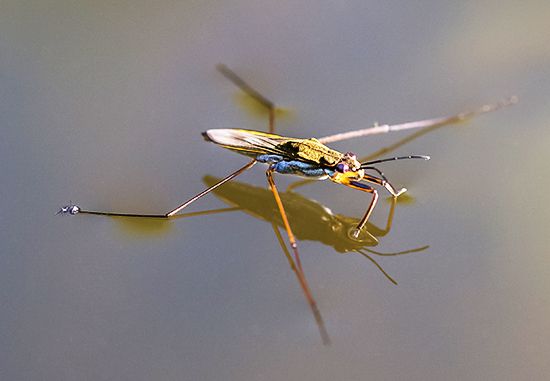
How do heteropterans use their piercing-sucking mouthparts for feeding?
Heteropterans utilize specialized piercing-sucking mouthparts to feed on plant juices or animal tissues. These mouthparts consist of a troughlike, four-segmented labium that houses four threadlike stylets—modified mandibles and maxillae.611
The Feeding Mechanism
- Penetration: The mandibles, which feature serrated tips, and the maxillae work together to pierce the food source. As they penetrate, the labium typically retracts or “jackknifes” to guide the stylets into the tissue.6
- Canal Formation: The two maxillary stylets lock together using minor grooves and ridges to form two distinct tubular canals.6
- Fluid Exchange: The posterior canal serves as a salivary duct, injecting digestive enzymes or fluids into the prey or plant. These fluids serve to stun or kill prey, prevent blood coagulation, and initiate external digestion. The anterior canal acts as a food tube.612
- Ingestion: A specialized sucking pump, located in the head, creates negative pressure to draw fluids through the food canal and into the esophagus.6
This sophisticated system allows heteropterans to efficiently extract nutrients from diverse sources, ranging from plant sap to the liquefied tissues of prey.812
How do heteropterans differ from other insect orders?
Heteropterans, or “true bugs,” are distinguished from all other insect groups by a unique combination of anatomical features. While they share the piercing-sucking mouthparts characteristic of the order Hemiptera, they possess specific traits that set them apart from other suborders, such as the homopterans.68
Key Distinguishing Features
- Wing Structure: Heteropterans are named for their forewings, which are divided into two distinct textures: a thickened, leathery basal half and a membranous apical half. When at rest, these wings lie flat over the abdomen, with the membranous tips overlapping to form a characteristic X-shaped design.815616
- Head Anatomy: A defining feature is the hardened gula, a bridge on the underside of the head that separates the mouthparts from the prothorax. In contrast, other related groups often have a reduced or absent gula, causing the mouthparts to fuse with or abut the prothorax.68
- Mouthpart Origin: The beak (rostrum) of a heteropteran arises from the front of the head and is movable, whereas in homopterans, the beak is typically fixed rigidly to the head and appears to arise from the underside.15
- Scent Glands: Most terrestrial and many aquatic heteropterans possess scent glands, which are entirely absent in homopterans.8
Sources
- heteropteran - Beneficial aspects — Encyclopædia Britannica
- plant bug — Encyclopædia Britannica
- Cereal farming - Insects — Encyclopædia Britannica
- Biological control — Encyclopædia Britannica
- Coleoptera - As predators — Encyclopædia Britannica
- heteropteran — Encyclopædia Britannica
- homopteran — Encyclopædia Britannica
- heteropteran - Distinguishing taxonomic features — Encyclopædia Britannica
- list of true bugs — Encyclopædia Britannica
- stink bug — Encyclopædia Britannica
- heteropteran - Mouthparts — Encyclopædia Britannica
- insect - Head — Encyclopædia Britannica
- heteropteran - Harmful aspects — Encyclopædia Britannica
- assassin bug — Encyclopædia Britannica
- homopteran - Critical appraisal — Encyclopædia Britannica
- heteropteran - Wings — Encyclopædia Britannica
Published on · 3 min read