Walking Catfish
The walking catfish (Clarias batrachus) is a species of catfish native to Asia and Africa that possesses the unique ability to travel significant distances…
What is walking catfish?
The walking catfish (Clarias batrachus) is a species of catfish native to Asia and Africa that possesses the unique ability to travel significant distances over dry land.12
To move across land, the fish uses its pectoral-fin spines as anchors to prevent jackknifing, while its body musculature generates snakelike movements. It is also an air-breather, utilizing specialized treelike respiratory structures that extend above its gill chambers to survive outside of water.134
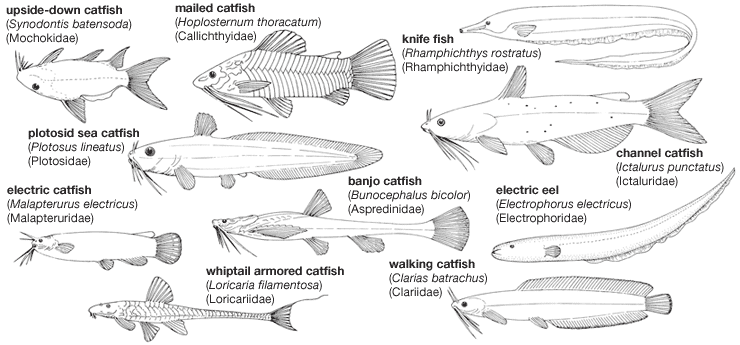
Introduced into southern Florida, the walking catfish is considered an exotic species and poses a serious threat to native fauna in the region. As with other members of the order Siluriformes, it belongs to the family Clariidae and shares the characteristic long barbels, or feelers, around the mouth that resemble cat whiskers.134
How do invasive species affect local ecosystems?
Invasive species are nonnative organisms that significantly disrupt the ecosystems they colonize. When these species possess a competitive advantage—often due to a lack of natural predators in their new environment—they can establish thriving populations that displace indigenous life.5
The ecological consequences of these invasions are profound:
- Loss of Biodiversity: Invasive species often outcompete native organisms for food, space, and other vital resources, frequently leading to the localized extinction of native species.5
- Predation: Invasive predators can decimate prey populations, sometimes eliminating them entirely from an area.5
- Disease Transmission: Many invasive organisms act as vectors, spreading parasites and pathogens that further destabilize the environment.5
- Economic Impact: These disruptions cause significant harm to human communities that rely on the biological resources of the affected ecosystems.5
Addressing these threats requires proactive measures, such as stricter international trade inspections and habitat restoration efforts that prioritize the removal of invaders and the reintroduction of native species.6
What other fish species are capable of breathing air?
Many fish species have evolved specialized adaptations to breathe air, allowing them to survive in oxygen-poor environments or even spend time on land. These adaptations include:78
- Lungfishes: These fish possess primitive lungs derived from the swim bladder, enabling them to gulp air at the surface. Some species can even enter a state of estivation during droughts, surviving for months or years in a subterranean cocoon.78
- Labyrinth fish: Including Siamese fighting fish and gourami, these fish possess a labyrinth organ—a vascularized structure above the gills that functions like a rudimentary lung.79
- Electric eels: These fish are obligatory air breathers that gulp air to exchange oxygen through their highly vascularized mouths.78
- Mudskippers: These fish absorb oxygen through their skin and the lining of their mouth and throat while on land.10
- Mangrove killifish: Capable of surviving out of water for months, they alter their gills to retain nutrients and excrete waste through their skin.10
- Other species: The bowfin uses its air bladder for respiration, while eels can absorb significant amounts of oxygen through their skin.8
Why do some catfish have venomous spines?
Many catfish species possess hardened fin rays known as spines in their dorsal and pectoral fins, which serve as a primary physical defense against predators. In certain groups, this protection is enhanced by the development of venom glands at the base of these spines.11
The presence of these venomous structures is a specialized adaptation found in several families, including:
- Ictaluridae: This family includes North American bullheads and madtoms. includes North American bullheads and madtoms.11
- Clariidae: Known as labyrinthic catfishes.11
- Ariidae and Plotosidae: These groups are commonly referred to as sea catfishes.11
When a human or other animal is punctured by these spines, the fish can inject venom, resulting in extremely painful injuries. While these stings are rarely fatal, they provide the fish with a significant deterrent against potential threats.11
Sources
- walking catfish — Encyclopædia Britannica
- catfish — Encyclopædia Britannica
- walking catfish — Merriam-Webster
- ostariophysan - Walking and flying — Encyclopædia Britannica
- invasive species — Encyclopædia Britannica
- invasive species - Solutions — Encyclopædia Britannica
- How do fish breathe? — Encyclopædia Britannica
- Respiratory system - Fishes — Encyclopædia Britannica
- 14 Questions About Aquatic Animals Answered - Are there certain fish that can live without water? — Encyclopædia Britannica
- labyrinth fish — Encyclopædia Britannica
- ostariophysan - Defense — Encyclopædia Britannica
- 9 Fish Named After Other Animals — Encyclopædia Britannica
- perciform - Danger to human life — Encyclopædia Britannica
Published on · 3 min read