Murre
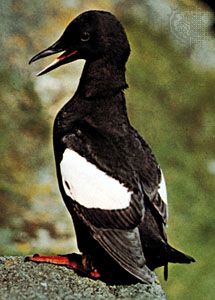
Murres are black and white seabirds belonging to the auk family, typically measuring about 40 cm (16 inches) in length. When standing erect on shore, their…
What are the distinct physical characteristics of murres?
Murres are black and white seabirds belonging to the auk family, typically measuring about 40 cm (16 inches) in length. When standing erect on shore, their posture is often compared to that of a penguin.12
Key physical characteristics include:
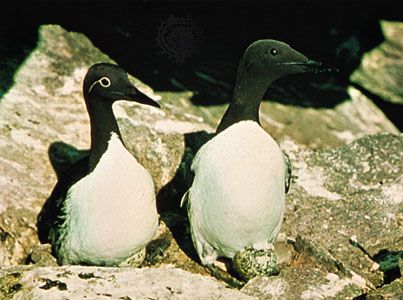
- Plumage: They are characterized by their black and white coloration. Some populations of the common murre exhibit a “bridled” mutation during the breeding season, which features a white ring around the eye and a thin white stripe extending behind it.12
- Bill: The common murre possesses a thin, long, straight bill. In contrast, the thick-billed (or Brünnich’s) murre is distinguished by a somewhat heavier beak.21
- Eggs: Females lay a single, pear-shaped egg. This unique shape ensures that if the egg rolls on a cliff ledge, it moves in a circle rather than rolling off the edge.2
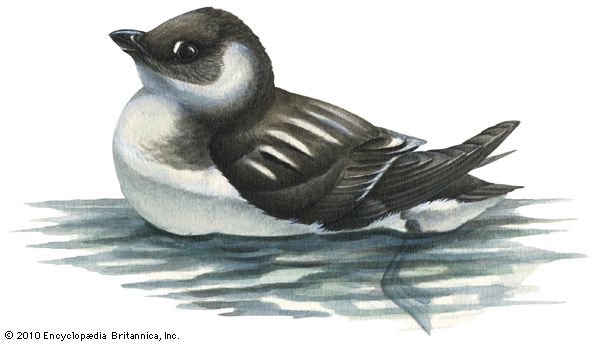
It is important to distinguish these birds from murrelets, which are significantly smaller—about 20 cm (8 inches) long—and possess different physical traits.3
How do murres care for their young, and what challenges do they face during the breeding season?
Murres (genus Uria) exhibit unique reproductive behaviors adapted to their life on sheer, exposed cliffs. Each pair lays a single, pear-shaped egg directly on narrow rocky ledges. This conical shape is a critical adaptation, as it causes the egg to roll in a circle if disturbed, preventing it from falling off the cliff edge.14
Parental Care
Murres invest heavily in their single offspring. The chick matures rapidly, and to protect it from predators such as gulls and skuas, the young bird enters the sea while still only half-grown. Once in the water, the chick is accompanied and cared for by its parents as it continues to develop.1
Challenges During Breeding
The breeding season presents several significant challenges:
- Predation: Murres face constant threats from marauding gulls and skuas that target their eggs and chicks.1
- Environmental Exposure: Nesting on open, vertical cliffs leaves the birds and their eggs exposed to the elements.
- Space Constraints: Because they nest in vast, crowded colonies on narrow ledges, competition for space is intense, and the risk of eggs being knocked off or lost is a constant pressure, which their unique egg shape helps mitigate.14
What are the different species of murres, and how do they differ from each other?
There are two primary species within the genus Uria, which are commonly known as murres. In British usage, these birds are often referred to as guillemots, a term that also encompasses other species in the auk family.1
The two species are:
- Common Murre (U. aalge): This species has a widespread range, breeding from the Arctic Circle as far south as Nova Scotia, California, Portugal, and Korea. Atlantic populations sometimes exhibit a “bridled” mutation, characterized by a white ring around the eye and a thin stripe extending behind it, though this trait is absent in Pacific populations.1
- Thick-billed Murre (U. lomvia): Also known as Brünnich’s murre, this species is distinguished by its somewhat heavier beak. It typically nests in more northerly regions, such as Ellesmere Island, often in areas where the common murre is absent, though their breeding grounds do occasionally overlap.1
Both species are approximately 40 cm (16 inches) long and share similar nesting behaviors on sheer cliffs.1
Where are murres typically found, and what are their preferred habitats?
Murres are seabirds that primarily inhabit Arctic and north temperate coastal regions, where they are known for nesting in vast, densely packed colonies on the narrow, sheer ledges of vertical cliffs.15
Their habitat preferences are closely tied to their need for proximity to the sea for foraging. While they spend the breeding season on these exposed cliff faces, they are highly adapted to a marine existence. In the autumn, they migrate to pelagic (open ocean) winter feeding grounds, traveling primarily by swimming rather than flying.15
The two species exhibit some geographic variation in their range:
- Common Murre (U. aalge): Found across a broad range, breeding from the Arctic Circle south to regions including Nova Scotia, California, Portugal, and Korea.1
- Thick-billed Murre (U. lomvia): Typically favors more northerly latitudes, nesting as far north as Ellesmere Island and other islands within the Arctic Circle, often in areas where the common murre is not present.1
Sources
- Murre — Encyclopædia Britannica
- Murrelet — Encyclopædia Britannica
- common murre — Merriam-Webster
- 7 animals that lay the most unusual eggs — Encyclopædia Britannica
- Charadriiform - Auks (suborder Alcae) — Encyclopædia Britannica
- Pelecaniform - Nests, eggs, and young — Encyclopædia Britannica
- murre — Merriam-Webster
Published on · 3 min read