Auk
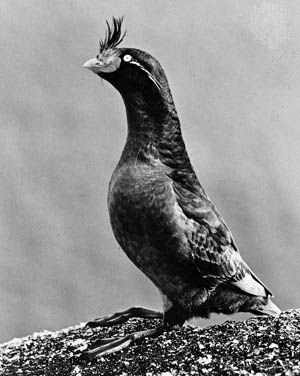
The family Alcidae, commonly known as auks or alcids, consists of 22 known species of diving birds. Of these, 21 species are currently living, while one…
Which species of auks are still alive today, and which ones have gone extinct?
The family Alcidae, commonly known as auks or alcids, consists of 22 known species of diving birds. Of these, 21 species are currently living, while one species is extinct.1
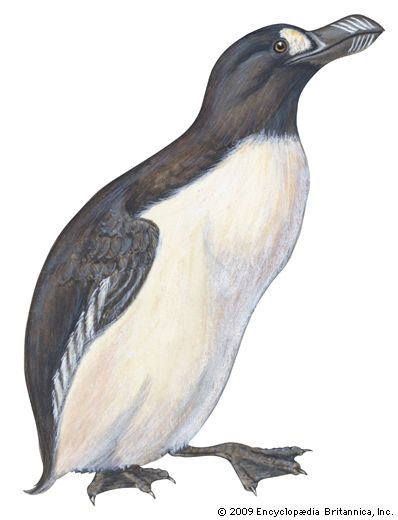
The only extinct member of this family is the great auk (Pinguinus impennis). This flightless seabird, which stood about 75 cm (30 inches) tall, was once found across the North Atlantic but was driven to extinction by human hunting for food and bait. The last known specimens were killed in 1844.12
The 21 surviving species include a variety of birds adapted to Arctic, subarctic, and north temperate regions. Notable living members of the family include:1
- The little auk, or dovekie1
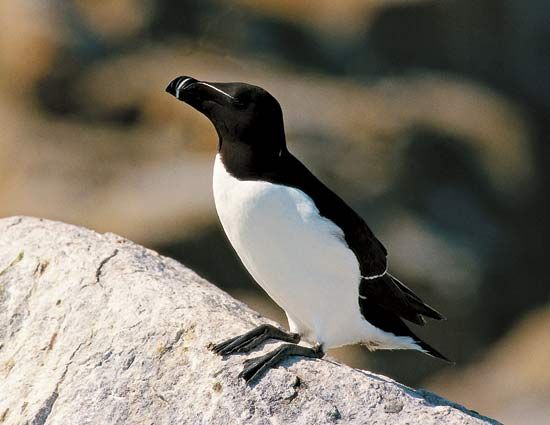
- The razorbill, which is the closest living relative of the great auk12
- Various species of puffin, guillemot, murre, murrelet, and auklet1
What is the typical diet and feeding behavior of auks?
Auks (family Alcidae) are specialized seabirds that are entirely dependent on the ocean for their sustenance. Unlike other members of the order Charadriiformes, alcids are uniquely adapted for swimming underwater, where they propel themselves using their half-open wings to capture prey.14
Their diet consists of a variety of marine life, including fish, crustaceans, mollusks, and plankton. Their specific feeding habits often correlate with their size:1
- Larger species: Birds such as puffins, murres, and guillemots typically feed on a combination of small fish and various marine invertebrates.4
- Smaller species: Murrelets and auklets subsist almost exclusively on invertebrates, particularly tiny, free-swimming (planktonic) crustaceans such as euphausiids.4
Outside of the breeding season, these birds are pelagic, meaning they spend their time living on the open ocean, where they forage for these food sources.4
What is the geographical distribution of auks in the world?
Auks, which belong to the family Alcidae, are primarily distributed throughout the northern parts of the Northern Hemisphere. Their range is largely confined to Arctic, subarctic, and north temperate regions.15
Key aspects of their geographical distribution include:
- Breeding Grounds: Auks nest colonially in island colonies along Arctic and north temperate seacoasts. While most species nest on coastal cliffs, rock crevices, or in burrows, some murrelets breed inland on mountains, though they remain within flying distance of the sea.35
- Range Limits: While they are predominantly northern birds, the distribution of some species extends as far south as Baja California in the Eastern Pacific.56
- Pelagic Movement: During the winter months, many auks are pelagic, meaning they move far from land to live and forage on the open ocean. Some species, such as certain auklets, may winter as far south as Japan and Mexico.56
Why were great auks unable to fly?
The great auk (Pinguinus impennis) was a flightless seabird that evolved from a flying ancestor, as indicated by the structural similarities it shared with other members of the Alcidae family.21
Its flightlessness was a secondary, specialized condition driven by the dual requirements of its anatomy. For alcids, the wing serves as both an aerial wing and an aquatic paddle for swimming underwater. Because body weight increases with size more rapidly than wing area, there is a critical trade-off between the wing’s efficiency as a paddle and its ability to provide lift in the air.10
In the case of the great auk, the need for a small, efficient paddle for underwater pursuit of prey limited its aerial capabilities. By abandoning flight, the great auk was able to grow larger, with its wings reduced to less than 15 cm in length, which optimized its performance as an aquatic diver rather than an aerial flier.210
Sources
- Auk — Encyclopædia Britannica
- Great auk — Encyclopædia Britannica
- Alcidae — Merriam-Webster
- Charadriiform - Locomotion and feeding behaviour — Encyclopædia Britannica
- Skua — Encyclopædia Britannica
- Auklet — Encyclopædia Britannica
- Arctic - Marine fauna — Encyclopædia Britannica
- Charadriiform - Auks (suborder Alcae) — Encyclopædia Britannica
- Coraciiform - Distribution — Encyclopædia Britannica
- Bird - Flightlessness — Encyclopædia Britannica
- Charadriiform - Adaptations for flight — Encyclopædia Britannica
Published on · 3 min read