Muscovy Duck
The Muscovy duck (Cairina moschata) is a large perching duck native to the wooded freshwater habitats of Central and South America. Unlike most other ducks…
What is Muscovy duck?
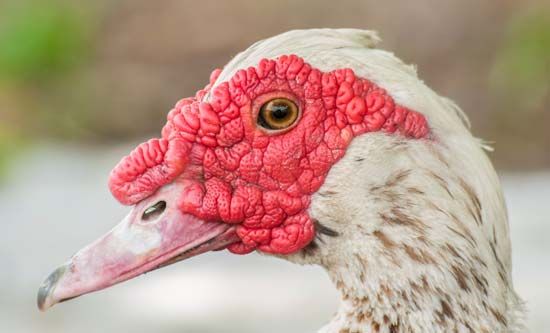
The Muscovy duck (Cairina moschata) is a large perching duck native to the wooded freshwater habitats of Central and South America. Unlike most other ducks, it does not descend from the mallard.1
These birds are easily identified by the red, fleshy caruncles on their faces and their large size; males are the largest ducks in the world, sometimes weighing over 7 kg (15 pounds). While wild populations are typically glossy black with white wing patches, domesticated varieties—often called “Barbary ducks”—exhibit more varied, lighter plumage.1
Muscovy ducks are omnivores that feed on aquatic and terrestrial plants, insects, and small animals. They are nonmigratory and known for being relatively quiet, communicating primarily through hissing and visual cues rather than quacking. Domesticated by Indigenous peoples in South America long before the arrival of Europeans, they are now raised globally as a source of lean protein. The IUCN currently classifies the species as one of least concern.1
What are caruncles and why do Muscovy ducks have them?
A caruncle is defined as a naked, fleshy outgrowth on the body of an animal, such as a bird’s wattle. In the case of the Muscovy duck, these red, fleshy growths appear on the face and serve as a distinct physical characteristic that sets the species apart from other ducks.31
The presence and extent of these caruncles vary based on the duck’s status and sex:
- In the wild: Only male Muscovy ducks possess these red facial caruncles. They are used as part of the male’s courtship displays, where males hiss, puff, and display their features to compete for breeding females.14
- In domesticated populations: Both males and females develop these caruncles, though males typically have more.14
While these growths are a prominent feature of the species, they are primarily associated with sexual signaling and sexual dimorphism within the population.1
How does the behavior of wild Muscovy ducks differ from domesticated ones?
The behavior of wild and domesticated Muscovy ducks differs primarily in their social structures and physical capabilities.
Behavioral Differences
- Social and Mating Habits: Wild Muscovy ducks are polygynous and do not form long-term pairs. Males engage in lek mating behavior, where they defend specific territories and perform elaborate courtship displays—such as hissing, head-pumping, and tail-swaying—to attract females. In contrast, some reports suggest that certain groups of domesticated Muscovy ducks may form pair bonds.1
- Mobility and Agility: Wild Muscovy ducks are capable of flight and are generally more agile. While they are nonmigratory, they are active birds that perch in trees during the day and roost in high tree cavities or nest boxes at night to avoid predators. Domesticated varieties are typically larger, heavier, and significantly less agile, which limits their natural flight and perching behaviors.1
Both groups share similar dietary habits as omnivores, though domesticated ducks are often raised in agricultural settings where their diet may be supplemented by grains.1
What is sexual dimorphism and how is it seen in this species?
Sexual dimorphism refers to the differences in appearance—such as size, color, shape, or structure—between males and females of the same species. These variations are often driven by sexual selection, where specific traits provide an advantage in competing for mates or attracting the opposite sex.51
In the Muscovy duck, sexual dimorphism is clearly observable through several physical and behavioral traits:
- Size: Males are significantly larger than females, often 30–50 percent larger. While females weigh less, males can grow up to 86 cm (34 inches) and weigh more than 7 kg (15 pounds).6
- Caruncles: In wild populations, only males possess the red, fleshy facial growths known as caruncles, which they use during courtship displays. In domesticated populations, both sexes develop these caruncles, though males typically have more.64
- Plumage: While both sexes have white wing patches, these patches are larger on the male.6
These differences illustrate how evolution shapes traits to assist in reproductive success, such as the male’s need to defend territory and attract females.51
Sources
- Muscovy duck — Encyclopædia Britannica
- Muscovy duck — Merriam-Webster
- caruncle — Merriam-Webster
- Muscovy duck: Top Questions — Encyclopædia Britannica
- Sexual dimorphism — Encyclopædia Britannica
- sexual selection — Encyclopædia Britannica
Published on · 3 min read