Mʾzab
The M'zab is a region of Sahara oases located in central Algeria. It stretches along the Wadi M'zab and is characterized by its arid surroundings, known as…
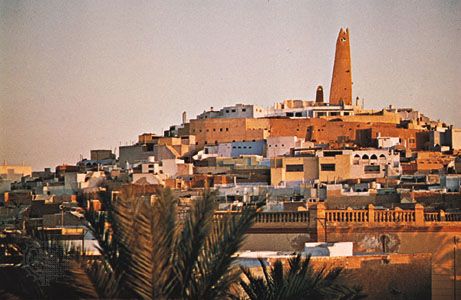
What is the geographical location and significance of the M’zab region in Algeria?
The M’zab is a region of Sahara oases located in central Algeria. It stretches along the Wadi M’zab and is characterized by its arid surroundings, known as chebka.1
The region is historically and culturally significant as the home of the Mzabite people, a Berber group who settled the area in the 11th century to seek refuge and defense in an inhospitable landscape. The M’zab is famous for its “Pentapolis”—five historic walled towns, including the chief settlement of Ghardaïa—which feature unique, terraced architecture and are governed by an assembly of scholars.123
The Mzabites are known for their strict, egalitarian, and separatist practice of the Ibāḍī branch of Islam, which has preserved their distinct social and religious identity for centuries. Additionally, the region is celebrated for its legendary palm groves, sustained by sophisticated traditional water management and dam systems that have allowed agriculture to flourish in the desert.21
Who are the Mozabites, and what is their cultural and historical background?
It is important to clarify that the term “Mozabite” refers to the Mzabite people, a distinct Berber group in Algeria. They should not be confused with “Mozarabs,” who were Arabicized Christians living in medieval Spain.45
Historical Background
The Mzabites are descendants of followers of the Ibāḍī branch of Islam who were driven from Tiaret in the 9th century. Seeking refuge, they eventually settled in the inhospitable Wadi M’zab region around 1010 CE for defensive purposes. Their history is defined by this migration and their subsequent development of a secluded, highly organized society in the desert.43
Cultural Identity
- Religious Practice: Mzabites practice a strict, egalitarian, and separatist form of Ibāḍī Islam. Their religious life is characterized by high standards of purity; notably, non-members are not permitted in their mosques.4
- Social Structure: The community is endogamous, meaning they do not marry outside their sect, which has contributed to their physical homogeneity. While men often travel throughout Algeria for trade, the women remain within the community and are heavily veiled.4
- Governance and Economy: The region is governed by an assembly of scholars known as the ḥalqah. They are renowned for their sophisticated water management, including dams and wells, which sustain legendary palm groves in the arid landscape.43
How has the M’zab region’s economy evolved over time, particularly in relation to its oasis settlements?
The economy of the M’zab region has historically centered on the mastery of its arid environment, evolving from traditional oasis agriculture to a more modernized system.
Traditional Foundations
For centuries, the Mzabite economy relied on the intensive cultivation of legendary palm groves. This was made possible by a sophisticated, highly regulated system of water management. The population utilized a strict code for water distribution and constructed dams across the Wadi M’zab to capture runoff. Agriculture, which includes the production of dates, cereals, legumes, and fruits, remains a vital seasonal activity between May and December.42
Economic Evolution and Modernization
While agriculture remains a cultural cornerstone, the region has seen significant shifts:
- Trade and Commerce: Mzabite men have long traveled throughout Algeria to operate small businesses, particularly grocery stores, maintaining a dual economic life where they work abroad but return periodically to their home oases.4
- Handicrafts: The production of traditional goods—including pottery, brassware, jewelry, and carpets—continues to be a notable economic activity, highlighted by events such as the annual spring carpet festival.4
- Technological Integration: The traditional “Song of M’zab”—the sound of pulleys from over 4,000 wells—is increasingly being replaced by modern motor pumps.2
- Industrial Development: The region has begun to modernize through the establishment of a small industrial zone and the integration of natural gas piped from the nearby Hassi R’Mel field.2
What are the five main ksour (fortified towns) in the M’zab Valley?
The M’zab region is famous for its “Pentapolis,” a collection of five historic fortified towns (ksour) built along the Wadi M’zab. While the region later expanded to include other settlements, the original five towns that constitute the core of the Mzabite heritage are:
- Ghardaïa: The chief settlement and administrative center of the region.2
- El-Ateuf: Recognized as the oldest of the five towns.2
- Beni Isguene: Known as the sacred town of the Mzabite League, it maintains strict traditions, including barring non-members of the sect from staying overnight within its walls.2
- Melika: Historically populated by black Africans, this town is noted for its large cemeteries.2
- Bou Noura: Situated on a rock overhanging the riverbed, it is historically described as the smallest and poorest of the original five towns.2
It is worth noting that in the 17th century, the towns of Guerrera and Berriane were also incorporated into the broader Mzabite administrative structure, though the term “Pentapolis” specifically refers to the original five settlements.2
Sources
- Ghardaïa — Encyclopædia Britannica
- Mʾzab — Encyclopædia Britannica
- Mozabite — Merriam-Webster
- Mʾzabite — Encyclopædia Britannica
- Islam - The Khārijites — Encyclopædia Britannica
- Mozarab — Encyclopædia Britannica
Published on · 4 min read