Richat Structure
The Richat Structure is a prominent geographic feature located in the Sahara near Ouadane, Mauritania. Spanning approximately 50 km (30 miles) in diameter…
What is Richat Structure?
The Richat Structure is a prominent geographic feature located in the Sahara near Ouadane, Mauritania. Spanning approximately 50 km (30 miles) in diameter, it consists of a series of concentric rings that resemble an eye when viewed from space.12
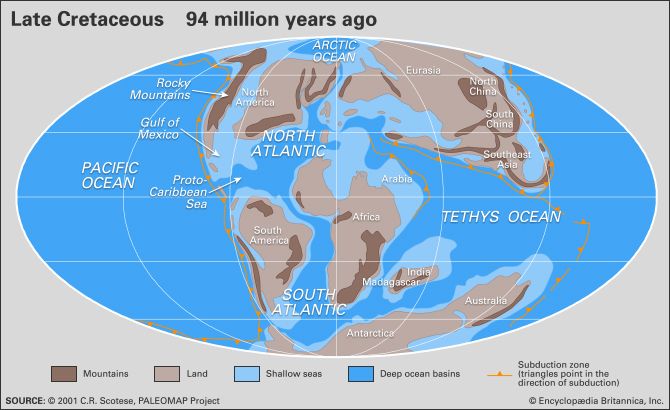
While its circular shape once led to theories that it was an impact crater, geologists have determined it is actually an uplifted geological dome. It was formed by molten rock during the Cretaceous Period and subsequently shaped by millions of years of erosion. The rings are composed of alternating layers of resistant igneous rock and softer sedimentary rock.2
Although some have speculated that the site is the location of the legendary Atlantis, scholars maintain that Atlantis is a fictional metaphor created by Plato. The structure has historical significance as a navigational landmark and as a site of early human habitation, evidenced by the discovery of Acheulean tools.2
How does erosion shape the appearance of the Richat Structure?
The Richat Structure’s distinctive appearance is the result of millions of years of erosion acting upon an uplifted geological dome. Originally formed by molten rock during the Cretaceous Period, the structure consists of alternating layers of varying rock types that respond differently to environmental forces.1
The concentric rings that give the structure its eye-like appearance are shaped by the differential erosion of these layers:
- Harder Layers: The higher, more prominent rings are composed of resistant igneous rock, such as basalt and quartzite, which withstand the elements more effectively.1
- Softer Layers: The lower, shorter rings consist of softer sedimentary rock, such as sandstone and shale, which are more susceptible to being worn away by wind, sand, and water over time.1
This uneven weathering process carves out the circular pattern, exposing the underlying geological strata and creating the striking visual contrast observed from space.1
What evidence suggests early humans lived near the Richat Structure?
Evidence of early human habitation at the Richat Structure is primarily based on the discovery of stone artifacts at the site. Archaeologists have unearthed Acheulean and pre-Acheulean tools, including hand axes, which suggest that early humans utilized the area for hunting and manufacturing activities.2
The Acheulean industry represents a significant advancement in early technology, characterized by the production of bifacial implements with sharper, straighter edges compared to earlier, more primitive tools. The presence of these artifacts indicates that early hominids possessed the skills necessary to adapt to local conditions by selecting specific materials—such as quartzite, which is also found within the geological layers of the Richat Structure—to craft a variety of implements for survival.42
Why did people once mistake the Richat Structure for the lost city of Atlantis?
The Richat Structure has been incorrectly linked to the legendary lost city of Atlantis primarily due to its striking appearance and geographic location. From an aerial or satellite perspective, the structure’s series of concentric rings resembles the description of the city provided by the philosopher Plato around 360 BCE, which depicted Atlantis as a series of alternating rings of water and land.2
However, this association is purely speculative and lacks scientific basis. Geologists have confirmed that the Richat Structure is an uplifted geological dome formed by molten rock during the Cretaceous Period, with its circular shape created by millions of years of erosion on varying rock layers. Furthermore, classicists and historians maintain that Atlantis is a fictional construct, serving as a metaphor in Plato’s writings rather than a historical site.21
Sources
- Richat Structure: Top Questions — Encyclopædia Britannica
- Richat Structure — Encyclopædia Britannica
- Nashville Dome — Encyclopædia Britannica
- Stone tool industry — Encyclopædia Britannica
Published on · 3 min read