Naked Mole Rat
The naked mole rat (Heterocephalus glaber) is a burrowing rodent native to the arid regions of East Africa, including Ethiopia, Kenya, and Somalia. Despite…
What is a naked mole rat?
The naked mole rat (Heterocephalus glaber) is a burrowing rodent native to the arid regions of East Africa, including Ethiopia, Kenya, and Somalia. Despite their name, they are not entirely hairless; they possess about 100 fine hairs that function as sensory whiskers to help them navigate their subterranean tunnel networks.123
These animals are notable for being one of the few eusocial mammals, living in large, hierarchical colonies dominated by a single breeding queen. They are highly adapted to underground life, possessing small eyes, degenerated hearing, and powerful jaws with protruding incisors used for digging.23
Naked mole rats are scientifically renowned for their “superpowers,” which include:
- Longevity and Cancer Resistance: They have exceptionally long lifespans and very low cancer rates, largely due to the presence of supersized hyaluronan molecules that prevent tumor formation.24
- Oxygen Deprivation Tolerance: They can survive in low-oxygen environments by switching their metabolism to process fructose when oxygen is unavailable.4
What does a naked mole rat look like?
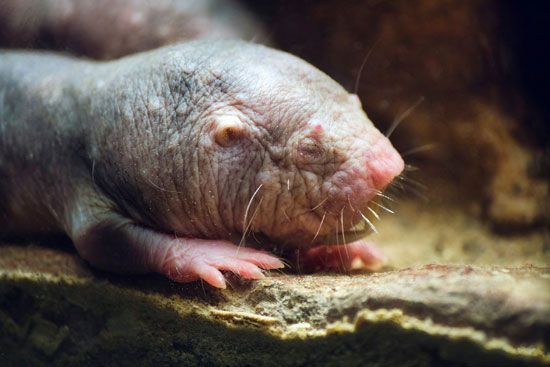
The naked mole rat (Heterocephalus glaber) is a burrowing rodent characterized by a distinct, specialized appearance adapted for life underground.12
Physical Characteristics
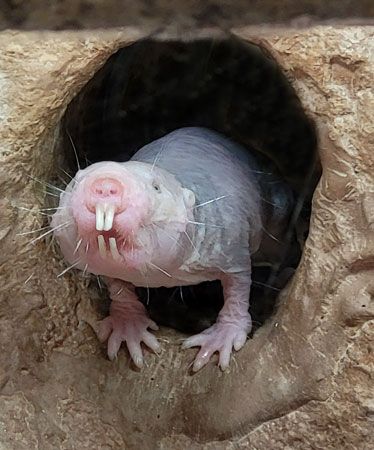
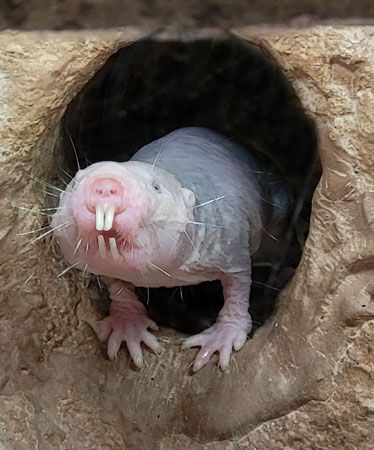
- Skin and Appearance: They are named for their wrinkled, pinkish, and nearly hairless skin. While they appear bald, they are not entirely hairless; they possess approximately 100 fine, pale hairs scattered across their bodies and tails, as well as sparse fringes along their lips and feet. These hairs function as sensory whiskers, helping the animals navigate their dark, subterranean environments.12
- Head and Jaws: They have broad heads with strong, muscular jaws. A defining feature is their four large, protruding incisor teeth, which are used for gnawing through soil to excavate tunnels.12
- Body Structure: These rodents have stocky, cylindrical bodies with short legs, which allow them to move easily through narrow tunnels. They are typically 7.5 to 9 cm (3 to 3.5 inches) long and weigh between 28 and 80 grams, though their size can vary depending on their specific role within the colony.12
- Sensory Adaptations: They possess very small eyes and are considered practically blind. They lack external ears, having only small openings, and rely primarily on their senses of touch and smell to navigate.412
Where do naked mole rats live?
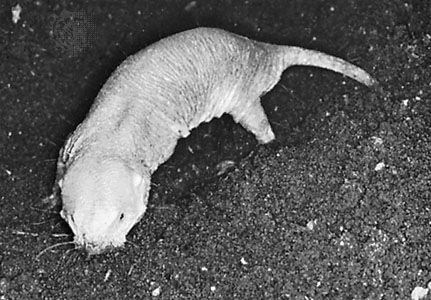
Naked mole rats (Heterocephalus glaber) are native to the arid, grassy, and semiarid regions of East Africa, specifically inhabiting Ethiopia, Kenya, Somalia, and Djibouti.12
These rodents are highly adapted to a subterranean lifestyle, spending their entire lives underground in elaborate burrow systems. These tunnels, which can extend up to 4 km (2.5 miles) in length and reach depths of 2 meters (6.5 feet), consist of complex networks of chambers used for nesting, nursing, and food storage. They prefer sandy and loamy soils within dry grasslands and savannas, where they excavate their homes by gnawing through the earth with their powerful incisor teeth.24
How do naked mole rats survive underground?
Naked mole rats possess remarkable physiological and behavioral adaptations that allow them to thrive in harsh, subterranean environments:
- Metabolic Resilience: To survive in low-oxygen conditions common in deep burrows, they can switch their metabolism from relying on glucose to using fructose and sucrose. This allows them to continue producing energy for their brain cells even when oxygen is unavailable for more than 18 minutes.2
- Digging and Navigation: They use their powerful, muscular jaws and four large incisor teeth to excavate extensive tunnel networks. Because they are nearly blind, they rely on touch and smell, using fine body hairs as whiskers to sense vibrations and air currents.3
- Social Cooperation: As eusocial mammals, they live in colonies where individuals cooperate to dig tunnels, gather food, and protect the queen. They also practice thermoregulation by huddling together to conserve body heat.3
- Nutritional Efficiency: They practice coprophagy, reingesting their feces to maximize nutrient absorption, which is essential given the energy-intensive nature of digging for roots and tubers.3
Sources
- naked mole rat — Merriam-Webster
- naked mole rat — Encyclopædia Britannica
- The Naked Mole Rat’s Latest Superpower — Encyclopædia Britannica
- blesmol — Encyclopædia Britannica
- blind mole rat — Encyclopædia Britannica
Published on · 3 min read