Nautilus
The term "nautilus" refers to two distinct groups of cephalopod mollusks with different habitats and distributions:
What is the habitat and distribution of nautilus species in the world’s oceans?
The term “nautilus” refers to two distinct groups of cephalopod mollusks with different habitats and distributions:
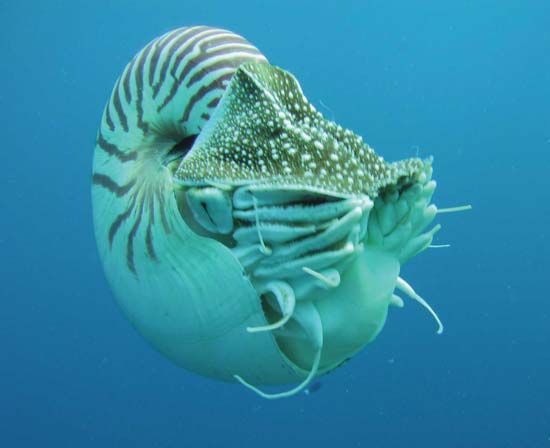
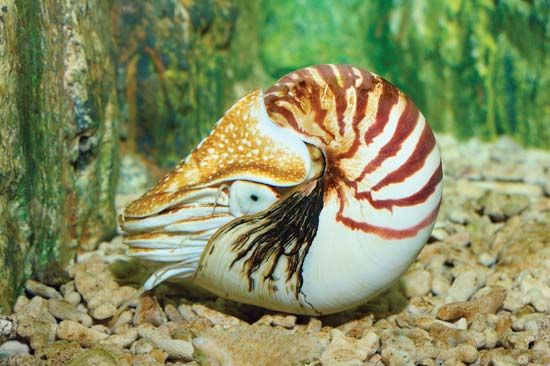
- Pearly (Chambered) Nautilus (Nautilus): These animals are found in the ocean at depths ranging from 50 to 600 meters (about 160 to 1,970 feet). They are known to move vertically through the water column and typically live near the bottom. While they are generally deep-water dwellers, they are sometimes found in shallower waters, such as in the Philippines, where they are fished. They are considered social animals and are often found together in large numbers.12
- Paper Nautilus (Argonauta): This is a cosmopolitan genus, meaning it is widely distributed throughout the world’s oceans. Unlike the pearly nautilus, the paper nautilus is typically found near the surface of tropical and subtropical seas, where it feeds on plankton.1
How many species of nautilus are known to exist today?
It is a common misconception to group all “nautilus” species together; however, the term refers to two distinct, unrelated groups of cephalopod mollusks.
There is only one surviving genus of the pearly, or chambered, nautilus (Nautilus), which represents the last living members of the ancient order Nautiloidea. In contrast, the paper nautilus belongs to the genus Argonauta, which is a group of pelagic cephalopods related to the octopus. While the Nautilus genus is a singular taxonomic group, Argonauta comprises several species distributed across tropical and subtropical seas.14
How does the nautilus’s eye structure compare to other cephalopods and other animals?
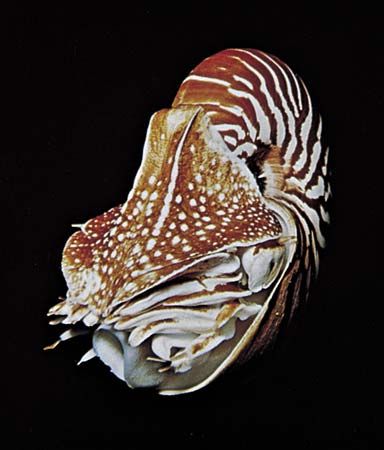
The eye structure of the Nautilus is unique among cephalopods, as it functions as a “pinhole eye” rather than the complex lens-based camera eyes found in other cephalopods like the Octopus or squid.56
Comparison of Eye Structures
- Nautilus (Pinhole Eye): The Nautilus eye is an open pit without a lens. While it features muscles to move the eye and a pupil that adjusts to light intensity, it lacks the refractive power to focus light onto a retina. Consequently, the image produced has very poor resolution, and because the pupil must remain small to achieve even modest clarity, the resulting image is extremely dim.65
- Other Cephalopods (Lens Eye): In contrast, coleoid cephalopods (octopuses, squids, and cuttlefishes) possess sophisticated lens eyes that are superficially similar to those of fish. These eyes use a gradient-index lens to focus light sharply onto the retina, providing high resolution and brightness.3
Evolutionary Context
The differences between these eyes highlight a classic case of convergent evolution. While the lens eyes of fish and coleoid cephalopods are functionally similar, they evolved independently from different tissues—vertebrate eyes from neural tissue and cephalopod eyes from epidermal tissue. Furthermore, their retinas differ significantly: vertebrate retinas are “inverse” (with nerves in front of photoreceptors), while cephalopod retinas are “everse” (with nerves leaving from the rear).3
Despite these morphological differences, all these groups share deep genetic commonalities, such as the Pax-6 gene and the use of rhodopsin, which suggest that the molecular building blocks for vision were present in their common ancestors long before these diverse eye types diverged.7
What is known about the nautilus’s diet and feeding habits?
The pearly, or chambered, Nautilus is a relatively slow-moving cephalopod that inhabits depths ranging from 50 to 600 meters. Unlike its more active relatives—such as squids and octopuses—the Nautilus is considered a primitive, less-specialized form that relies on its coiled, calcareous external shell for protection.31
Feeding Habits
- Prey: The Nautilus actively searches for food, primarily hunting for shrimp and other small prey.3
- Capture Mechanism: It utilizes approximately 94 small, suckerless, and contractile tentacles to capture its prey.13
- Alimentary System: Once captured, the prey is processed through a specialized alimentary system. This includes a buccal mass equipped with a pair of jaws (mandibles) and a rasping tongue known as a radula, which helps break down food before it passes through the esophagus into the stomach and digestive gland.1
In contrast to the Nautilus, the paper nautilus (Argonauta) is a different genus that lives near the surface of tropical and subtropical seas and feeds primarily on plankton.3
Sources
- nautilus — Encyclopædia Britannica
- cephalopod - Ecology — Encyclopædia Britannica
- cephalopod - Form and function — Encyclopædia Britannica
- paper nautilus — Merriam-Webster
- Photoreception - Pinhole eyes — Encyclopædia Britannica
- Photoreception - Lens eyes — Encyclopædia Britannica
- Photoreception - Evolution of eyes — Encyclopædia Britannica
- Mechanoreception - Mechanoreceptor function — Encyclopædia Britannica
Published on · 3 min read