Mollusk
Mollusks have evolved a diverse array of defense mechanisms to survive against predators, ranging from physical barriers to complex behavioral and chemical…
What defense mechanisms have mollusks evolved to protect themselves from predators?
Mollusks have evolved a diverse array of defense mechanisms to survive against predators, ranging from physical barriers to complex behavioral and chemical strategies.
Physical Protection
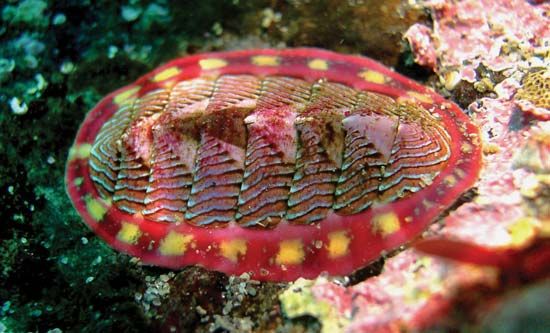
Many mollusks rely on external structures for protection. This includes hardened cuticles, calcareous plates, or shells into which the soft body can be withdrawn. Gastropods like snails often possess an operculum, a hardened plate on the foot that acts as a “door” to seal the shell opening. Other species, such as chitons and solenogasters, can roll their bodies into a protective ball, while limpets and other mollusks use a powerful muscular foot to adhere firmly to substrates. Burrowing into the substrate is another common method used by bivalves, scaphopods, and some gastropods to escape detection.12
Chemical and Sensory Defense
Mollusks frequently employ chemical deterrents, such as secreting noxious or distasteful substances from salivary glands or mantle cells. Some gastropods, such as the Eolidacea, can ingest cnidarians and store their stinging cells (nematocysts) to use for their own defense. Additionally, many species secrete mucus to deter predators or use fluids—such as the ink of cephalopods or the purple fluid of the sea hare—to confuse attackers, mask their scent, or create a visual distraction.13
Behavioral and Visual Strategies
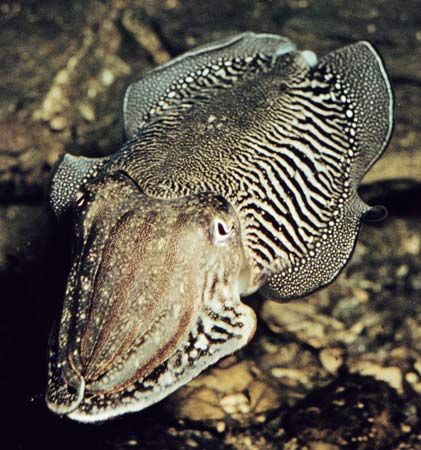
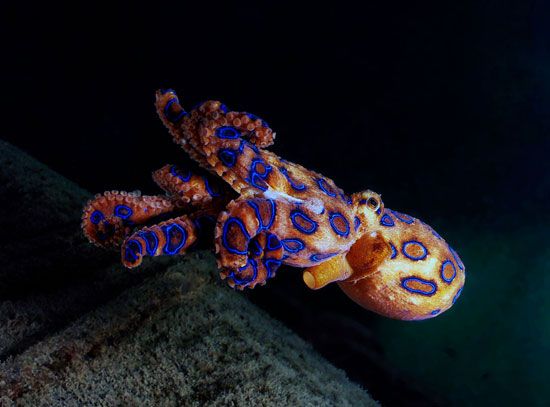
Cephalopods, including octopuses and cuttlefishes, utilize sophisticated camouflage and coloration to blend into their surroundings or startle predators. They can rapidly alter their skin texture and color using specialized cells called chromatophores. Some deep-sea squids even use bioluminescence for defense. Furthermore, certain octopuses exhibit high intelligence, with some documented using tools like coconut shells for portable shelter.13
How are mollusks classified into different classes, and what are some examples of each?
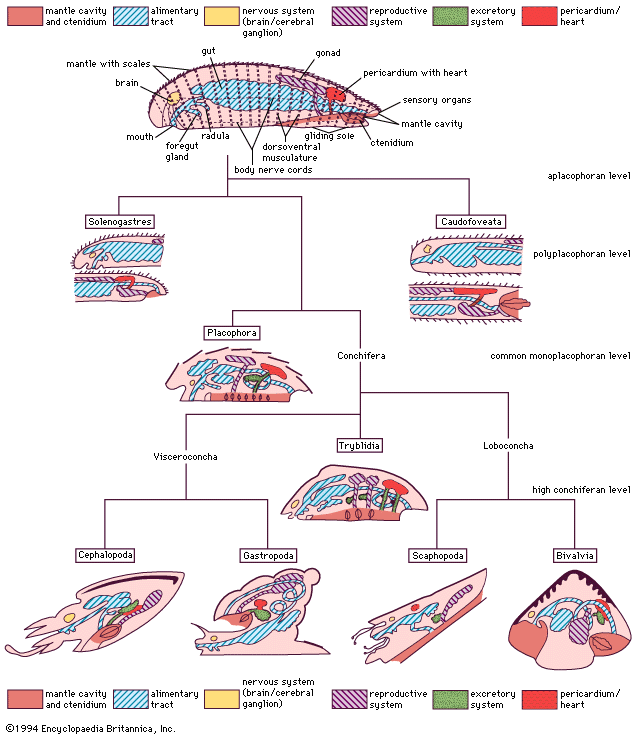
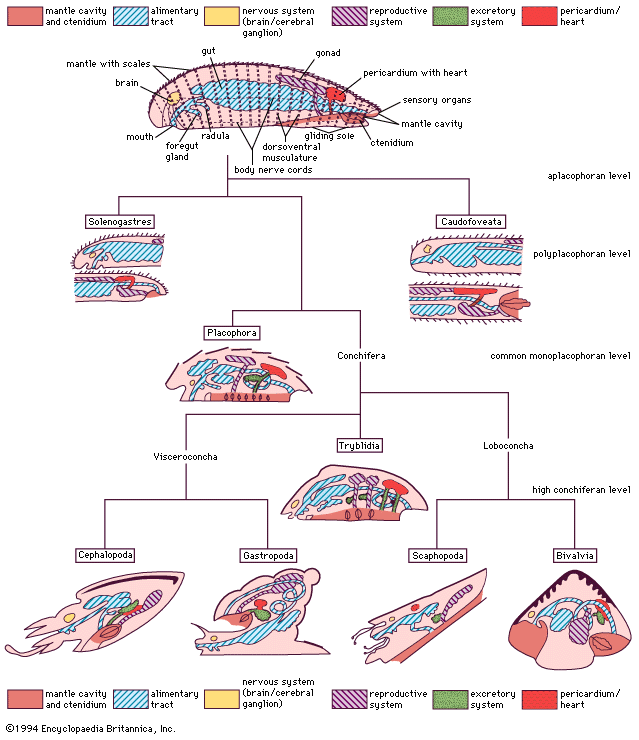
The phylum Mollusca is classified into several distinct classes based on body structure, shell morphology, and evolutionary traits. These are generally divided into the subphylum Aculifera (shell-less or spicule-bearing) and the subphylum Conchifera (shell-bearers).4
Major Classes of Mollusks
- Aplacophora: Worm-shaped, shell-less marine mollusks. This class includes the subclasses Caudofoveata (burrowing forms) and Solenogasters (gliding predators).5
- Polyplacophora: Commonly known as chitons, these are characterized by a flattened body and eight dorsal shell plates.5
- Monoplacophora: Rare, cap-shaped mollusks that possess multiple pairs of gills and excretory organs.5
- Bivalvia: Characterized by a shell divided into two hinged valves. Examples include clams, oysters, mussels, and scallops), and scallops.46
- Scaphopoda: Known as tusk shells, these marine burrowers have a tubiform shell and a specialized head with tentacles.5
- Gastropoda: The largest class, including snails, slugs, and limpets. They are defined by a coiled shell (often with an operculum) or a reduced/absent shell in slugs.57
- Cephalopoda: Highly mobile predators with tentacles and a modified foot used for jet propulsion. Examples include nautiluses, cuttlefishes, squids, and octopuses.58
What economic and cultural importance do mollusks have for humans?
Mollusks hold significant economic and cultural importance for humans, serving as vital food sources, industrial materials, and historical markers of human development.
Economic Importance
- Food Industry: Mollusks, particularly bivalves such as clams, oysters, mussels, and scallops, are a major global food source. Millions of metric tons are harvested annually, supporting extensive fishing and commercial cultivation industries.910
- Jewelry and Ornaments: Many shell-bearing species are harvested for the pearl and mother-of-pearl industries. Beyond jewelry, shells are used to manufacture buttons, inlays, lampshades, and other decorative items.91011
- Economic Challenges: Some species, such as the invasive zebra mussel, cause millions of dollars in damage by clogging water-intake pipes in power plants and cooling systems, while also disrupting native ecosystems.910
Cultural and Historical Significance
- Archaeological Record: Prehistoric shell mounds, or middens, provide critical evidence of human occupancy and diet throughout history. These refuse heaps contain the remains of mollusks consumed by early human societies, helping anthropologists date ancient cultures.12
- Historical Utility: Throughout history, various shells have been used as tools, decorative objects, and even as a form of currency in ancient societies.11
Health Considerations
While economically valuable, some gastropods serve as intermediate hosts for parasites that cause diseases like schistosomiasis. Additionally, filter-feeding bivalves can concentrate toxins from red tides, posing risks to human health if consumed.910
What role do mollusks play in marine and terrestrial ecosystems?
Mollusks are integral components of both marine and terrestrial ecosystems, occupying diverse roles as primary consumers, predators, and environmental engineers.
Marine Ecosystems
In marine environments, mollusks contribute significantly to organic turnover. Many bivalves are filter feeders that strain suspended organic material from the water, with some species capable of filtering up to 40 liters per hour. By grazing on algae and sessile organisms, gastropods like limpets and periwinkles exert substantial influence on the structure of rocky shorelines.914
Mollusks also engage in complex biological associations. Some species form symbiotic relationships with algae or bacteria in deep-sea hydrothermal vents, while others are commensal, living within the burrows of other invertebrates for protection. Furthermore, cephalopods serve as key carnivores in the marine food web, preying on crustaceans and fish.1516
Terrestrial Ecosystems
On land, land snails and slugs are highly successful, inhabiting diverse environments from forests to deserts. They primarily function as decomposers, feeding on decaying plant matter, fungi, and carrion, which facilitates nutrient cycling in soil and surface litter. Their presence is often abundant, with some forest habitats supporting millions of individuals per acre, making them a vital food source for various small predators.1714
Sources
- mollusk - Features of defense — Encyclopædia Britannica
- cephalopod - Behaviour — Encyclopædia Britannica
- Avoidance behaviour - Protection reflexes, armour, and spines — Encyclopædia Britannica
- mollusk - Annotated classification — Encyclopædia Britannica
- gastropod — Encyclopædia Britannica
- bivalve — Encyclopædia Britannica
- mollusk - Critical appraisal — Encyclopædia Britannica
- cephalopod - General features and importance to humans — Encyclopædia Britannica
- mollusk - Importance to humans — Encyclopædia Britannica
- pearl — Encyclopædia Britannica
- bivalve - Importance — Encyclopædia Britannica
- seashell — Encyclopædia Britannica
- Shell mound — Encyclopædia Britannica
- mollusk - Habitats, feeding habits, and associations — Encyclopædia Britannica
- bivalve - Associations — Encyclopædia Britannica
- gastropod - Ecology and habitats — Encyclopædia Britannica
- bivalve - Ecology and habitats — Encyclopædia Britannica
- Filter feeding — Encyclopædia Britannica
- gastropod - Distribution and abundance — Encyclopædia Britannica
Published on · 4 min read