Plectoceras
Plectoceras is an extinct genus of small marine cephalopods that lived during the Ordovician Period, approximately 488 million to 444 million years ago.
What is Plectoceras?
Plectoceras is an extinct genus of small marine cephalopods that lived during the Ordovician Period, approximately 488 million to 444 million years ago.1
These organisms were nautiloids, meaning they are related to the modern pearly nautilus. They were characterized by a coiled shell made up of a series of chambers, with simple junctures between each segment.1
How do nautiloids differ from ammonites?
While both nautiloids and ammonoids are extinct or near-extinct shelled cephalopods, they are distinguished primarily by the complexity of their internal shell structures.
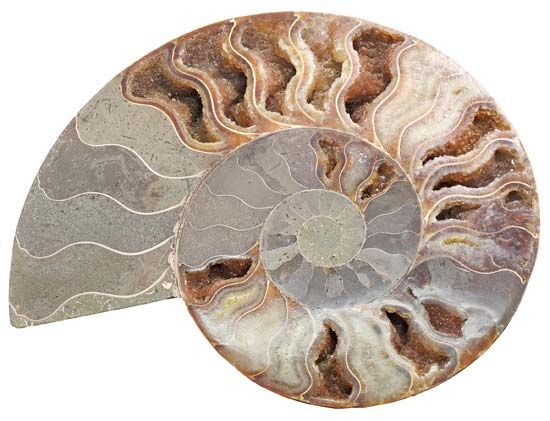
The most significant difference lies in the suture patterns—the lines where the internal partitioning walls (septa) meet the outer shell wall:
- Nautiloids: Characterized by simple, relatively straight or gently curved suture patterns. This group includes the modern pearly nautilus, the only living representative of the subclass.3
- Ammonoids: Distinguished by highly crenulated, folded, and complex suture patterns. These patterns evolved from simple (goniatite) to more folded (ceratite) and eventually to highly interwoven (ammonite) designs over time.3
Additionally, while both groups share a common ancestry within the cephalopods, ammonoids are thought to have evolved from straight-shelled Devonian forms known as Bactrites, which possessed certain nautiloid traits. Ammonoids became important index fossils due to their rapid evolution and wide distribution before going extinct at the end of the Cretaceous Period.23
What defines the Ordovician Period?
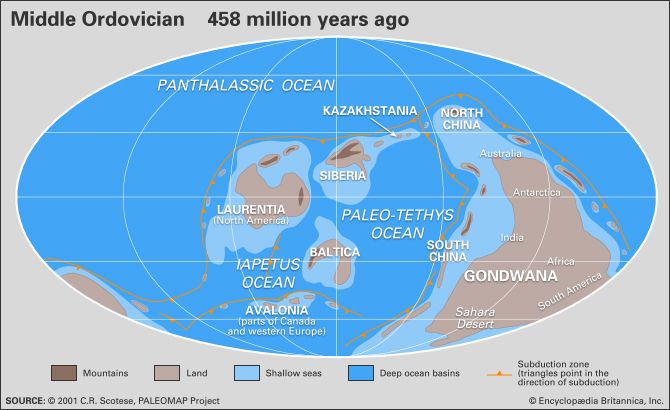
The Ordovician Period was the second period of the Paleozoic Era, spanning from 485.4 million to 443.8 million years ago. It is defined by profound shifts in plate tectonics, climate, and biological evolution.56
Geological and Climatic Context
During this period, rapid seafloor spreading led to some of the highest global sea levels in the Phanerozoic Eon, causing extensive flooding of the continents. Atmospheric carbon dioxide levels were significantly higher than today, generally fostering warm climates; however, the period concluded with a brief, intense interval of glaciation in the Southern Hemisphere.657
Biological Significance
The period is marked by the “Ordovician radiation,” an intense diversification of marine life that saw the emergence of almost every modern phylum of marine invertebrate. Dominant life forms included:65
- Brachiopods and bryozoans
- Trilobites, mollusks, and echinoderms
- Graptolites and the rise of early fish65
The period ended with the second-largest mass extinction in Earth’s history, which claimed roughly 85 percent of species.65
How does the modern pearly nautilus survive today?
The modern pearly nautilus (Nautilus) survives in the ocean depths, ranging from 50 to 600 metres (about 160 to 1,970 feet), by utilizing a specialized shell and a unique physiological structure.10
- Buoyancy Control: The nautilus possesses a smooth, coiled external shell containing approximately 36 chambers. It regulates the gases within these chambers via a tube called the siphuncle, which allows the animal to maintain neutral buoyancy and act as a float.10
- Locomotion and Feeding: It moves through the water using jet propulsion and captures prey, such as shrimp, using up to 94 small, suckerless, contractile tentacles.10
- Physiological Adaptations: Unlike more active cephalopods, the nautilus has a partly lacunar circulatory system and simple, open-pit eyes that lack lenses. It also lacks the ink sac found in most other cephalopods, relying instead on its protective shell for defense.11
As the last surviving genus of the ancient order Nautiloidea, the pearly nautilus remains a significant subject for researchers studying the evolution of cephalopods.10
Sources
- Plectoceras — Encyclopædia Britannica
- cephalopod — Encyclopædia Britannica
- ammonoid — Encyclopædia Britannica
- cephalopod - Evolution and paleontology — Encyclopædia Britannica
- A Journey Through Time Since the Precambrian - Ordovician Period: 485.4 million to 443.4 million years ago — Encyclopædia Britannica
- Ordovician Period - Invertebrates — Encyclopædia Britannica
- Ordovician Period — Encyclopædia Britannica
- Ordovician Period - Paleoclimate — Encyclopædia Britannica
- Silurian Period - Late Ordovician mass extinction — Encyclopædia Britannica
- nautilus — Encyclopædia Britannica
- cephalopod - Reproduction and life cycles — Encyclopædia Britannica
- cephalopod - Form and function — Encyclopædia Britannica
Published on · 3 min read