Neoregelia
Neoregelia is a genus comprising approximately 40 species of epiphytes belonging to the pineapple family (Bromeliaceae). Native to tropical South America…
What is Neoregelia?
Neoregelia is a genus comprising approximately 40 species of epiphytes belonging to the pineapple family (Bromeliaceae). Native to tropical South America, these plants are characterized by their ability to grow supported by other plants, utilizing aerial roots to absorb moisture from the atmosphere.1
Key features of Neoregelia include:
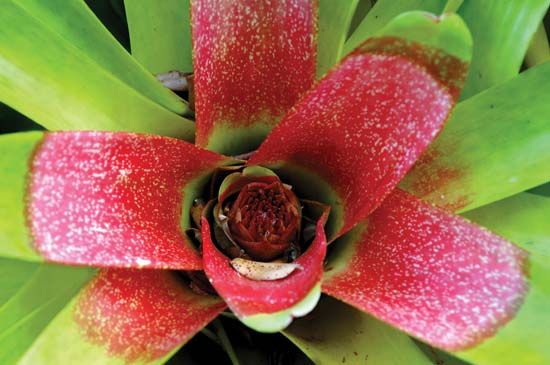
- Appearance: The plants form a rosette of leaves that are frequently marbled, mottled, or banded. Some species possess spines or scales on their foliage.1
- Flowering: Small flowers in shades of white, blue, or purple develop deep within the central cup of the rosette. During the flowering phase, the central leaves often undergo a color change.1
- Ornamental Use: Several species, most notably the blushing bromeliad (N. carolinae), are popular as indoor ornamental plants due to their vibrant foliage and flowers.1
What are epiphytes and how do they survive without soil?
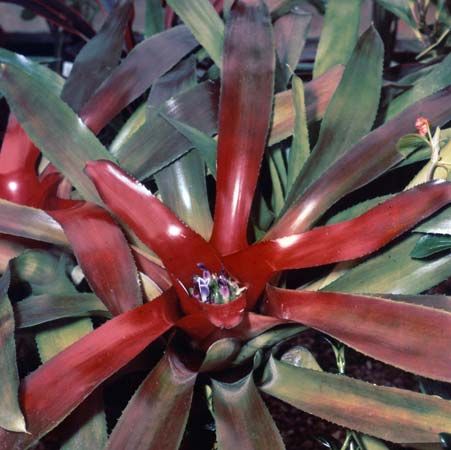
An epiphyte is a plant that grows upon another plant or object solely for physical support rather than nourishment. Unlike parasitic plants, epiphytes do not derive nutrients from their host; they are often called “air plants” because they do not require soil to survive.23
Epiphytes thrive in environments like tropical rainforests by growing high in the tree canopy, which allows them to access sunlight that is otherwise blocked by dense forest foliage. They survive without soil through several specialized adaptations:3
- Water Absorption: They obtain moisture from rain and water vapor in the air. While many use their roots to absorb water, others utilize specialized leaves for this purpose.3
- Nutrient Acquisition: Nutrients are typically absorbed from organic debris and leaf litter that collects on the host plant.3
- Attachment: Many species use adventitious roots to anchor themselves firmly to branches, rocks, or other non-soil surfaces.34
How do bromeliads collect water in their central cups?
In many bromeliads, particularly those known as tank bromeliads, the leaves are spirally arranged to form a tight, hollow tube or rosette. This structure acts as a natural reservoir that collects and holds rainwater, sometimes containing up to 20 litres (5 gallons) of water.56
These plants have evolved to utilize this stored water as a vital resource. While some bromeliads absorb moisture directly through specialized hairs on their leaf surfaces, the central pool serves as a crucial water supply and a unique habitat for various aquatic organisms, including insects, frogs, and salamanders. In addition to providing water, the decaying organic debris that collects within these pools serves as a primary source of nutrients for the plant.576
What other plants belong to the Bromeliaceae family?
The Bromeliaceae family is a diverse group of over 3,000 species across 56 genera. While the pineapple (Ananas comosus) and Spanish moss are the most well-known members, the family includes a wide variety of ornamental and specialized plants.58
Some notable genera and species within the family include:
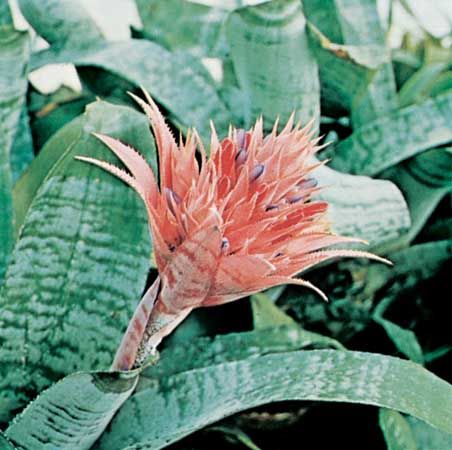
- Aechmea: Often cultivated for their striking foliage and flowers.58
- Billbergia: Known for their tubular rosettes and pendulous inflorescences.8
- Brocchinia: Includes rare carnivorous species like B. reducta and B. hectioides.5
- Catopsis: Another genus containing carnivorous species.5
- Dyckia: Typically terrestrial plants with succulent-like leaves.8
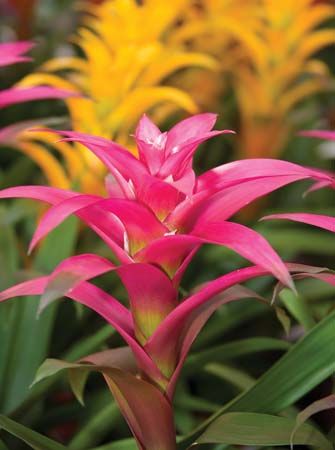
- Guzmania and Neoregelia: Popular indoor ornamentals valued for their colorful bracts.58
- Puya: Includes the giant Puya raimondii, which can reach heights of over 10 meters.58
- Vriesea: Frequently grown for their decorative, sword-shaped flower spikes.8
Sources
- Neoregelia — Encyclopædia Britannica
- Did you know? — Merriam-Webster
- epiphyte — Encyclopædia Britannica
- adventitious root — Encyclopædia Britannica
- Bromeliaceae — Encyclopædia Britannica
- angiosperm - Leaf modifications — Encyclopædia Britannica
- Life in a bromeliad pool — Encyclopædia Britannica
- list of plants in the family Bromeliaceae — Encyclopædia Britannica
Published on · 3 min read