Night Lizard
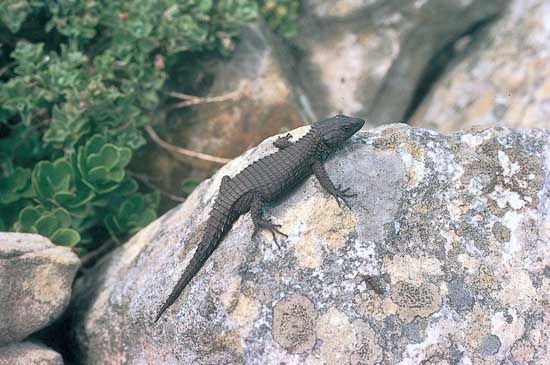
Night lizards (family Xantusiidae) possess several distinct biological and behavioral characteristics that set them apart from other lizards:
What are the unique characteristics of night lizards that distinguish them from other reptiles?
Night lizards (family Xantusiidae) possess several distinct biological and behavioral characteristics that set them apart from other lizards:
- Eye Structure: Unlike many other lizards, they lack eyelids. Instead, their eyes are covered by a transparent scale called a spectacle, which they clean by licking with their tongues. While they possess elliptical pupils for low-light vision, they are primarily active during the day in dark, sheltered environments.
- Reproduction: All species are viviparous, meaning they give birth to live young. They form a placenta to nourish developing embryos, a trait that distinguishes them from many egg-laying reptiles. Their brood sizes are notably small, ranging from one to eight offspring.
- Longevity: Despite their small size—often under 10 cm (4 inches)—night lizards are remarkably long-lived, with some species surviving up to 20 years, significantly longer than most other small lizards.
- Autotomy: They exhibit a high capacity for tail autotomy, allowing them to reflexively shed their tails to escape predators and subsequently regenerate them nearly in full.
How do night lizards differ from other lizard families in terms of physical appearance?
In terms of physical appearance, night lizards (family Xantusiidae) are distinguished from many other lizard families by several key features:
- Lack of Eyelids: Unlike many other lizard groups—such as iguanids or lacertids—night lizards do not have movable eyelids. Instead, their eyes are protected by a transparent, fixed scale known as a spectacle.
- Eye Maintenance: Because they lack eyelids, night lizards have evolved the ability to clean their spectacles by licking them with their tongues, a behavior more commonly associated with geckos.
- Size and Build: They are characterized as small, secretive lizards, typically measuring less than 10 cm (4 inches) in length from snout to vent. Their physical form is adapted for their lifestyle in confined spaces, such as rock crevices, caves, and beneath decaying vegetation.
- Tail Autotomy: Their long tails are physically adapted to be easily autotomized—reflexively separated from the body—as a defense mechanism, and they possess the capacity to regenerate them nearly in full.
What is the average size range for night lizards?
Night lizards (family Xantusiidae) are characterized by their relatively small body sizes, typically measuring less than 10 cm (4 inches) in length from snout to vent. Among the various species, the desert night lizard (Xantusia vigilis) is noted as one of the smallest, measuring less than 4 cm (1.6 inches) from snout to vent.
Where are night lizards typically found, and what type of habitats do they prefer?
Night lizards (family Xantusiidae) are secretive reptiles found across a range of environments in southwestern North America, Mexico, Central America, and Cuba. They are typically found in confined, sheltered microhabitats, including:16
- Crevices and Caves: Many species, such as the granite night lizard (X. henshawi), inhabit rock crevices where they can move about during the day.1
- Decaying Vegetation: They are frequently found living under logs, decaying vegetation, and other debris.1
- Desert Environments: The desert night lizard (X. vigilis) specifically resides underneath decaying Joshua trees within the Mojave and Sonoran deserts.1
- Tropical and Subtropical Regions: Species in the genus Lepidophyma are distributed throughout various habitats ranging from eastern Mexico into Panama.1
Because these lizards are active at relatively low body temperatures (25–28 °C, or 77–82 °F), they often occupy microhabitats that remain cool, even when located in otherwise hot environments like deserts.3
Sources
- night lizard — Encyclopædia Britannica
- lizard - Feeding habits — Encyclopædia Britannica
- lizard - Water loss and other variables — Encyclopædia Britannica
- Reproductive behaviour - Reptiles — Encyclopædia Britannica
- Integument - Reptiles — Encyclopædia Britannica
- lizard - Annotated classification — Encyclopædia Britannica
- lizard - Thermoregulation — Encyclopædia Britannica
Published on · 3 min read