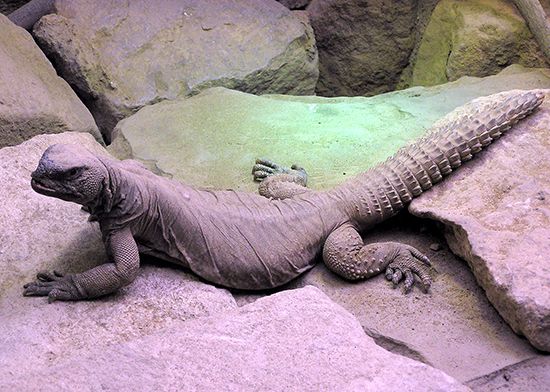
Spiny-tailed Lizard
The spiny-tailed lizard, belonging to the genus Uromastyx, is a member of the Agamidae family. These lizards inhabit arid and semiarid regions ranging from…
What is spiny-tailed lizard?
The spiny-tailed lizard, belonging to the genus Uromastyx, is a member of the Agamidae family. These lizards inhabit arid and semiarid regions ranging from northern Africa to India. Physically, they are characterized by their stout bodies, broad heads, and limbs, typically reaching lengths of 25 to 30 cm (10 to 12 inches) as adults.1
A defining feature of the species is its tail, which is covered in protective spines. When threatened, these lizards often retreat into burrows and lash their tails from side to side to deter predators. Unlike many other lizard species that hunt insects, adult spiny-tailed lizards are primarily herbivorous, feeding on plants. All species within this group reproduce by laying eggs.12
What are some other members of the Agamidae family?
The Agamidae family is a diverse group of Old World lizards comprising approximately 350 species across 50 genera. While they vary significantly in appearance and habitat, they are generally distinguished from New World iguanas by their acrodont dentition, where teeth are fused to the top of the jaw margin.345
Notable members of the Agamidae family include:
- Agamas: The namesake genus (Agama) of the family, which includes over 30 species.34
- Frilled Lizards (Chlamydosaurus): Known for the large, umbrella-like fold of skin around their necks that they expand when threatened.35
- Flying Lizards (Draco): A unique genus capable of gliding between trees using winglike membranes supported by elongated ribs.35
- Molochs (Moloch horridus): Also known as the thorny devil, this Australian lizard is covered in sharp spines and is highly adapted to arid environments.35
- Bearded Dragons (Pogona): Popular as pets, these Australian lizards are recognized by the spiny scales and expandable throat pouch that resembles a “beard”.6
How do these lizards survive in arid desert environments?
Lizards have evolved several physiological and behavioral strategies to thrive in arid desert environments, where they must manage extreme temperatures and limited water availability.
Thermoregulation
Because lizards are ectothermic, they rely on their surroundings to regulate body temperature. In deserts, they use behavioral thermoregulation to maintain an optimal range, typically between 28 and 38 °C (82 and 100 °F). Diurnal species often bask in the sun to warm up, while others may occupy cool microhabitats, such as burrows, to avoid the heat of the day. Some species, like the night lizard, are specifically adapted to remain in cool environments despite the surrounding desert heat.7
Water Conservation
Water management is critical in arid regions. Lizards are highly efficient because they excrete nitrogenous wastes as uric acid, which requires very little liquid. Additionally, their low metabolic rates mean they consume less water than birds or mammals. Herbivorous lizards often possess salt glands to excrete mineral salts, and some desert species can even harvest water from dew that collects on their skin in the early morning.8
Morphological Adaptations
Many desert lizards have evolved physical traits to navigate their environment. For example, some species have developed fringes on their toes, which increase surface area and prevent them from sinking into loose sand.1
What are some common predators of the spiny-tailed lizard?
The spiny-tailed lizard (Uromastyx) faces threats from a variety of birds, mammals, and other reptiles that commonly prey on lizards.1
To defend against these predators, the spiny-tailed lizard utilizes its stout, spine-covered tail as a primary deterrent. When threatened, these lizards typically retreat into burrows or rock crevices, leaving only their formidable, spiny tails exposed to discourage attackers. If a predator approaches while the lizard is partially inside a burrow, the lizard may violently lash its tail from side to side to strike the enemy. These defensive behaviors are highly effective at preventing predators from successfully capturing or consuming them.111
Sources
- spiny-tailed lizard — Encyclopædia Britannica
- lizard - Feeding habits — Encyclopædia Britannica
- Agamidae — Encyclopædia Britannica
- lizard - Annotated classification — Encyclopædia Britannica
- bearded dragon — Merriam-Webster
- Agamidae — Merriam-Webster
- lizard - Thermoregulation — Encyclopædia Britannica
- lizard - Water loss and other variables — Encyclopædia Britannica
- Biosphere - Humidity — Encyclopædia Britannica
- lizard - Locomotion and limb adaptations — Encyclopædia Britannica
- lizard - Defensive strategies — Encyclopædia Britannica
Published on · 3 min read