Iguanid
Iguanid lizards, which are primarily diurnal, rely heavily on complex visual displays for their reproductive and territorial behaviors.
How do iguanid lizards reproduce, and what unique features might their breeding behaviors have?
Iguanid lizards, which are primarily diurnal, rely heavily on complex visual displays for their reproductive and territorial behaviors.12
Courtship and Territoriality
Males often establish territories to attract females, using ritualized displays to avoid physical combat. These include:
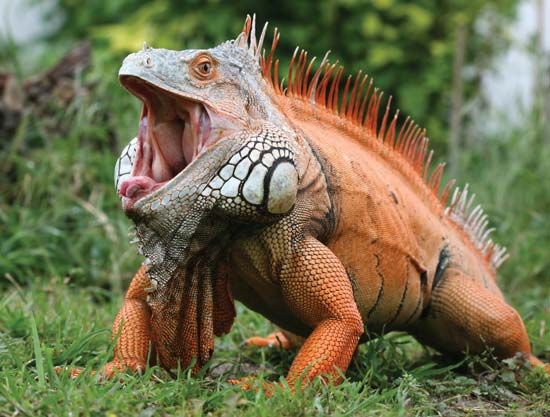
- Visual Signaling: Males may erect crests, puff out their bodies, or extend a brightly colored throat fan (dewlap) to appear larger and more conspicuous.12
- Stereotyped Movements: Courtship and territorial defense involve specific actions such as push-ups, head bobbing, and tail waving. During courtship, males approach females using distinct, pulsating, jerky movements.1
- Chemical Cues: While visual stimuli are primary, some species, such as the desert iguana (Dipsosaurus dorsalis), also utilize chemical signals to distinguish between individuals.1
Mating and Nesting
Copulation involves the male grasping the female by the neck or head and positioning his body to align their cloacae for the insertion of a hemipenis. Most iguanids are oviparous (egg-laying). For example, the common green iguana (Iguana iguana) digs deep, elaborate burrows to deposit eggs, often returning to the same nesting colonies annually. Incubation periods vary significantly; while many temperate species hatch within weeks, some, like the Fijian iguana (Brachylophus fasciatus), may have incubation periods lasting nearly a year.13
Where are iguanid lizards typically found in the world, and what types of habitats do they prefer?
Iguanid lizards are a diverse family of approximately 700 species found primarily throughout the Americas, ranging from southern Canada to the tip of South America. While the vast majority of the family is concentrated in the Western Hemisphere, there are notable exceptions: the genus Brachylophus is found in Fiji and other Pacific islands, and the genera Oplurus and Chalarodon are native to Madagascar.5
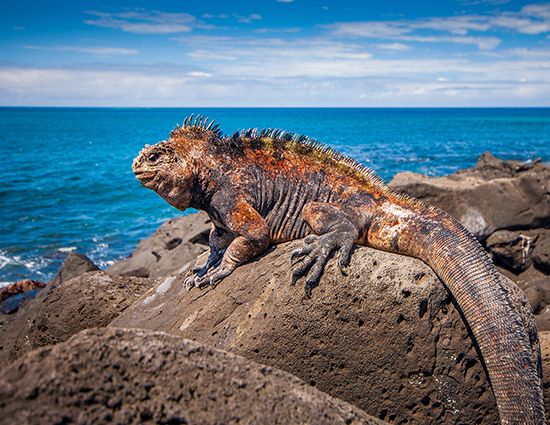
These lizards occupy a wide variety of environments, reflecting their adaptability. They are particularly conspicuous in the American Southwest, where they inhabit arid regions and deserts. Many species, including the well-known common iguana, thrive in tropical forests and grasslands. Others have adapted to specialized niches, such as the marine iguanas of the Galapagos Islands, which forage for algae in the ocean, or rock iguanas (Cyclura) that inhabit the West Indies.561
What are the key characteristics that distinguish iguanid lizards from other lizard families?
Iguanid lizards are distinguished from other lizard families by several key morphological and behavioral traits that reflect their evolutionary history as members of the infraorder Iguania.1
Key Characteristics
- Dentition: A defining feature of the family Iguanidae is the retention of ancestral pleurodont dentition, where teeth are cemented to the inside of the jawbones, rather than being attached to the surface of the jaw as seen in related families like Agamidae and Chamaeleonidae.1
- Foraging and Sensory Mode: Unlike many other lizards that rely on a highly developed vomeronasal system for active foraging, iguanids are primarily “sit-and-wait” predators. They rely heavily on visual cues to detect prey—typically arthropods—and to mediate social interactions. Because their tongues are primarily used for prey capture rather than chemoreception, they lack the advanced chemical-sensing capabilities found in autarchoglossan lizards.16
- Physical Features: Many species possess a large dewlap—a loose, often brightly colored fold of skin beneath the head and neck—used for signaling. They also frequently feature a crest of narrow, elongate scales running along the back and tail.68
- Social Behavior: Iguanids are typically territorial, with males defending specific areas where females reside, a system that contrasts with the sequential polygyny found in more active, chemosensory-driven lizard groups.1
How do iguanid lizards communicate with each other?
Iguanid lizards primarily rely on visual communication to mediate social interactions, such as territorial defense and courtship. Because they are “sit-and-wait” predators that depend on visual cues, they have evolved elaborate, ritualized displays to communicate with one another while minimizing the risk of physical combat.12
Visual Communication
- Displays: Iguanids often increase their apparent size by puffing up their bodies and posturing. They perform stereotyped movements, including head bobbing, push-ups, and tail waving, to signal to others.1
- Ornamentation: Many species possess a dewlap—a loose, often brightly colored fold of skin under the throat—which is extended to advertise their presence or threaten rivals. They may also erect crests of scales along their backs and necks to enhance their visual impact.2111
- Courtship: During mating, males approach females using distinct, pulsating, jerky movements that differ from their territorial displays.1
Chemical Communication
While visual signals are dominant, some iguanids also utilize chemical stimuli. For example, desert iguanas can distinguish between their own odors and those of others. They may deposit pheromones in carrier compounds that remain inactive until another lizard flicks the carrier with its tongue. These deposits can even be detected visually by iguanas, as the pheromone packets absorb ultraviolet light, appearing as black specks to them.112
Sources
- iguanid — Encyclopædia Britannica
- lizard - Courtship and territoriality — Encyclopædia Britannica
- reptile - Embryonic development and parental care — Encyclopædia Britannica
- Reproductive behaviour - Reptiles — Encyclopædia Britannica
- iguana: Top Questions — Encyclopædia Britannica
- iguana — Encyclopædia Britannica
- lizard - Water loss and other variables — Encyclopædia Britannica
- lizard - Evolution and classification — Encyclopædia Britannica
- Iguanodon — Encyclopædia Britannica
- dewlap — Merriam-Webster
- Animal communication - Signal production — Encyclopædia Britannica
- coloration - Optical functions: combination of concealing and advertising coloration — Encyclopædia Britannica
Published on · 4 min read