Gecko
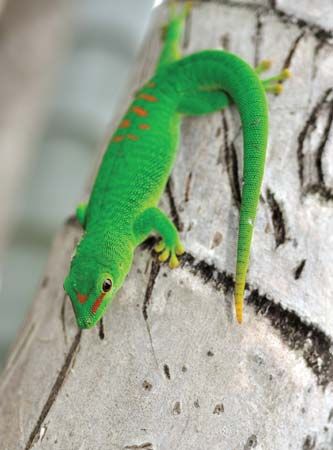
Geckos are primarily nocturnal reptiles that feed mostly on insects. Unlike some other lizard groups that rely on "sit-and-wait" tactics or active foraging…
How do geckos hunt and what types of prey do they typically eat?
Geckos are primarily nocturnal reptiles that feed mostly on insects. Unlike some other lizard groups that rely on “sit-and-wait” tactics or active foraging via vomerolfaction, geckos utilize jaw prehension to capture their prey.12
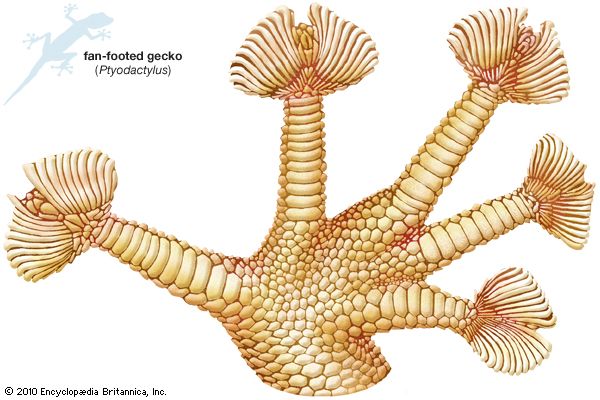
While they hunt, geckos rely on their sense of smell to discriminate between chemical cues in their environment. Their physical adaptations, such as specialized toe pads covered in microscopic, forked hairlike processes, allow them to navigate vertical surfaces and ceilings with ease, providing them with a significant advantage when pursuing or accessing prey in diverse habitats ranging from jungles to human habitations. Because most geckos are active from dusk to dawn, they have evolved vertical pupils that help them navigate and hunt effectively in low-light conditions.21
How do geckos reproduce, and what is unique about their egg-laying process?
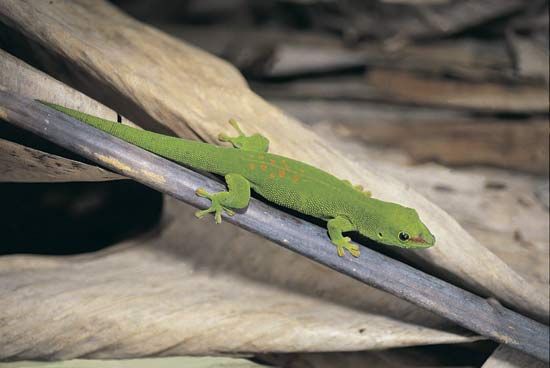
Most geckos reproduce by laying eggs, a process known as oviparity. While most lizard eggs are leathery and porous, allowing them to expand by absorbing moisture during development, gecko eggs are unique because their shells harden shortly after being deposited. Once hardened, these eggs do not change in size or shape.345
Geckos typically have a genetically fixed clutch size of two eggs, with each ovary usually producing one egg per reproductive cycle. These eggs are often white and hard-shelled. Females frequently deposit them in protected areas such as cracks or crevices in rock faces, beneath tree bark, or attached to the underside of leaves. In some cases, multiple females may share a nesting site, resulting in clusters containing dozens of eggs at various stages of development. Some gecko species even produce adhesive eggs that can be attached to vertical surfaces.14
While the vast majority of geckos are egg-layers, there is a notable exception: all species of geckos native to New Zealand give birth to live young (viviparity).34
What role do geckos play in their ecosystems, particularly in pest control?
Geckos play a significant role in their ecosystems primarily as insectivores. Because the vast majority of the more than 1,000 gecko species feed on insects, they act as natural regulators of insect populations within their respective habitats, which range from deserts to jungles.1
This role is particularly noticeable in human habitations, where certain gecko species frequently reside. By consuming insects that may otherwise become pests, these lizards provide a form of natural pest control. Unlike “sit-and-wait” predators that rely on visual cues to ambush prey, geckos utilize jaw prehension to capture their food, often navigating vertical surfaces and ceilings with specialized adhesive toe pads to access prey in diverse environments. Their nocturnal activity, occurring from dusk to dawn, allows them to target insects that are active during those hours, further integrating them into the food web as effective predators.12
What are the different ways geckos can change color, and why do they do it?
The provided search results do not contain information regarding geckos changing their color. While the documents discuss color change mechanisms in other lizards such as chameleons, anoles, and horned lizards, they note that most geckos typically have drab coloration, such as grays, browns, and whites, and do not describe them as having the ability to change color.
Sorry, the Britannica knowledge base does not contain information about geckos changing color.
Sources
- gecko — Encyclopædia Britannica
- lizard - Feeding habits — Encyclopædia Britannica
- lizard - Life cycle — Encyclopædia Britannica
- lizard - Embryonic development and sex determination — Encyclopædia Britannica
- reptile - Embryonic development and parental care — Encyclopædia Britannica
- lizard - Courtship and territoriality — Encyclopædia Britannica
- How Do Chameleons Change Colour? — Encyclopædia Britannica
- lizard - Scales and colour change — Encyclopædia Britannica
- coloration - Short-term changes — Encyclopædia Britannica
- coloration - Optical functions: combination of concealing and advertising coloration — Encyclopædia Britannica
- coloration - Background matching — Encyclopædia Britannica
- coloration - Physiological control — Encyclopædia Britannica
Published on · 3 min read