Norfolk Island Pine
The Norfolk Island pine (Araucaria heterophylla) is an evergreen conifer belonging to the Araucariaceae family. Despite its common name, it is not a true…
What is Norfolk Island pine?
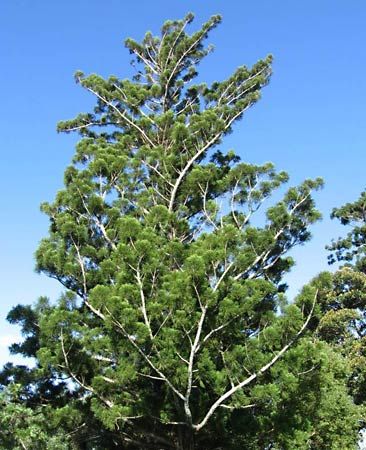
The Norfolk Island pine (Araucaria heterophylla) is an evergreen conifer belonging to the Araucariaceae family. Despite its common name, it is not a true pine.1
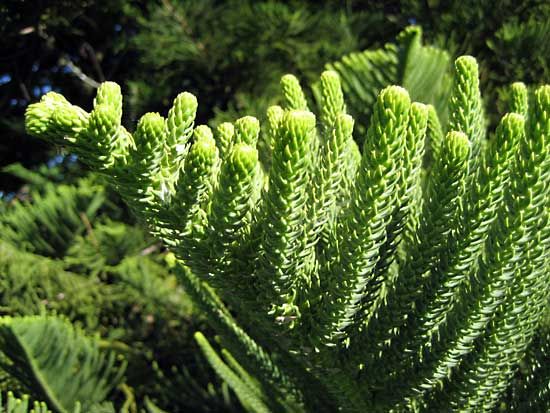
Native to Norfolk Island in the South Pacific Ocean, the tree can reach heights of 60 meters (200 feet) in its natural habitat. It is characterized by a straight trunk and branches arranged in symmetric whorls. Its foliage changes with age: young plants feature needlelike leaves, while mature trees develop scalelike, overlapping leaves.1
Discovered during Capt. James Cook’s second expedition, the tree is valued for its timber in construction and shipbuilding. Today, it is widely cultivated as an outdoor ornamental in Mediterranean climates and as a popular houseplant globally. An unusual biological trait of the species is that lateral branches, if cut and rooted, will grow only horizontally and never form an erect stem.12
Why is this tree not considered a true pine?
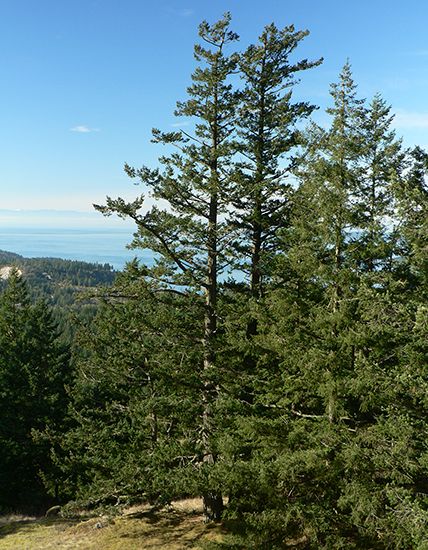
The Norfolk Island pine is not considered a true pine because it belongs to an entirely different botanical family. While true pines are members of the family Pinaceae and the genus Pinus, the Norfolk Island pine (Araucaria heterophylla) belongs to the family Araucariaceae.
Taxonomically, these two groups are distinct:
- True Pines: These belong to the genus Pinus, which includes approximately 115 species native primarily to northern temperate regions.1
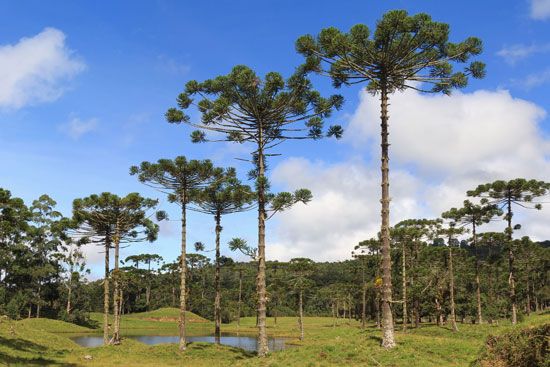
- Norfolk Island Pine: This is a member of the genus Araucaria, a group of about 20 species of pinelike coniferous plants found in the Southern Hemisphere, including regions like Norfolk Island, Australia, and South America.34
Although both are conifers and share some superficial similarities in appearance—such as their evergreen nature and needlelike foliage in early growth stages—they are evolutionarily separate, leading botanists to classify them into different families.314
What are some other types of conifer trees?
Conifers are a diverse group of gymnosperms within the class Pinopsida, comprising seven extant families. While they share common traits such as being woody, typically evergreen, and bearing seeds in cones, they exhibit significant variety in form and habitat.564
Key families and examples of conifer trees include:
- Pinaceae: The largest and most widespread family in the Northern Hemisphere. It includes pines, spruces, firs, larches, hemlocks, and the true cedars (Cedrus).54
- Cupressaceae: A diverse family that includes junipers, redwoods, giant sequoias, bald cypresses, and arborvitae.5
- Araucariaceae: Found primarily in the Southern Hemisphere, this family includes the monkey puzzle tree, bunya pine, and Moreton Bay pine.57
- Podocarpaceae: A large family of nearly 200 species, such as Podocarpus, which often feature yewlike needles or broad, oblong leaves.5
- Taxaceae: Includes the yew, known for its solitary seeds surrounded by a fleshy aril rather than a traditional woody cone.5
- Cephalotaxaceae: Known as plum-yews, these are small, localized trees found in East Asia.5
- Sciadopityaceae: Represented by the umbrella pine, which is endemic to Japan and distinct for its unique whorled foliage.5
How do evergreen trees differ from deciduous trees?
Evergreen and deciduous trees are primarily distinguished by their leaf-retention strategies and adaptations to seasonal changes.
Evergreen Trees
Evergreen plants retain their foliage throughout the year and into the following growing season. Their leaves are typically thicker and more leathery than those of deciduous trees, often appearing needlelike or scalelike in conifers10. These leaves are coated in waxes and resins that protect them from freezing and fracturing in cold climates, allowing them to remain on the tree for two years or longer.1011
Deciduous Trees
Deciduous trees shed their leaves annually, typically in autumn or during a tropical dry season. This process is a protective adaptation; because deciduous leaves are generally thin, they are susceptible to cold temperatures. If these trees retained their leaves in winter, the water within the leaf cells could freeze and expand, rupturing the cells and rendering them useless for photosynthesis. Furthermore, shedding leaves prevents physical damage from wind and the weight of snow accumulation. The shedding is a controlled process involving the formation of an abscission layer that separates the leaf from the twig.1011
While most conifers are evergreen, there are notable exceptions, such as the larch, bald cypress, and dawn redwood, which are deciduous.7
Sources
- Norfolk Island pine — Encyclopædia Britannica
- Norfolk Island pine — Merriam-Webster
- pine — Encyclopædia Britannica
- Araucaria — Encyclopædia Britannica
- conifer - Annotated classification — Encyclopædia Britannica
- conifer — Encyclopædia Britannica
- gymnosperm - Pinophyta — Encyclopædia Britannica
- cedar — Encyclopædia Britannica
- Did you know? — Merriam-Webster
- evergreen — Encyclopædia Britannica
- Why Do Leaves Fall in Autumn? — Encyclopædia Britannica
- Did you know? — Merriam-Webster
Published on · 3 min read