Pinaceae
The Pinaceae family, the largest and most widespread conifer group in the Northern Hemisphere, is primarily distinguished from other conifer families by the…
How do Pinaceae trees differ from other conifer families?
The Pinaceae family, the largest and most widespread conifer group in the Northern Hemisphere, is primarily distinguished from other conifer families by the structure of its seed-bearing cones and reproductive development.1
Key differences include:
- Cone Structure: In Pinaceae, the woody seed-cone scales are fused to the bracts only at their bases, and the scales typically carry two winged seeds. Unlike some other families where scales and bracts are intimately fused or highly modified, Pinaceae bracts are usually hidden by the scales in mature cones.1
- Male Gametophyte Development: Pinaceae pollen grains are unique in their development, undergoing three successive divisions to produce a four-celled grain containing two prothallial cells. Other conifer families vary significantly in this regard; for instance, Cupressaceae and Taxaceae lack prothallial cells entirely, while Araucariaceae can have as many as 40.2
- Leaf Arrangement: While many conifers have diverse leaf forms, Pinaceae leaves are most often needlelike and spirally arranged, occurring either singly or in clusters (fascicles).31
What are the main characteristics of trees in the Pinaceae family?
The Pinaceae family, or pine family, is the largest and most widespread group of conifers in the Northern Hemisphere, comprising 11 genera and approximately 220 species. These trees are essential components of boreal forests and are vital sources of timber, paper pulp, and resins.124
Key Characteristics
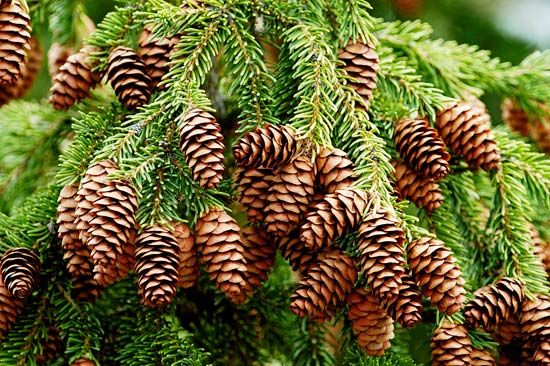
- Reproductive Structures: All members are monoecious, bearing both male and female reproductive structures on the same plant. The male cones are typically clustered and produce pollen grains with two air bladders for wind dispersal. The woody, seed-bearing cones feature spirally arranged scales, each carrying two winged seeds. These scales are fused to the bracts only at their bases.152
- Leaves: The leaves are generally needlelike and arranged spirally, either singly or in bundles (fascicles). They are adapted to minimize water loss, often featuring a thick, waxy coating and sunken stomates.126
- Growth and Ecology: Many species are iconic constituents of specific ecosystems and provide critical habitat for wildlife. Some species are fire-dependent, relying on wildfire to clear the understory and stimulate seed germination.45
What role do Pinaceae trees play in forest ecosystems?
Trees in the Pinaceae family serve as foundational elements of forest ecosystems, particularly within the taiga and other coniferous forests of the Northern Hemisphere, where they often constitute the majority of the living biomass.16
Their roles in these ecosystems include:
- Habitat and Food Provision: Pinaceae trees provide critical habitat for diverse wildlife. Their seeds serve as a vital food source for birds, squirrels, and other animals.1
- Symbiotic Relationships: Many Pinaceae species, such as pines, rely on ectomycorrhizae—a mutualistic association with fungi—to thrive. These fungal networks can connect trees, allowing for the exchange of nutrients and chemical signals between individuals and their seedlings.73
- Ecological Disturbance and Regeneration: Many members of the family are fire-dependent, meaning they rely on wildfire to clear the understory and expose the mineral soil necessary for seed germination. In these environments, the trees have evolved to survive or regenerate after disturbances that would otherwise allow more shade-tolerant species to dominate.86
- Biospheric Contribution: Through photosynthesis, these trees contribute significantly to the global biosphere, helping to regulate atmospheric conditions in the vast regions they dominate.6
How do Pinaceae trees reproduce, and what are their unique reproductive structures?
Members of the Pinaceae family are monoecious, meaning they bear both male and female reproductive structures on the same tree. Their reproduction relies on wind-dispersed pollen, a process that is often inefficient but effective over long distances due to the specialized structure of the pollen grains.11112
Reproductive Structures
- Male Cones (Microstrobili): These are typically small, clustered, and short-lived. Each cone consists of spirally arranged scales, with each scale bearing two pollen sacs. The pollen grains produced are distinctively equipped with two air-filled “wings” or bladders, which facilitate travel via air currents.1111312
- Female Cones (Megastrobili): These are compound, woody structures composed of spirally arranged scales. Each scale is associated with a bract and bears two inverted ovules on its upper surface.11113
The Reproductive Process
During the spring, female cones open slightly to receive pollen. The ovules often exude a pollination droplet that traps wind-borne pollen grains, drawing them into the ovule.1113
A notable characteristic of Pinaceae reproduction is the extended timeline; in many species, such as pines, the process from pollination to seed maturation can span two full growing seasons, with fertilization occurring months after the initial pollination. Once mature, the seeds are often released from the woody cones, sometimes aided by specialized wings that help them disperse through the air.11131
Sources
- Pinaceae — Encyclopædia Britannica
- conifer - Annotated classification — Encyclopædia Britannica
- pine - Physical description and natural history — Encyclopædia Britannica
- conifer - Gametophyte phase — Encyclopædia Britannica
- conifer - Leaves — Encyclopædia Britannica
- pine — Encyclopædia Britannica
- Taiga - Trees — Encyclopædia Britannica
- mycorrhiza — Encyclopædia Britannica
- fungus - Mycorrhiza — Encyclopædia Britannica
- conifer - Sporophyte phase — Encyclopædia Britannica
- pollination - Wind — Encyclopædia Britannica
- plant reproductive system - Gymnosperms — Encyclopædia Britannica
- seed - Dispersal by birds — Encyclopædia Britannica
Published on · 4 min read