Nukunonu
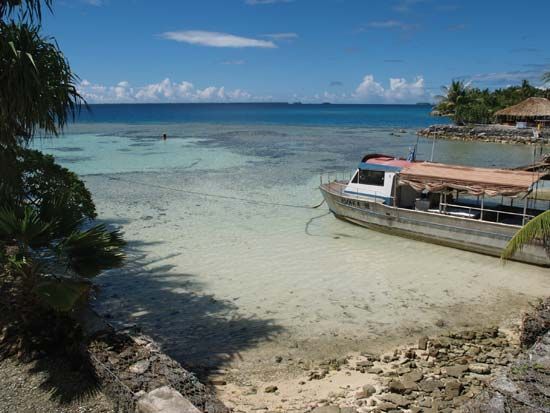
Nukunonu is a coral atoll located in Tokelau, a dependency of New Zealand situated in the South Pacific Ocean.
What is Nukunonu?
Nukunonu is a coral atoll located in Tokelau, a dependency of New Zealand situated in the South Pacific Ocean.1
The atoll consists of 30 islets that surround a lagoon measuring approximately 8 miles by 7 miles. Historically known as Duke of Clarence Island after its 1791 discovery by the captain of the British ship Pandora, the island’s population was converted to Roman Catholicism by a Samoan missionary prior to 1858.1
Life on Nukunonu is characterized by the following:
- Subsistence: Residents rely on coconuts, pandanus, and marine resources, as fresh water is limited.1
- Infrastructure: The lack of a suitable anchorage makes shipping difficult.1
- Governance: Local affairs are managed by a Taupulega (Council of Elders), which includes family heads and two elected representatives.1
Covering an area of 1.8 square miles, the atoll had a recorded population of 287 in 2006.1
What are the other atolls that make up Tokelau?
Tokelau is a territory of New Zealand consisting of three coral atolls arranged in a southeast-to-northwest line in the South Pacific Ocean. In addition to Nukunonu, the other two atolls are:2
- Fakaofo: Covering 1.5 square miles, this atoll consists of 61 islets that encircle a closed lagoon. It was historically known as Bowditch Island.32
- Atafu: The smallest of the three at 1.4 square miles, it comprises 19 islets. It was discovered by John Byron in 1765 and named Duke of York Island.24
Each of these atolls maintains its own administrative center, and local governance is managed by a Taupulega (Council of Elders).2
How does the Taupulega council govern the island?
On each of the three atolls in Tokelau, local governance is managed by the Taupulega, or Council of Elders.3
The composition and function of the Taupulega include:
- Membership: The council is comprised of the heads of family groups on the atoll, alongside two elected officials: the faipule (village leader) and the pulenuku (village mayor).32
- Broader Governance: The three faipule and three pulenuku from the respective atolls collectively form the Tokelau Council, which serves as the territory’s executive body when the General Fono (the national legislative assembly) is not in session.3
Through this structure, the Taupulega ensures that local family leadership remains central to the administration of island affairs while maintaining a link to the broader territorial government.3
What are the main challenges of living on a coral atoll?
Living on a coral atoll presents significant environmental and logistical challenges due to the unique geological and physical nature of these islands.
Key Challenges of Atoll Life
- Limited Freshwater Resources: Atolls lack rivers and streams. Residents rely on a thin, lens-shaped layer of rainwater that permeates the coral and sits above heavier seawater. This requires careful conservation through wells and storage tanks.67
- Fragile Soils: The land on atolls is often limited in both depth and quality, making large-scale agriculture difficult and prone to failure.89
- Geological Instability: Because atolls are low-lying—often only a few meters above sea level—they are physically unstable. They are susceptible to erosion from waves and damage from cyclonic storms, which can reshape or destroy the land.7
- Isolation and Infrastructure: Many atolls are remote, which restricts economic growth and complicates the development of infrastructure. Residents often rely on imported goods, including food and fuel, due to the limited capacity for local production.9
- Environmental Threats: Coral reefs are the foundation of these ecosystems, but they face existential threats from climate change, including rising ocean temperatures and ocean acidification, which can lead to coral bleaching and the loss of vital marine habitats.10
Sources
- Nukunonu — Encyclopædia Britannica
- Fakaofo — Encyclopædia Britannica
- Tokelau — Encyclopædia Britannica
- Atafu — Encyclopædia Britannica
- Tuamotu Archipelago — Encyclopædia Britannica
- Cook Islands - Relief and drainage — Encyclopædia Britannica
- atoll — Encyclopædia Britannica
- Cook Islands - Soils — Encyclopædia Britannica
- Coral bleaching — Encyclopædia Britannica
- lagoon - The effect of time — Encyclopædia Britannica
- coral reef - Tropical water conditions — Encyclopædia Britannica
- Micronesia - Economy — Encyclopædia Britannica
- lagoon - Coral lagoons — Encyclopædia Britannica
- coral island — Encyclopædia Britannica
Published on · 3 min read