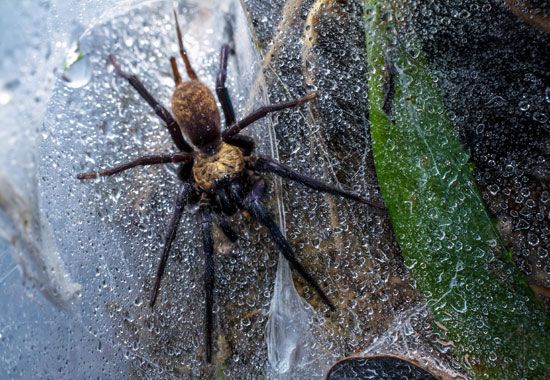
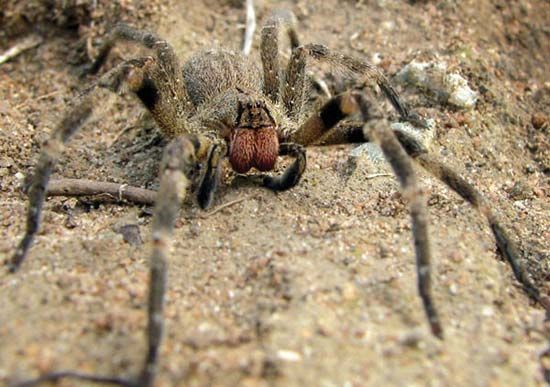
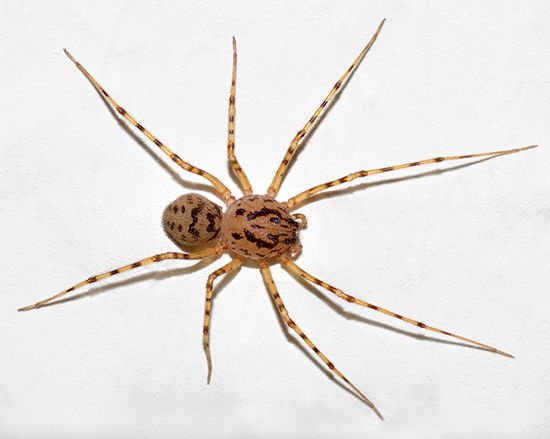
Nursery-web Spider
A nursery-web spider is any member of the family Pisauridae, a group of hunting spiders that do not spin webs to capture their prey. These spiders are found…
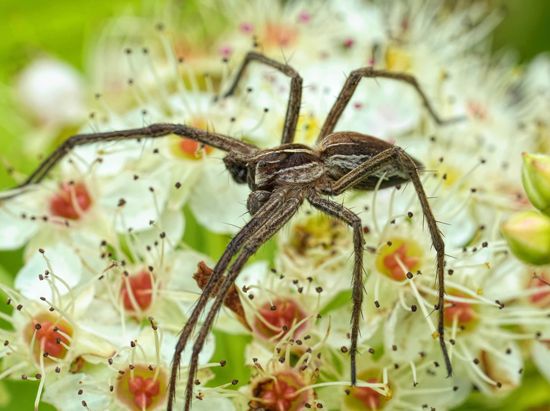
What is nursery-web spider?
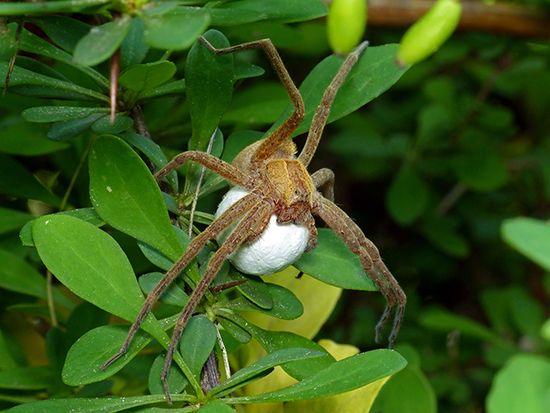
A nursery-web spider is any member of the family Pisauridae, a group of hunting spiders that do not spin webs to capture their prey. These spiders are found nearly worldwide and are often observed near water, where many species can walk on the surface or dive underwater to escape predators.12
They are named for the female’s habit of constructing a protective nursery web for her offspring and standing guard over it. After mating, the female carries her silken egg sac in her mouthparts until the young are ready to emerge; she then attaches the sac to a plant, secures it with leaves and silk, and remains to protect the young.1
During courtship, males may offer the female a “nuptial gift,” such as a fly wrapped in silk, to reduce the risk of sexual cannibalism, as females may consume males after mating. Nursery-web spiders are medium to large in size and are sometimes confused with wolf spiders.1
How do wolf spiders differ from nursery-web spiders?
While nursery-web spiders and wolf spiders are both hunting spiders that do not rely on webs to capture prey, they exhibit distinct maternal behaviors and physical characteristics.
Maternal Care
The most significant difference lies in how they protect their offspring:
- Nursery-web spiders (family Pisauridae): Females carry their silken egg sac in their mouthparts. When the young are ready to emerge, the mother attaches the sac to a plant, constructs a protective “nursery web” around it, and stands guard over the site until the spiderlings are ready to disperse.1
- Wolf spiders (family Lycosidae): Females carry their egg sac attached to their spinnerets, dragging it behind them. Once the eggs hatch, the young spiderlings climb onto the mother’s back, where they remain for several days or weeks until they are capable of independent survival.67
Physical and Behavioral Traits
- Eyesight: Wolf spiders are easily identified by their unique eye arrangement: four small eyes in the bottom row, two very large eyes in the middle, and two medium-sized eyes on top.7
- Habitat: While both can be found near water, wolf spiders are often associated with ground-dwelling behaviors, such as building silk-lined burrows or living under leaf litter and stones.7
What is the purpose of the nuptial gift in spider courtship?
In the context of spider courtship, a nuptial gift serves primarily as a strategy to facilitate successful mating while minimizing the risk of sexual cannibalism, where the female consumes the male.89
For species like the nursery-web spider, the male captures prey—such as a fly—and wraps it in silk to present to the female. By providing this meal, the male occupies the female, allowing him to mate with her while she is distracted by feeding.89
The effectiveness of this gift is critical to the male’s survival and reproductive success:
- Satiation: The gift helps satiate the female’s appetite, reducing the likelihood that she will attack or consume the male during the mating process.9
- Deception: If the male provides a deceptive gift, such as an empty silk package, he typically fails to secure a mating opportunity and faces a higher risk of being attacked and eaten by the female.9
How do some spiders hunt without using webs?
Many spiders have evolved sophisticated hunting strategies that do not rely on building webs to ensnare prey. These hunting spiders typically locate food by searching randomly or by responding to environmental vibrations and visual cues.1
Common Hunting Techniques
- Stalking and Pouncing: Spiders such as wolf spiders and jumping spiders possess keen eyesight. They actively track their prey, stalking it until they are within striking distance before pouncing.1
- Ambush Hunting: Some species, like crab spiders, wait for prey on flowers that match their own coloration. They remain still until an insect lands nearby, at which point they grasp it with their legs and deliver a lethal bite. Wandering spiders are also ambush hunters that roam foliage and the ground to find prey.110
- Active Entanglement: Spitting spiders use a unique method where they touch their prey, back away, and then shoot a zigzag stream of sticky material from their fangs to immobilize the victim before biting it.1
- Specialized Tools: Bolas spiders use a single thread with a sticky droplet at the end, which they swing or throw at passing moths, often using chemical mimicry to attract their targets.1
Sources
- nursery-web spider — Encyclopædia Britannica
- Pisauridae — Merriam-Webster
- spider - Spiderwebs — Encyclopædia Britannica
- spider - Annotated classification — Encyclopædia Britannica
- spider - Importance — Encyclopædia Britannica
- spider - Eggs and egg sacs — Encyclopædia Britannica
- wolf spider — Encyclopædia Britannica
- spider - Courtship — Encyclopædia Britannica
- Why Do Some Animals Eat Their Mates After Sex? — Encyclopædia Britannica
- spider - Stalking prey — Encyclopædia Britannica
- wandering spider — Encyclopædia Britannica
- sound reception - Behavioral evidence — Encyclopædia Britannica
- sound reception - Anatomical evidence — Encyclopædia Britannica
- Reproductive behaviour - Arachnids — Encyclopædia Britannica
Published on · 3 min read