Wandering Spider
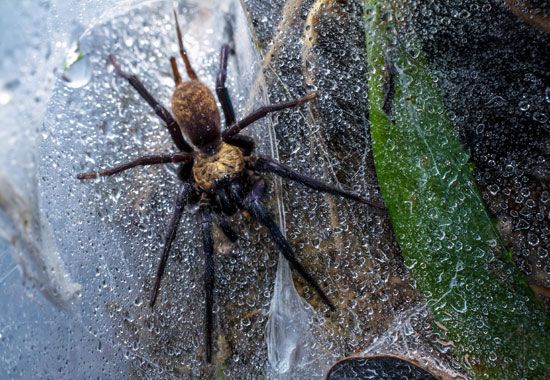
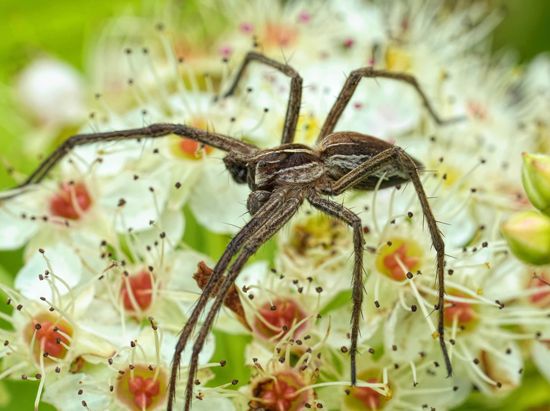
Wandering spiders (family Ctenidae) are large, nocturnal spiders characterized by several distinct physical features:
What are the distinguishing physical characteristics of wandering spiders?
Wandering spiders (family Ctenidae) are large, nocturnal spiders characterized by several distinct physical features:
- Eye Arrangement: They possess eight eyes arranged in three rows. The median eyes form a trapezoid that is wider behind than in front. Within this arrangement, the eyes of the posterior row are the largest, while the anterior lateral eyes are the smallest.12
- Legs: The first two pairs of legs are armed with strong bristles (setae) on the lower side. Additionally, some adult species have only two tarsal claws.12
- Body Patterns: While appearance can vary, some species, such as the tiger wandering spider (Cupiennius salei), exhibit characteristic banding patterns on their upper legs.1
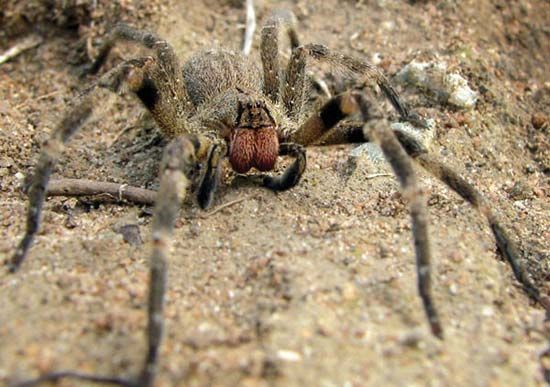
These spiders are ambush hunters that do not construct webs to capture prey, relying instead on their physical agility and, in some species, potent venom. Certain members of the genus Phoneutria are known for an aggressive defense posture where they raise their front legs straight into the air.1
What are some common misconceptions about wandering spiders?
A common misconception regarding wandering spiders is that they are likely to crawl into a person’s mouth while they sleep. In reality, these spiders are highly sensitive to vibrations caused by human breathing and heartbeats, which they find terrifying; consequently, they actively avoid sleeping humans.1
Another frequent point of confusion involves the nickname “banana spider.” While the Brazilian wandering spider is often called a banana spider because it may occasionally stow away in fruit shipments, this name is also applied to several other unrelated species, including huntsman spiders, tarantulas, and golden silk spiders. This can lead to the mistaken belief that all spiders found in banana shipments are the same dangerous species.34
Finally, while some Phoneutria species are venomous and medically significant, deaths from their bites are extremely rare. The fear surrounding these spiders is often exaggerated, as the vast majority of the world’s spider species are not dangerous to humans.56
How venomous are wandering spiders, and what effects does their venom have on humans?
While many wandering spiders are harmless, members of the genus Phoneutria—specifically the Brazilian wandering spiders—are considered among the most venomous spiders in the world. Their venom is highly toxic to the human nervous system, and they are known for an aggressive defense posture where they raise their front legs straight into the air.715
When a human is bitten by a Phoneutria species, the venom can cause several systemic effects, including:
Although these spiders are medically significant and potentially dangerous, it is important to note that fatalities are rare. Furthermore, researchers are currently investigating the venom of P. nigriventer for its potential use in medical treatments, specifically for erectile dysfunction.17
Are there any medical uses or research involving wandering spider venom?
Research into the venom of the Brazilian wandering spider has identified potential medical applications for its unique chemical properties. Specifically, scientists are investigating the venom of P. nigriventer as a possible treatment for erectile dysfunction.1
This research is prompted by the clinical observation that human victims of a Phoneutria bite often experience priapism, a prolonged and painful erection, as a systemic effect of the spider’s neurotoxic venom. By isolating the specific proteins and enzymes within the venom, researchers aim to harness these biological mechanisms for therapeutic use.18
Sources
- wandering spider — Encyclopædia Britannica
- spider - Annotated classification — Encyclopædia Britannica
- banana spider — Merriam-Webster
- spider: Top Questions — Encyclopædia Britannica
- Brazilian wandering spider — Merriam-Webster
- Do We Really Swallow Spiders in Our Sleep? — Encyclopædia Britannica
- 9 of the World’s Deadliest Spiders - Brazilian Wandering Spiders ( Phoneutria fera and P. nigriventer ) — Encyclopædia Britannica
- Venom — Encyclopædia Britannica
Published on · 3 min read