Spitting Spider
A spitting spider (family Scytodidae) is a unique type of spider known for its specialized hunting technique: it ensnares prey by spitting a venomous…
What is spitting spider?
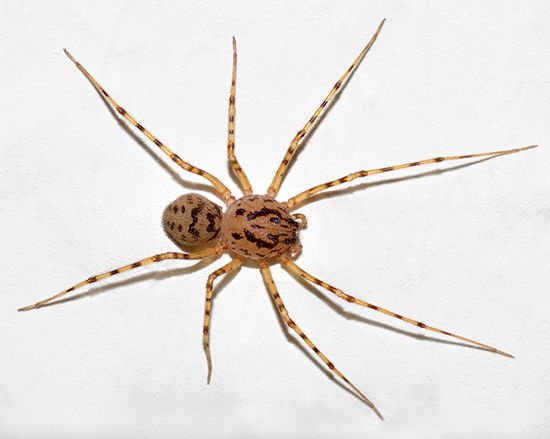
A spitting spider (family Scytodidae) is a unique type of spider known for its specialized hunting technique: it ensnares prey by spitting a venomous, mucilaginous silk.12
Unlike many other spiders, they do not build webs to capture food. Instead, they possess modified venom glands in their cephalothorax that produce this sticky material, which is ejected through pores near the tips of their fangs. When a spitting spider encounters prey, it approaches, backs off, and shoots a zigzag stream of this substance to glue the victim to a surface. Once the prey is immobilized and struggling, the spider moves in to deliver a lethal bite.23
These spiders typically have six eyes rather than the usual eight and feature a high, domed carapace to accommodate their large venom glands. They are most commonly found in shady tropical environments, where they hunt insects and other spiders.13
How do other spiders use silk to capture their prey?
While all spiders produce silk, only about half of all species use it to construct webs for capturing prey. Beyond traditional web-building, spiders employ diverse and specialized strategies to utilize silk:45
- Active Trapping: Orb weavers build intricate, circular nets that act as air filters for weak-flying insects. Other spiders create sheet webs, tangle webs, or funnel webs, which serve as both homes and snares.45
- Active Manipulation: Ogre-faced spiders hold a small, flat web between their front legs and throw it over passing insects. Similarly, bolas spiders swing or throw a single silk thread tipped with a sticky droplet to capture prey, often using chemical mimicry to attract moths.462
- Ambush and Detection: Trap-door spiders line their burrows with silk and use it to create hinged doors, while other tube-dwelling spiders place silk “trip threads” around their retreats to detect vibrations from passing prey.2
- Spitting: Spitting spiders eject a zigzag stream of sticky, venomous silk to glue prey to a surface before moving in to bite.2
We could dive deeper into the evolutionary adaptations that allow spiders to produce different types of silk for these varied tasks.
Why do most spiders have eight eyes while spitting spiders only have six?
While it is common to associate spiders with eight eyes, the number and arrangement of eyes are actually distinguishing features that vary significantly across different spider families. There is no single rule dictating that eight is the standard; rather, evolution has shaped the visual systems of various species to suit their specific ecological niches and hunting strategies.71
Spitting spiders (family Scytodidae) possess six eyes as a characteristic trait of their family. Because these spiders rely on a unique method of immobilizing prey by spitting venomous, mucilaginous silk rather than relying on complex visual tracking or web-based vibration detection, their sensory needs differ from those of other groups.81
In many other spiders, the eight eyes are divided into principal eyes for acute vision and secondary eyes for motion detection or navigation. Since eye arrangement is a family-specific trait, the reduction to six eyes in spitting spiders—or even fewer in other families like the Caponiidae—simply reflects the diverse evolutionary paths spiders have taken to thrive in their environments.917
What are some other unique hunting methods used by different spider species?
Beyond traditional web-building, many spider species have evolved highly specialized hunting strategies to capture prey:
- Active Stalking and Pouncing: Wolf spiders and jumping spiders rely on keen eyesight to locate prey. Jumping spiders stalk their targets, closing the distance before pouncing, while wolf spiders actively roam to chase down insects.210
- Aggressive Mimicry: Bolas spiders use chemical mimicry to release pheromones that attract male moths. They then swing or throw a single, sticky silk thread—the “bola”—to capture the approaching insect.211
- Net-Casting: Ogre-faced spiders (net-casting spiders) hold a small, rectangular web between their legs. When prey passes beneath them, they throw the web over the victim to ensnare it.212
- Spitting: Spitting spiders use modified venom glands to shoot a zigzag stream of sticky, venomous material onto prey, effectively gluing the victim to a surface before they move in to bite.2
- Ambush Tactics: Trap-door spiders construct silk-lined burrows with camouflaged, hinged doors. They wait inside, darting out to grab passing arthropods. Similarly, crab spiders often wait on flowers that match their own color, grasping unsuspecting insects with their legs.213
Sources
- spitting spider — Encyclopædia Britannica
- spider - Stalking prey — Encyclopædia Britannica
- spider - Venom — Encyclopædia Britannica
- spider - Spiderwebs — Encyclopædia Britannica
- Types of Spiderwebs — Encyclopædia Britannica
- bolas spider — Merriam-Webster
- How many eyes does a spider have? — Encyclopædia Britannica
- Photoreception - Corneal eyes — Encyclopædia Britannica
- spider - Nervous system and senses — Encyclopædia Britannica
- trapdoor spider — Encyclopædia Britannica
- bolas spider — Encyclopædia Britannica
- wolf spider — Encyclopædia Britannica
- ogre-faced spider — Encyclopædia Britannica
Published on · 3 min read