Turret Spider
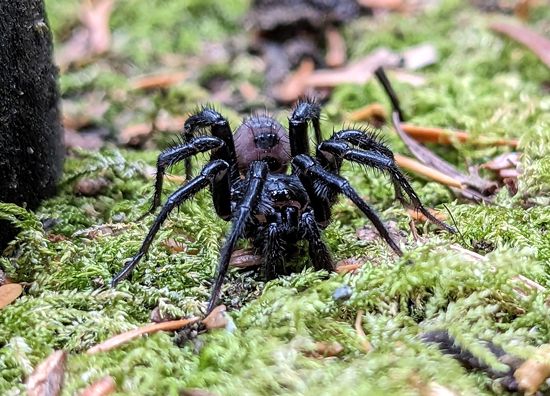
The turret spider (Atypoides riversi) is a species of folding-door spider endemic to the forests of northern and central California. It is a reclusive…
What is turret spider?
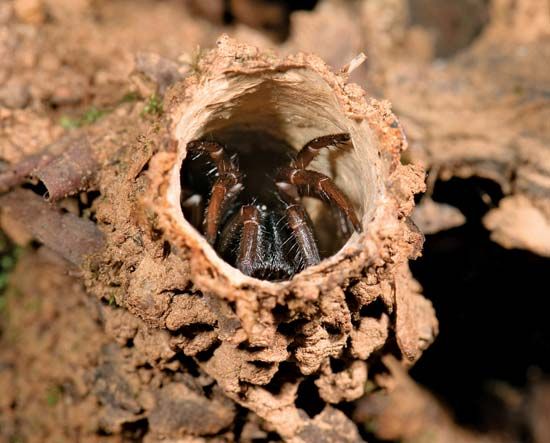
The turret spider (Atypoides riversi) is a species of folding-door spider endemic to the forests of northern and central California3. It is a reclusive arachnid known for constructing a unique, silk-lined burrow that extends above the ground to form a collapsible, camouflaged rim—the “turret” from which it derives its name.12
As a nocturnal ambush predator, the turret spider perches in its turret at night, waiting for insects or other invertebrates to pass by. It uses its large, downward-striking fangs to impale prey before dragging it into the burrow.32
Physically, these spiders reach about 1.8 cm in length and possess a chestnut-brown body with a purplish-brown abdomen. While they are members of the same infraorder as tarantulas and trapdoor spiders, their bite is not considered dangerous to humans. Females are notably long-lived, potentially surviving for more than 15 years.2
How do trapdoor spiders differ from turret spiders?
While turret spiders and trapdoor spiders are both members of the infraorder Mygalomorphae and share similar ambush-predator lifestyles, they are distinguished primarily by their burrow architecture and taxonomic classification.234
Key Differences
- Burrow Entrance: The most notable difference lies in the design of the burrow opening. Trapdoor spiders construct a silken-hinged door that acts as a lid to conceal the burrow. In contrast, turret spiders (a type of folding-door spider) create a silk-lined rim that extends above the ground. They close this entrance by pulling the sides of the flexible rim together, similar to a bifold door.324
- Taxonomy: Trapdoor spiders comprise several families, with the family Ctenizidae being the most well-known. Turret spiders belong to the family Antrodiaetidae.324
- Physical Features: Folding-door spiders, including the turret spider, are characterized by the presence of one to three hard plates, or sclerites, on the upper surface of their abdomen, a feature not typically highlighted as a defining trait for all trapdoor spider families.24
Both spiders are reclusive, nocturnal hunters that use downward-striking fangs to impale prey, and both are generally considered harmless to humans.234
What are the main characteristics of the Mygalomorphae infraorder?
The infraorder Mygalomorphae (formerly known as Orthognatha) consists of a group of spiders that are generally large, long-lived, and primarily inhabit warm climates.8
Key Characteristics
- Fang Orientation: Unlike araneomorph spiders, whose fangs move sideways and together, mygalomorphs possess chelicerae that move forward and down in a vertical, parallel motion.69
- Respiratory System: A defining anatomical feature of this infraorder is the presence of two pairs of book lungs, totaling four, which are used for respiration.689
- Internal Anatomy: Mygalomorphs typically possess a heart with four (rarely three) ostia. Additionally, their nervous system shows a fusion of ganglia from the 13th through the 18th segments.8
- Reproductive Morphology: The reproductive structures are relatively simple compared to other spider groups; males have simple pedipalp bulbs, and females lack an epigynum.8
This infraorder includes well-known groups such as tarantulas, trapdoor spiders, purseweb spiders, and Australian funnel-web spiders. Many species within this group are known for their reclusive nature and their tendency to construct silk-lined burrows or tubes in the ground.1086
How do spiders use silk to build their homes?
Spiders utilize silk—a protein-based substance produced in abdominal glands—to construct a variety of homes and structures. While all spiders produce silk, they use it in diverse ways to create environments for shelter, protection, and hunting.1112
Construction for Shelter
Many spiders, such as trapdoor spiders, use silk primarily to reinforce their homes rather than to catch prey. These spiders dig subterranean burrows and line the walls and the hinged entrance with silk to provide structural integrity and concealment. Similarly, funnel-web spiders construct silk tunnels that serve as both a secure retreat and a snare for prey at the entrance.1312
Construction for Hunting
Web-building spiders use silk to create elaborate traps:
- Orb Webs: Orb weavers construct circular webs by first establishing a bridge of silk, then creating radial spokes, and finally weaving a spiral of sticky, ensnaring silk.1415
- Sheet and Tangle Webs: Other species create flat, dense mats known as sheet webs or irregular, three-dimensional tangle webs that use sticky anchor threads to ensnare insects.1512
The silk is extruded through spinnerets, with different glands producing specialized threads for specific functions, such as frame threads for structural support or sticky silk for trapping prey.11
Sources
- turret spider — Merriam-Webster
- turret spider: Top Questions — Encyclopædia Britannica
- turret spider — Encyclopædia Britannica
- trapdoor spider — Encyclopædia Britannica
- folding-door spider — Encyclopædia Britannica
- list of spiders — Encyclopædia Britannica
- spider - Stalking prey — Encyclopædia Britannica
- tarantula — Encyclopædia Britannica
- spider - Annotated classification — Encyclopædia Britannica
- Mygalomorphae — Merriam-Webster
- spider - Silk — Encyclopædia Britannica
- How do spiders make circular webs? — Encyclopædia Britannica
- trapdoor spider — Merriam-Webster
- spider - Spiderwebs — Encyclopædia Britannica
- Types of Spiderwebs — Encyclopædia Britannica
Published on · 3 min read