Submarine Fracture Zone
A submarine fracture zone is a long, narrow, and mountainous lineation that significantly shapes ocean floor topography. These features generally separate…
How do submarine fracture zones affect ocean floor topography?
A submarine fracture zone is a long, narrow, and mountainous lineation that significantly shapes ocean floor topography. These features generally separate ocean-floor ridges that differ in depth by as much as 1.5 km.1
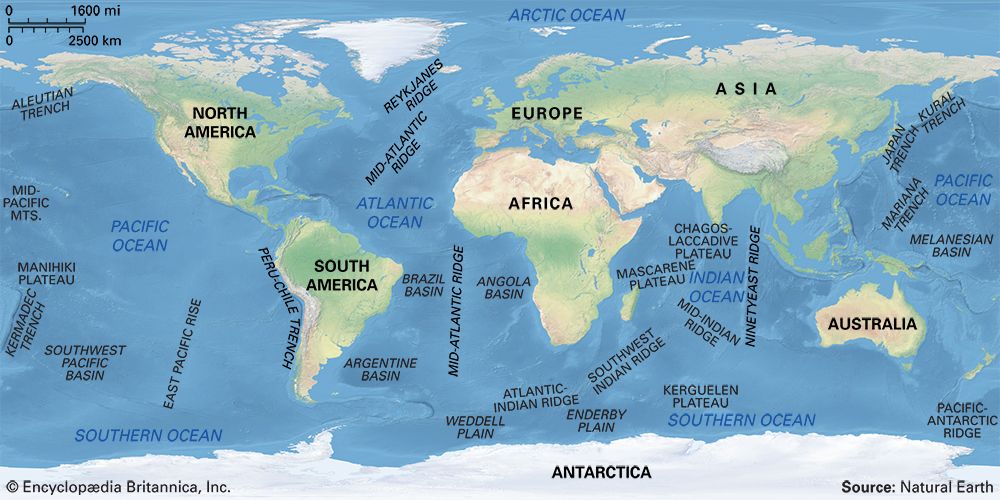
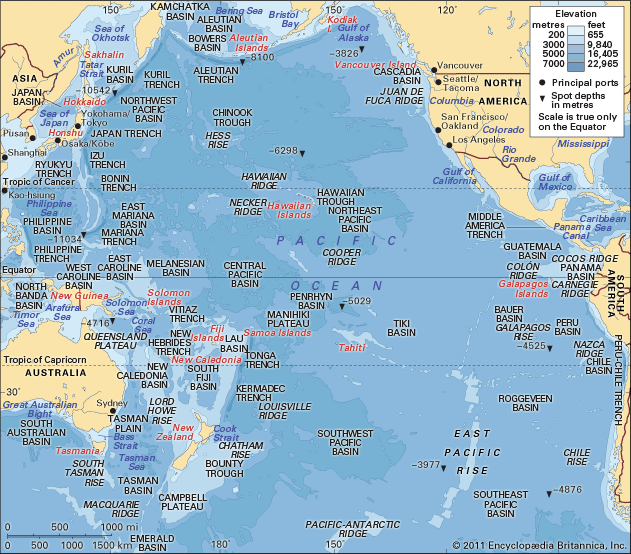
The largest fracture zones, such as those in the Pacific Ocean, can extend for thousands of kilometers and reach widths of 100 to 200 km. They are characterized by complex systems of ridges and intervening troughs, often possessing several kilometers of vertical relief.1
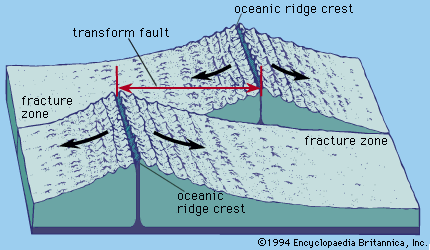
According to the theory of plate tectonics, these zones are intimately linked to seafloor spreading. While the segments of a fracture zone located between offset ridge axes function as active transform faults where tectonic plates slide past one another, the remaining portions are considered inactive “scars” on the ocean floor. These inactive segments do not experience seismic activity, as the seafloor on both sides moves as part of a single, unified lithospheric plate.12
How do submarine fracture zones influence ocean currents and marine life?
Sorry, the Britannica knowledge base does not contain information regarding how submarine fracture zones influence ocean currents or marine life. The provided search results focus exclusively on the geological formation, tectonic mechanisms, and physical topography of these features.
What role do submarine fracture zones play in marine geology and oceanography?
Submarine fracture zones are long, narrow, and mountainous lineations that serve as critical features in marine geology. They are characterized by complex systems of ridges and troughs, often exhibiting significant vertical relief and separating ocean-floor segments that can differ in depth by as much as 1.5 km.14
In the context of plate tectonics, these zones are essential to the mechanism of seafloor spreading. Where a fracture zone intersects an active ridge axis, it functions as a transform fault, acting as a boundary between plates moving in opposite directions. This activity explains the seismic occurrences found at these specific intersections. Conversely, the segments of a fracture zone extending beyond these active ridges are considered inactive “scars” on the lithosphere, where the seafloor on both sides moves as a unified plate, resulting in an absence of seismic or volcanic activity.14
Furthermore, these zones provide a record of geological history. They often display offset magnetic stripes—mirror-image patterns of magnetic intensity—that allow scientists to reconstruct past plate movements and age differences in the oceanic crust.14
How do submarine fracture zones relate to plate tectonics and seafloor spreading?
Submarine fracture zones are essential features for understanding plate tectonics and the mechanics of seafloor spreading. These long, mountainous lineations serve as structural boundaries that accommodate the movement of rigid lithospheric plates.12
Relationship to Seafloor Spreading
According to the theory of seafloor spreading, new oceanic crust is continuously created at oceanic ridges as volcanic material rises from the mantle. As this material cools, it becomes magnetized, recording the Earth’s magnetic field at that time. Fracture zones often intersect these spreading centers, creating offsets in the ridge crests and the resulting marine magnetic anomalies. By mapping these displaced magnetic stripes, scientists can reconstruct the history of plate movements and calculate spreading rates.14
Transform Faults vs. Inactive Scars
The role of a fracture zone depends on its location relative to active spreading centers:
- Ridge–Ridge Transform Faults: Where a fracture zone connects two offset spreading centers, it acts as a seismically active fault boundary. Here, tectonic plates slide past one another in opposite directions.12
- Inactive Fracture Zones: Beyond the active ridge segments, the fracture zone becomes an inactive “scar” on the seafloor. Because the crust on both sides of these segments moves as part of a single, unified plate, there is no differential motion, seismic activity, or volcanism.128
Sources
- submarine fracture zone — Encyclopædia Britannica
- transform fault — Encyclopædia Britannica
- Indian Ocean - Oceanic ridges and fracture zones — Encyclopædia Britannica
- Murray Fracture Zone — Encyclopædia Britannica
- ocean basin - General features — Encyclopædia Britannica
- submarine gap — Encyclopædia Britannica
- ocean current - Pressure gradients — Encyclopædia Britannica
- oceanic crust - Marine magnetic anomalies — Encyclopædia Britannica
Published on · 3 min read