Palaeospondylus
Palaeospondylus is a genus of enigmatic, fishlike fossil vertebrates dating to the Middle Devonian epoch (approximately 398 to 385 million years ago). Found…
What is Palaeospondylus?
Palaeospondylus is a genus of enigmatic, fishlike fossil vertebrates dating to the Middle Devonian epoch (approximately 398 to 385 million years ago). Found primarily in the Old Red Sandstone of Scotland, these small creatures measured about 5 cm (2 inches) in length.12
Unlike many contemporary placoderms, Palaeospondylus lacked dermal armor and possessed a well-ossified skeleton and a developed caudal fin. Despite the discovery of hundreds of specimens, its evolutionary classification remains a subject of significant scientific debate. While historically associated with the placoderms, researchers have also proposed links to agnathans, acanthodians, sharks, lungfishes, and even amphibians. Currently, its precise relationship to other vertebrate groups is considered completely unknown.123
What are placoderms and why were they significant?
Placoderms were a group of primitive, extinct jawed fishes that flourished during the Devonian Period (approximately 416 to 359 million years ago). Their name, meaning “plate skin,” refers to the heavy bony armor that covered their heads and trunks, often connected by a joint in the neck.43
They were significant primarily for being among the earliest vertebrates to evolve jaws, a major evolutionary advancement that allowed them to occupy diverse ecological niches. While many were small bottom-dwellers, some, such as the genus Dunkleosteus, grew up to 10 meters (33 feet) long and served as the dominant predators of their time.34
Despite their success, their highly specialized jaw structures and armor were not ancestral to modern bony fishes, and they largely went extinct by the end of the Devonian as other, more adaptable fish groups emerged. Their exact evolutionary relationship to modern sharks and bony fishes remains a subject of scientific uncertainty.43
What does the term ‘Devonian’ mean in geological history?
The Devonian Period is a major interval in geological history spanning from approximately 419.2 million to 359 million years ago. Often referred to as the “Age of Fishes,” the period is defined by the remarkable evolutionary radiation and diversification of primitive fish in both marine and freshwater environments.56
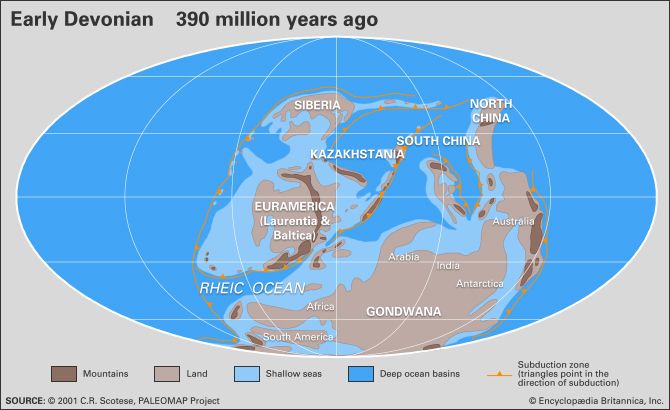
Geologically, the period was marked by the formation of the supercontinent Laurussia (or Euramerica) through the collision of Laurentia and Baltica, an event associated with the Caledonian orogeny. Much of the globe was covered by shallow seas, though the period also saw the development of extensive nonmarine sedimentation, such as the Old Red Sandstone.75
Biological milestones during this time include the emergence of the first ammonites, the rise of vascular plants and the first forests, and the transition of vertebrates onto land with the appearance of the first four-legged tetrapods. The period also experienced significant extinction events, particularly among marine species, linked to fluctuations in sea levels and oxygen depletion in the oceans.567
Why is it difficult for scientists to classify ancient fossils?
Classifying ancient fossils is inherently challenging because the fossil record is often incomplete, and the process of classification itself can be subjective. Several key factors contribute to these difficulties:89
- Incomplete Data: Only a small fraction of ancient organisms are preserved, and preservation typically favors those with hard, resistant skeletons. Soft tissues are rarely fossilized, leaving scientists with limited morphological data to determine evolutionary relationships.910
- Convergence and Parallelism: Similarities in form can arise independently in unrelated lineages due to similar environmental pressures, a phenomenon known as convergence. Without a complete fossil record, it is often difficult to distinguish between these superficial resemblances and true homologies inherited from a common ancestor.111210
- Arbitrary Categorization: When fossils occur in time series, taxonomists must decide where to draw boundaries between ancestral and descendant groups. These “phyletic splits” can be arbitrary and may obscure evolutionary relationships.8
- Lack of Genetic Information: Unlike living organisms, fossils cannot provide genotype data. Scientists must rely on anatomical characters, which are subject to debate regarding their relative importance (weighting) in indicating lines of descent.812
- Taphonomic Processes: The processes of burial, decay, and preservation—collectively known as taphonomy—can alter or destroy evidence, further complicating the reconstruction of an organism’s true biological affinities.1310
Sources
- Palaeospondylus — Encyclopædia Britannica
- Palaeospondylus — Merriam-Webster
- fish - Placodermi: plate-skin fishes — Encyclopædia Britannica
- placoderm — Encyclopædia Britannica
- A Journey Through Time Since the Precambrian - Devonian Period: 419.2 million to about 359 million years ago — Encyclopædia Britannica
- Devonian Period - Significant geologic events — Encyclopædia Britannica
- Devonian Period - Devonian life — Encyclopædia Britannica
- taxonomy - Making a classification — Encyclopædia Britannica
- phylogeny - Evidence for specific phylogenies — Encyclopædia Britannica
- taxonomy - Evaluating taxonomic characters — Encyclopædia Britannica
- fossil — Encyclopædia Britannica
- taphonomy — Merriam-Webster
- bivalve - Critical appraisal — Encyclopædia Britannica
Published on · 3 min read