Olingo
The provided information does not contain details regarding the conservation status of olingo species or specific protection efforts currently in place.…
Are there any conservation concerns for olingo species, and if so, what efforts are being made to protect them?
The provided information does not contain details regarding the conservation status of olingo species or specific protection efforts currently in place. While olingos are recognized as small arboreal carnivores within the Procyonidae family, scientific knowledge about their habits and population trends remains limited.1
How does the olingo differ from other members of the raccoon family?
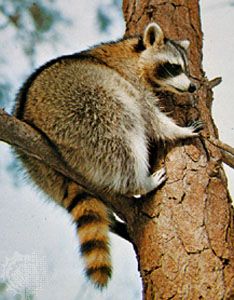
Olingos (genus Bassaricyon) are distinct members of the Procyonidae family, characterized by their slender bodies, grayish-brown fur, and pointed muzzles. While they share the family’s general traits—such as being tree-climbing mammals with rounded ears and plantigrade locomotion—they differ from other procyonids in several key ways:1
- Physical Build: Olingos are less stocky than kinkajous and possess narrower snouts.1
- Tail Characteristics: Unlike the kinkajou, which has a prehensile tail, the olingo has a nonprehensile, bushy, and faintly ringed tail.1
- Diet and Behavior: While many procyonids are opportunistic omnivores, olingos feed primarily on fruit. Unlike the social coatis or the family-oriented raccoons, olingos are nocturnal and often travel in small groups.12
- Habitat: Olingos are strictly arboreal residents of tropical forests in Central and northern South America, whereas other procyonids occupy a wider variety of environments, including urban areas.12
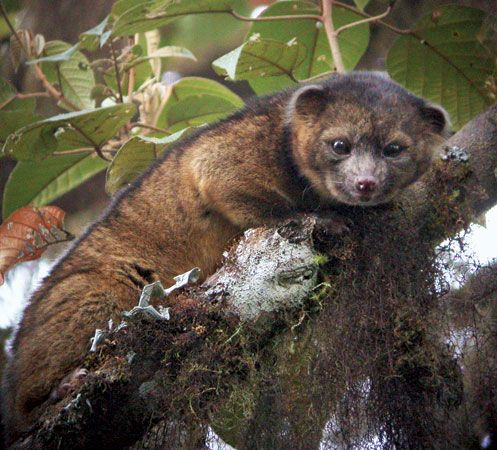
Within the genus, the olinguito is unique for its reddish-brown fur and its specialized habitat in high-altitude cloud forests.1
What are the physical characteristics and size of an olingo?
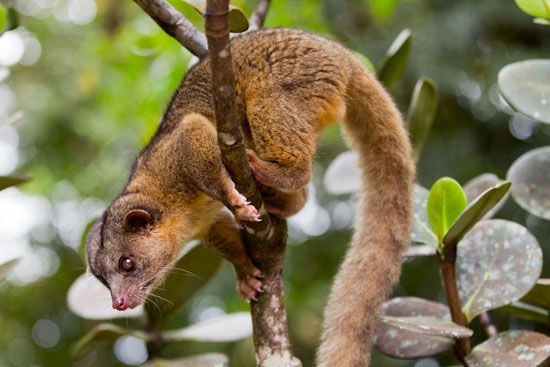
Olingos (genus Bassaricyon) are small, slender carnivores belonging to the raccoon family, Procyonidae.1
Their physical characteristics include:
- Body: They have a slender build with soft, grayish-brown fur.1
- Head: They feature pointed muzzles and rounded ears, giving them a narrower snout compared to the kinkajou.1
- Tail: They possess a bushy, nonprehensile tail that is faintly ringed.1
In terms of size, the body of an olingo measures between 35 and 50 cm (14 to 20 inches) in length. Their tail is significant in size, adding an additional 40 to 50 cm to their total length.1
While most olingos share these traits, the olinguito is distinguished by its reddish-brown, longer fur and its specialized adaptation to high-altitude cloud forests.1
What is an olingo and where can it be found in the wild?
An olingo (genus Bassaricyon) is any of six species of small, arboreal carnivores belonging to the raccoon family, Procyonidae. These nocturnal mammals are characterized by their slender bodies, soft grayish-brown fur, pointed muzzles, and rounded ears. They are distinguished from the related kinkajou by their narrower snouts and their long, bushy, nonprehensile tails, which are faintly ringed.14
In the wild, olingos are found in the jungles of Central and northern South America. While most species inhabit lower altitudes, the olinguito—a species described in 2013—is uniquely adapted to the high-altitude cloud forests of Colombia and Ecuador, living at elevations between 1,530 and 2,740 meters. Olingos are primarily fruit-eaters, though their diet may also include nectar, flowers, insects, and small animals.14
Sources
- olingo — Encyclopædia Britannica
- procyonid — Encyclopædia Britannica
- Bassariscus — Merriam-Webster
- olingo — Merriam-Webster
Published on · 3 min read