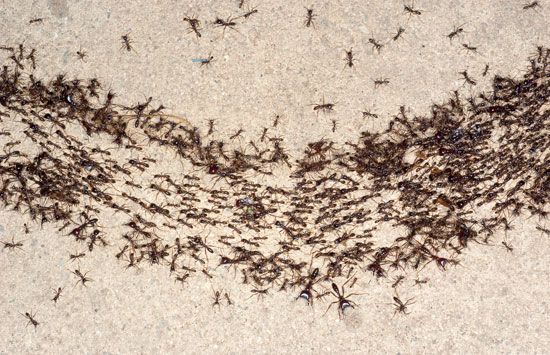
Carnivore
In an ecosystem, carnivores occupy higher trophic levels within the trophic pyramid, which represents the flow of energy through a community.
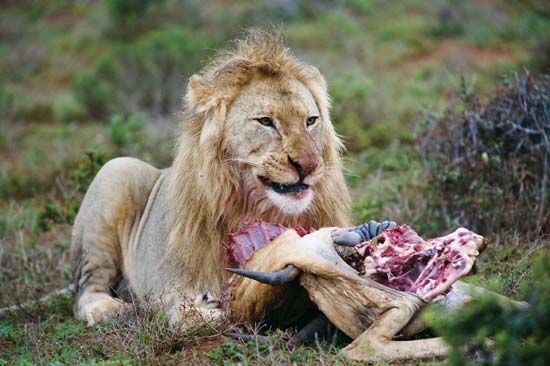
How do carnivores fit into the concept of trophic levels?
In an ecosystem, carnivores occupy higher trophic levels within the trophic pyramid, which represents the flow of energy through a community.12
Carnivores are classified based on their position in the food chain:
- Secondary consumers: These are primary carnivores that feed on herbivores and detritivores.342
- Tertiary consumers: These are often large carnivores or apex predators that prey on secondary consumers.42
These categories are not strictly rigid. Many organisms, including omnivores, may feed at multiple trophic levels depending on their diet. Because energy is lost as heat at each step of the food chain, carnivores at the top of the pyramid have the least amount of available energy compared to producers and primary consumers. By regulating prey populations, carnivores play a vital role in maintaining the stability and “balance of nature” within their ecosystems.34215
What is the definition of a carnivore in the food chain?
In the context of a food chain, a carnivore is defined as an animal whose diet consists of other animals. Within an ecosystem, these organisms are classified by their trophic level, which represents their position in the flow of energy:146
- Primary carnivores (secondary consumers) occupy the third trophic level and feed on herbivores.46
- Secondary carnivores (tertiary consumers) occupy the fourth trophic level and typically prey on primary carnivores.46
These classifications are not strictly rigid. Many organisms, such as omnivores, may consume both plant and animal matter, allowing them to feed at multiple trophic levels. Additionally, while the term is most commonly associated with animals, certain plants are also considered carnivorous because they have evolved specialized mechanisms to trap and consume prey.461
How have some carnivores evolved to become apex predators?
Carnivores have evolved into apex predators—animals at the top of the food chain with no natural enemies—through specialized physical and behavioral adaptations that enhance their hunting efficiency and survival.
Key evolutionary developments include:
- Dental Specializations: Highly carnivorous species have evolved specialized teeth, such as carnassials, which function like scissors to shear meat and cut tough sinews. Their canines are typically large and pointed, adapted for stabbing prey, while their overall tooth count is often reduced to favor these shearing functions.
- Skeletal Flexibility: Many carnivores possess reduced or absent clavicles, which increases shoulder flexibility and prevents bone breakage when the animal springs onto prey. Additionally, their jaw hinges are designed for vertical movement, providing the strength necessary to secure and consume prey.
- Digestive Efficiency: Because animal tissue is easier to digest than plant matter, these predators have evolved simpler, less-compartmentalized stomachs and shorter intestines compared to herbivores.
- Cognitive and Behavioral Traits: Apex predators often possess large, complex brains, supporting the intelligence required for sophisticated hunting strategies. Many also act as keystone species, maintaining ecosystem biodiversity by controlling prey populations and influencing the behavior of smaller predators.
We could dive deeper into how specific apex predators, such as wolves or killer whales, utilize these traits in their unique environments.
How have carnivores adapted to their role as predators?
Carnivores have evolved a suite of specialized physical and behavioral adaptations that facilitate the pursuit, capture, and consumption of prey. These adaptations vary across species but generally focus on enhancing hunting efficiency and digestive performance.1112
Physical Adaptations
- Dental Specializations: Many carnivores possess carnassials—specialized shearing teeth—that function like scissors to slice meat and cut tough sinews. Strong, pointed canines are adapted for stabbing and grasping prey, while the overall tooth structure is often optimized for a meat-based diet.8
- Skeletal Structure: To support hunting, many carnivores have evolved jaw hinges that allow for powerful vertical movement. Additionally, the reduction or absence of clavicles increases shoulder flexibility, which helps prevent bone breakage when an animal springs onto its prey.8
- Digestive Efficiency: Because animal tissue is simpler to digest than plant matter, carnivores typically have a less complex, single-chambered stomach and a shorter, less folded intestine compared to herbivores.8
- Sensory Capabilities: Predators rely on highly developed senses to locate food. This includes acute vision in raptors, sensitive hearing in owls, and echolocation in bats. Many also utilize chemical cues to identify and accept prey.1213
Behavioral Adaptations
- Hunting Strategies: Carnivores exhibit diverse hunting behaviors, ranging from solitary stalking to cooperative group hunting, such as the pack tactics used by wolves or the coordinated driving of fish by pelicans of fish by pelicans.812
- Intelligence: A large brain-to-body ratio supports the learning ability required to adapt to various hunting situations. This cognitive capacity allows for sophisticated strategies and the ability to be trained for specific tasks.10
- Specialized Tools: Beyond physical anatomy, some predators use external methods to immobilize prey, such as the venom used by spiders and certain snakes, or the silk threads used by spiders to wrap victims.1114
Sources
- trophic level — Encyclopædia Britannica
- community ecology - Autotrophs and heterotrophs — Encyclopædia Britannica
- carnivore - Importance of Carnivora — Encyclopædia Britannica
- food web — Encyclopædia Britannica
- trophic pyramid — Encyclopædia Britannica
- carnivore — Merriam-Webster
- carnivores — Merriam-Webster
- carnivore — Encyclopædia Britannica
- predator — Merriam-Webster
- apex predator — Encyclopædia Britannica
- carnivore - Form and function — Encyclopædia Britannica
- carnivore - Behaviour — Encyclopædia Britannica
- arthropod - Digestive system and feeding — Encyclopædia Britannica
- apex predator — Merriam-Webster
- Predation — Encyclopædia Britannica
- Chemoreception - Finding and recognizing food — Encyclopædia Britannica
Published on · 4 min read