Osage Orange
The Osage orange (Maclura pomifera) was historically significant to the Osage and other Native American tribes primarily due to the properties of its wood.…
How did Native American tribes, particularly the Osage, use this tree historically?
The Osage orange (Maclura pomifera) was historically significant to the Osage and other Native American tribes primarily due to the properties of its wood. Because the tree produces a very hard, durable yellow-orange timber, these tribes utilized it to craft high-quality bows and war clubs.1
Beyond its use in weaponry, the wood of the tree was also valued for its ability to yield a yellow dye. While the tree is known today for its ornamental use as a hedge or windbreak, its historical utility as a source of strong, flexible material made it a vital resource for indigenous groups in the south-central United States.1
What are the unique physical characteristics of the Osage orange tree?
The Osage orange (Maclura pomifera) is a distinctive, thorny tree or shrub belonging to the Moraceae family. Its physical characteristics include:
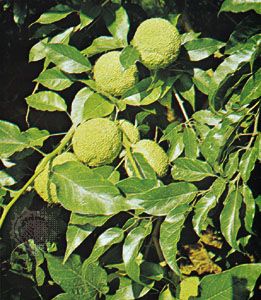
- Foliage: It features simple, shiny, oval-shaped leaves arranged alternately along its stems.12
- Wood: The tree is noted for its exceptionally hard, bright yellow-orange wood.12
- Fruit: The female plants produce a large, yellow-green, wrinkled, and spherical fruit that can exceed 13 cm (5 inches) in diameter. This fruit contains a milky sap that may cause dermatitis in humans.1
- Growth Habit: It is often characterized by its thorny branches, which allow it to be trained into dense, spiny hedges or effective windbreaks.12
- Reproduction: The species is dioecious, meaning individual plants bear either male or female flowers exclusively.1
What are the modern uses and applications of Osage orange wood?
Modern applications of Osage orange wood primarily leverage its exceptional hardness and durability. While historically prized by Native American tribes for crafting weaponry, the wood remains valued today for functional outdoor uses, including the production of railway ties and fence posts.1
Additionally, the wood is still recognized for its historical association with archery, often referred to as bowwood due to its suitability for constructing high-quality archery bows. Beyond its structural applications, the wood continues to be a source of yellow dye.31
What are some interesting folklore or legends associated with the Osage orange tree?
Sorry, the Britannica knowledge base does not contain information regarding folklore or legends associated with the Osage orange tree.
Sources
- Osage orange — Encyclopædia Britannica
- Osage orange — Merriam-Webster
- bowwood — Merriam-Webster
Published on · 2 min read