Osmundaceae
The Osmundaceae family, often called the royal fern family, possesses sporangia that are considered intermediate between primitive eusporangia and advanced…
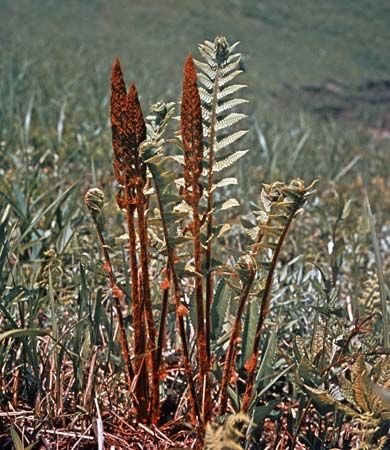
What is the structure of Osmundaceae sporangia, and how does it differ from other fern families?
The Osmundaceae family, often called the royal fern family, possesses sporangia that are considered intermediate between primitive eusporangia and advanced leptosporangia.1
Structure and Characteristics
Unlike typical leptosporangiate ferns, which have thin-walled, stalked sporangia arising from a single cell, Osmundaceae sporangia exhibit features of both types. They are generally larger than typical leptosporangia and lack the specialized, single-row annulus (a ring of thickened cells) used by many other ferns to catapult spores into the air. Instead, they feature a group of thickened cells that facilitate opening, though they lack the sophisticated mechanical discharge mechanism found in more advanced families.1
Differences from Other Ferns
- Indusium: A primary distinction is that Osmundaceae sori (clusters of sporangia) lack an indusium, the membranous covering found in many other fern families.23
- Development: While most ferns in the class Polypodiopsida possess typical leptosporangia, the Osmundaceae retain these intermediate, primitive characteristics.1
- Disposition: The arrangement of sporangia varies by genus; for example, Osmunda bears them on specialized fertile pinnae, whereas Todea and Leptopteris bear them on the backs of ordinary green pinnae.2
How ancient is the Osmundaceae family, and what is their evolutionary significance?
The Osmundaceae family is an ancient group of ferns with a fossil record extending back to the Late Permian Period, approximately 260 million to 251 million years ago. Early members of the family, such as Thamnopteris and Zalesskya, represent some of the earliest known ancestors of modern ferns.1
Evolutionary Significance
The evolutionary importance of the Osmundaceae lies in their status as a primitive, long-standing lineage. They are often considered “living fossils” because some extant species have remained nearly identical to their ancient ancestors for millions of years; for example, fossils of the interrupted fern (Osmunda claytoniana) dating back 200 million years are remarkably similar to modern versions.6
The family serves as a critical link in understanding fern evolution, as they possess sporangia that are intermediate between primitive eusporangia and more advanced leptosporangia. While many modern fern families did not undergo significant diversification until the Cretaceous Period, the Osmundaceae were already well established by the Triassic Period, providing a window into the early development of modern fern lineages.17
What are some common species of Osmundaceae, and where are they typically found?
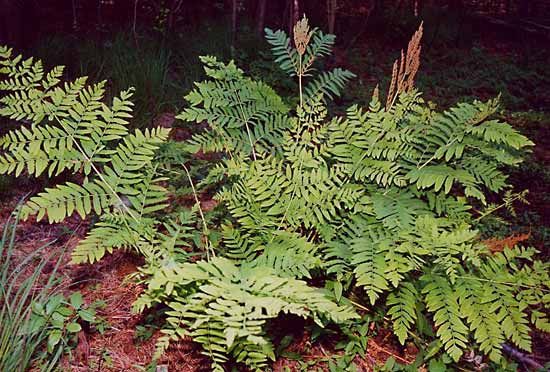
The Osmundaceae family, commonly known as the royal fern family, consists of three primary genera, each with distinct species and geographic distributions. These ferns are typically found in wet environments, ranging from temperate regions like Canada and Europe to various tropical locations.18
Common Genera and Species
- Osmunda: This genus includes approximately 12 species, such as the royal fern (O. regalis), cinnamon fern (O. cinnamomea), and interrupted fern (O. claytoniana). They are widely distributed and often utilized as garden ornamentals.18
- Todea: Represented by two species, T. barbara is found in Africa, Australia, and New Zealand, while T. papuana is native to New Guinea.1
- Leptopteris: This genus comprises six species characterized by thin, filmy leaves. They are primarily distributed across New Guinea, Polynesia, and New Zealand.1
These ferns are highly valued not only for their aesthetic appeal in greenhouses and gardens but also for their fibrous roots, known as osmundine, which serve as a vital growing medium for epiphytic orchids.18
How are Osmundaceae ferns used by humans, either for practical or ornamental purposes?
The Osmundaceae family, often referred to as the royal fern family, provides both practical and aesthetic value to humans.
Practical Uses
The most significant economic application of these ferns involves their root systems. The matted, fibrous roots and rhizomes of Osmunda species are harvested to produce a material known as osmundine, Osmunda fiber, or orchid peat. This material is highly valued by horticulturists as a specialized growing medium for epiphytic orchids, as it provides the necessary drainage and aeration required for these plants to thrive.8110
Ornamental Uses
Beyond their utility in cultivation, several species within the family are popular for their visual appeal. The royal fern (O. regalis), cinnamon fern, and interrupted fern are frequently cultivated as garden ornamentals and greenhouse plants due to their large, elegant fronds and historical significance as “living fossils”.81
Sources
- Osmundaceae — Encyclopædia Britannica
- plant - Subclass Polypodiidae — Encyclopædia Britannica
- fern - The sporangium — Encyclopædia Britannica
- fern - The sorus — Encyclopædia Britannica
- plant development - Preparatory events — Encyclopædia Britannica
- fern - Fossil record — Encyclopædia Britannica
- Osmundaceae — Merriam-Webster
- Osmunda — Encyclopædia Britannica
- royal fern — Merriam-Webster
- osmundine — Merriam-Webster
Published on · 3 min read