Oviraptor
The name Oviraptor is derived from New Latin, combining the prefix ovi- (from the Latin term for "egg") and the word raptor (meaning "plunderer" or "robber").
How did the name ‘Oviraptor’ originate, and what does it mean?
The name Oviraptor is derived from New Latin, combining the prefix ovi- (from the Latin term for “egg”) and the word raptor (meaning “plunderer” or “robber”).12
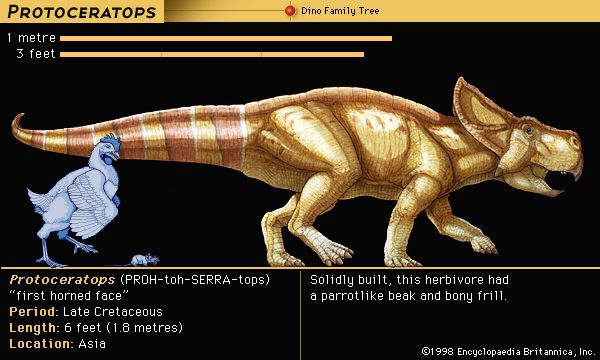
This name was assigned in 1924 because the first fossilized remains of the dinosaur were discovered alongside a clutch of eggs. At the time, paleontologists presumed these eggs belonged to Protoceratops, an early horned dinosaur, leading to the conclusion that the Oviraptor was an “egg stealer”.123
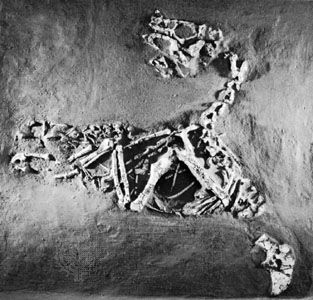
However, this interpretation was later proven incorrect. Microscopic analysis of the eggshells revealed they were not from a ceratopsian but were actually from a theropod. Subsequent discoveries of Oviraptor skeletons found in a brooding position atop their nests—similar to the behavior of modern birds—demonstrated that these dinosaurs were likely caring for their own young rather than raiding the nests of others.13
What is the significance of Oviraptor in the study of dinosaur behavior and evolution?
The Oviraptor is a significant figure in paleontology because it serves as a key piece of evidence for the evolutionary link between nonavian dinosaurs and modern birds. Its discovery and subsequent reinterpretation have fundamentally shifted our understanding of dinosaurian behavior and reproductive strategies.145
Insights into Dinosaur Behavior
The Oviraptor was initially mischaracterized as an “egg thief” because its fossils were found near eggs originally attributed to the horned dinosaur Protoceratops. However, later discoveries of Oviraptor skeletons found in a brooding position—crouched directly over their nests—proved that these dinosaurs were actually caring for their own offspring. This behavior is remarkably similar to that of living birds, providing strong evidence that complex parental care and nesting habits were established in theropod dinosaurs long before the emergence of modern avian species.15
Evolutionary Significance
The study of Oviraptor and related oviraptorids has been instrumental in demonstrating the deep evolutionary connection between theropods and birds. Key contributions include:46
- Anatomical Links: Oviraptor shares specific skeletal features with early birds, such as a unique wrist joint that allows for sideways flexion, a trait essential for the wing motion seen in modern flight.4
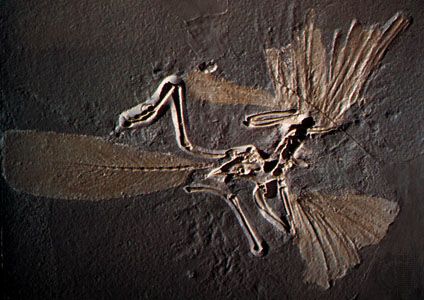
- Feather Evolution: Discoveries of feathered relatives, such as Caudipteryx, have shown that feathers did not evolve solely for flight. Instead, they likely served functions like insulation, display, and protecting eggs while brooding, suggesting that the precursors to avian flight were already present in non-flying theropods.4
- Dietary Diversity: As toothless theropods, Oviraptor and its relatives challenge the assumption that all theropods were strictly carnivorous, suggesting they may have been omnivorous, similar to modern ostriches.6
When and where did Oviraptor live during the prehistoric era?
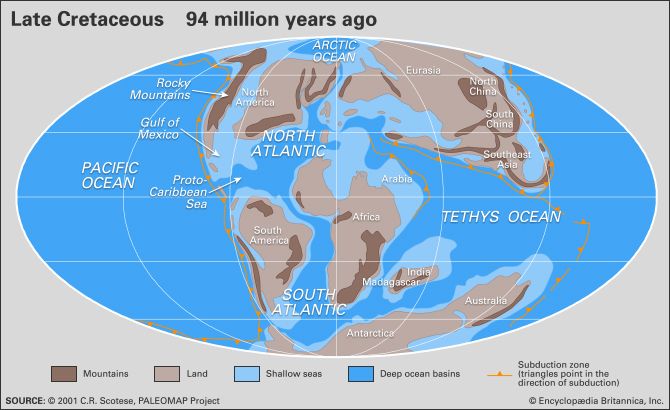
Oviraptor lived during the Late Cretaceous Period, a timeframe spanning approximately 100 million to 65.5 million years ago.1
Fossil evidence for this genus has been recovered from deposits in eastern Asia, specifically Mongolia, as well as North America.12
What are the key physical characteristics of Oviraptor dinosaurs?
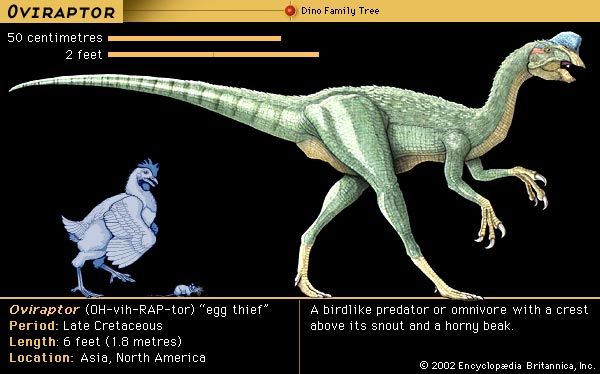
Oviraptor was a small, lightly built dinosaur characterized by several distinct physical features that reflect its adaptation to an active, potentially omnivorous lifestyle.1
Key physical characteristics include:
- Body Size and Stance: It reached approximately 1.8 meters (6 feet) in length and moved on two long, well-developed hind limbs.1
- Skull and Jaws: The skull was short and featured very large eyes, which were surrounded by a bony ring, suggesting the animal may have been capable of stereoscopic vision. The jaws were toothless and were likely covered by a horny, beaklike sheath. Additionally, the skull possessed unusual cranial crests.1
- Forelimbs: The forelimbs were long and slender, ending in three long, clawed fingers that were well-suited for grasping, ripping, and tearing.1
- General Build: As a member of the theropod group, Oviraptor shared anatomical links with birds, including skeletal features that suggest a high degree of mobility.17
Sources
- Oviraptor — Encyclopædia Britannica
- dinosaur - Tetanurae — Encyclopædia Britannica
- oviraptor — Merriam-Webster
- dinosaur - Reproduction — Encyclopædia Britannica
- dinosaur - Dinosaur descendants — Encyclopædia Britannica
- dinosaur - Theropoda — Encyclopædia Britannica
- feathered dinosaur — Encyclopædia Britannica
Published on · 3 min read