Owlet Frogmouth
Owlet frogmouths are insectivorous birds that primarily consume terrestrial prey, similar to the behavior of frogmouths. Their diet consists largely of…
What is the typical diet and hunting behavior of owlet frogmouths?
Owlet frogmouths are insectivorous birds that primarily consume terrestrial prey, similar to the behavior of frogmouths. Their diet consists largely of insects, which they capture using two distinct hunting strategies.12
Regarding their hunting behavior, these birds often sally from an elevated perch to snatch flying insects out of the air. Additionally, they hunt by pouncing on terrestrial prey found on the ground or on branches. While they are primarily insect-eaters, their hunting methods allow them to be versatile in securing food within their forest habitats.12
What are the breeding and nesting habits of owlet frogmouths?
Owlet frogmouths exhibit specific nesting habits that distinguish them from other members of the Caprimulgiformes order. Unlike nightjars, which often nest on the ground, or frogmouths, which build nests on tree branches, owlet frogmouths typically nest in hollow trees or within tunnels in sandbanks.13
When preparing their nesting site, they generally lay three to five white eggs, often placing them upon a mat of leaves or fur. While the incubation period for these birds remains unknown, it is understood that their nestlings are semi-dependent; they are born covered in whitish down and are fed by both parents until they are fully fledged.13
Where are owlet frogmouths typically found in their natural habitat?
Owlet frogmouths are primarily found in Australia, New Guinea, New Caledonia, and the Moluccas.1
Within these regions, they are arboreal birds that inhabit specific environments, including:
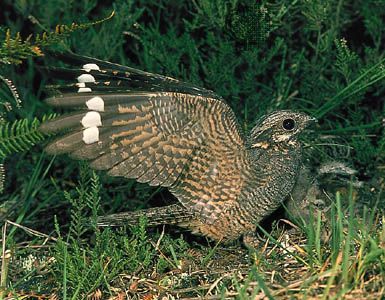
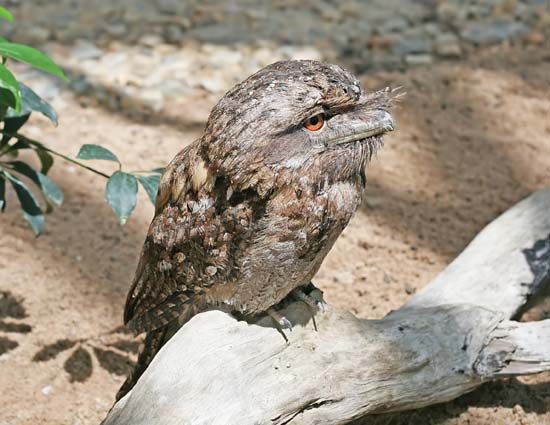
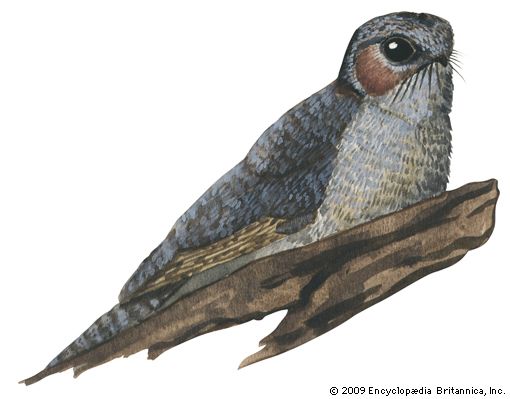
As tree-dwelling species, they typically perch crosswise on branches in an upright posture, often blending into their surroundings by resembling clusters of dead leaves. Because they are hole-nesters, their distribution and population numbers are often influenced by the availability of suitable nesting sites, for which they must compete with both owls and various diurnal bird species.564
How do owlet frogmouths differ from other frogmouth species?
Owlet frogmouths (family Aegothelidae) are distinct from true frogmouths (family Podargidae) in several key anatomical and behavioral ways:
- Size and Build: Owlet frogmouths are generally smaller, ranging from 16 to 25 cm in length, whereas true frogmouths are larger, typically measuring 20 to 40 cm.1
- Bill Structure: While both families have wide mouths, the bill of an owlet frogmouth is shorter and weaker than that of a true frogmouth and is largely obscured by forehead feathering.1
- Anatomy: A unique feature of the owlet frogmouth is that it is the only family within the order Caprimulgiformes that lacks ceca (blind pouches in the intestine). Additionally, unlike true frogmouths, which possess well-developed powder down tufts on the rump, owlet frogmouths do not share this specific trait.1
- Nesting Habits: While both are arboreal, true frogmouths construct nests on horizontal tree forks using twigs and plant matter. In contrast, owlet frogmouths are cavity nesters, preferring to lay their eggs in hollow trees or tunnels in sandbanks.3
- Vocalizations: Owlet frogmouths are known for owl-like whistles, churring calls, and hissing notes, whereas true frogmouths typically produce nasal booming, hooting, or croaking sounds.7
Sources
- Owlet frogmouth — Encyclopædia Britannica
- Caprimulgiform - Food habits — Encyclopædia Britannica
- Caprimulgiform - Reproduction — Encyclopædia Britannica
- Caprimulgiform - Form and function — Encyclopædia Britannica
- Caprimulgiform - Habitat — Encyclopædia Britannica
- Caprimulgiform - Natural history — Encyclopædia Britannica
- Caprimulgiform - Annotated classification — Encyclopædia Britannica
- Caprimulgiform - Vocalizations — Encyclopædia Britannica
Published on · 2 min read