Frogmouth
Frogmouths (family Podargidae) serve as nocturnal predators within their ecosystems, primarily inhabiting forested savannas, forest edges, and open forests.
What role do frogmouths play in their ecosystem?
Frogmouths (family Podargidae) serve as nocturnal predators within their ecosystems, primarily inhabiting forested savannas, forest edges, and open forests.12
Their ecological role is defined by their diet and hunting behavior:
- Pest Control: By consuming large insects, small lizards, and mice, they help regulate the populations of these organisms.1
- Seed Dispersal: Some Australian species also consume berries and fruit, which may contribute to seed dispersal within their habitats.1
In these environments, frogmouths occupy a niche that minimizes direct competition with other nocturnal birds, such as owls, through specific food preferences and distinct hunting methods. While they are specialized predators, they share their habitats with various other species, and their presence contributes to the complex food webs of the forests and savannas of southeastern Asia and Australia.21
What are the distinctive physical characteristics of frogmouth birds?
Frogmouths (family Podargidae) are distinguished by several unique physical traits that aid in their survival and camouflage:
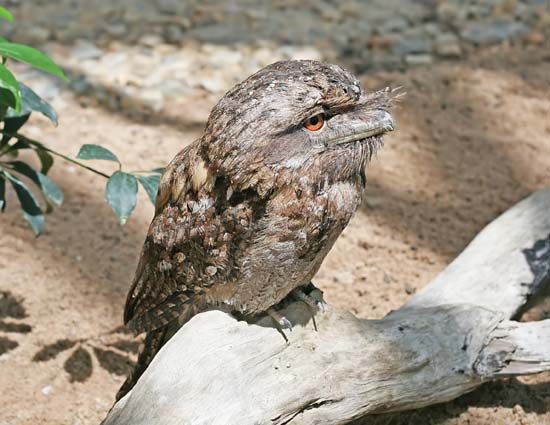
- Bill and Gape: They are named for their characteristic broad, froglike gape. Unlike other members of the order Caprimulgiformes, which often have weak bills, the frogmouth possesses a substantial, strong, and slightly hooked bill with a hard rhamphotheca (horny covering).145
- Plumage and Camouflage: Their feathers are soft and cryptically patterned in shades of reddish brown or grayish, allowing them to blend seamlessly with tree bark. This coloration provides excellent natural camouflage, helping them appear as dead stubs when they adopt their characteristic “broken-branch” alarm posture during the day.1456
- Eyes: They have large eyes, with irises that can be yellow, orange, or ruby in color.5
- Size: These arboreal birds range in length from approximately 10 to 40 cm (about 4 to 16 inches).14
- Anatomy: They possess well-developed powder down tufts on either side of the rump and have short legs with small, weak feet.45
How do frogmouths differ from owls, which they are often mistaken for?
While frogmouths and owls are both nocturnal predators and may appear similar, they belong to distinct biological groups and possess key differences in anatomy and behavior:
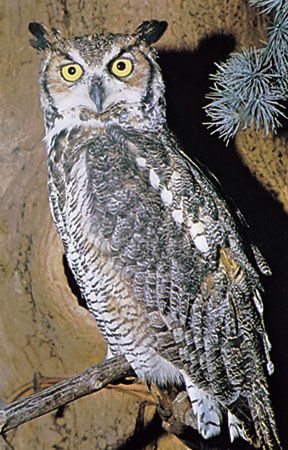
- Taxonomy: Frogmouths belong to the order Caprimulgiformes, whereas owls belong to the order Strigiformes. While they share some ecological niches, they are not the same type of bird.513
- Eye Placement: A primary distinction is that owls have forward-pointing eyes, which provide binocular vision for judging distance—a trait typical of many predators. While frogmouths also have large eyes, they lack the specialized forward-facing structure and binocular triangulation characteristic of owls.8
- Bill Structure: Frogmouths are named for their broad, froglike gape. Their bills are substantial and slightly hooked, but they differ significantly from the sharp, predatory beaks of owls.5
- Perching Behavior: During the day, frogmouths often sleep in a crouching position, resting lengthwise along a branch to mimic a broken limb. While they can appear owl-like when active, their resting posture is distinct from that of most owls.59
What are the feeding habits and diet of frogmouth birds?
Frogmouths are nocturnal predators that primarily hunt at night. Their diet consists largely of large insects, small lizards, and mice. In addition to these animal sources, some frogmouth species found in Australia also consume berries and fruit.1
These birds are arboreal and often hunt from perches, utilizing their broad, froglike gape to capture prey. While they share forested habitats with insectivorous owls, competition between the two groups is minimized through differences in specific food preferences and hunting methods.136
Sources
- Frogmouth — Encyclopædia Britannica
- frogmouth — Merriam-Webster
- Caprimulgiform - Habitat — Encyclopædia Britannica
- Caprimulgiform - Annotated classification — Encyclopædia Britannica
- Owlet frogmouth — Encyclopædia Britannica
- Caprimulgiform - Natural history — Encyclopædia Britannica
- Caprimulgiform - Form and function — Encyclopædia Britannica
- Caprimulgiform - Evolution and paleontology — Encyclopædia Britannica
- Photoreception - Diversity of eyes — Encyclopædia Britannica
- Caudata - Food and feeding — Encyclopædia Britannica
Published on · 3 min read