Why Do Deer Freeze in Headlights?
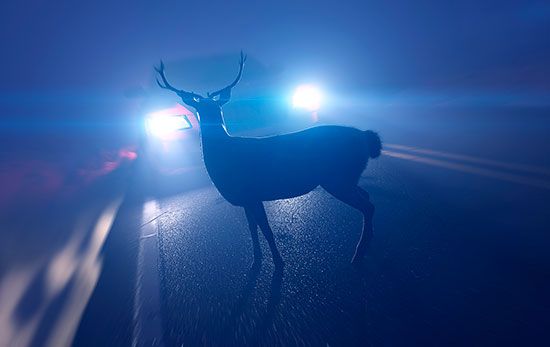
When deer appear to "freeze" in the presence of headlights, it is primarily due to their unique visual adaptations and instinctual survival behaviors.
Why do deer freeze in headlights?
When deer appear to “freeze” in the presence of headlights, it is primarily due to their unique visual adaptations and instinctual survival behaviors.1
As crepuscular animals, deer have eyes highly sensitive to low-light conditions, featuring a high density of rod cells and a tapetum lucidum that reflects light to improve night vision. When suddenly exposed to the intense brightness of car headlights, their pupils—which are fully dilated to capture dim light—cannot adjust quickly enough, leading to temporary blindness or disorientation.12
Beyond physical limitations, freezing is an instinctual response to perceived threats. In the wild, remaining motionless helps deer avoid detection by carnivores1. Because deer may lack experience with vehicles, they often do not associate the light and sound of an approaching car with danger, choosing instead to stand still in the hope that the “threat” will pass by without noticing them.1
What is the tapetum lucidum and how does it help animals see at night?
The tapetum lucidum is a specialized, mirror-like reflective layer located in the epithelium or retina of the eye, commonly found in many nocturnal vertebrates.34
It functions as an optical enhancement tool for low-light vision. When light enters the eye, it passes through the retina to reach the photoreceptors. Any photons that are not absorbed on this first pass strike the tapetum lucidum, which reflects the light back outward. This reflection provides the visual pigments a “second chance” to capture the light, significantly increasing the animal’s sensitivity to dim environments.34
The reflective quality of this layer is often created by the presence of the compound guanine. This structure is also responsible for the “eyeshine” effect—the familiar glow seen in the eyes of nocturnal animals when light is reflected back toward an observer. By maximizing the capture of available light, the tapetum lucidum allows animals such as cats and bush babies to navigate and hunt effectively in near-darkness.34
How does dichromatic vision differ from human color vision?
Dichromatic vision differs from human color vision primarily in the number of light-sensitive cone cells present in the retina.
Trichromacy vs. Dichromacy
Most humans possess trichromatic vision, which relies on three types of cones sensitive to short (blue), medium (green), and long (red) wavelengths of light. The brain interprets color by comparing the ratio of excitation across these three receptors, allowing for the discrimination of a wide spectrum of hues, including reds, oranges, and yellows.26
In contrast, dichromatic vision—common in many mammals and some humans with color-defective vision—relies on only two types of cone cells. Because these organisms lack the third cone mechanism, they cannot distinguish between certain colors that appear distinct to trichromats. For example:728
- Red-Green Confusion: Dichromats often struggle to differentiate between reds, oranges, and greens, as these colors may appear identical or blend into similar shades.78
- Luminosity Reliance: When dichromats can distinguish between these colors, it is often due to differences in brightness (luminosity) rather than hue.78
This evolutionary trade-off often favors sensitivity to movement or low-light conditions over a broad color spectrum.72
What are some other examples of crepuscular animals?
Crepuscular animals are those that are primarily active during the twilight hours of dawn and dusk. This behavioral pattern is distinct from strictly nocturnal or diurnal habits, often serving as an adaptation to avoid predators or extreme temperatures.
Prominent examples of crepuscular animals include:
- Caprimulgiform birds: This order of birds, which includes nightjars, frogmouths, potoos, and owlet-frogmouths, is primarily crepuscular. Their activity is largely limited to dawn and dusk, though they may remain active at night if there is sufficient moonlight.9
- Oilbirds: These birds are well-adapted for low-light conditions and typically leave their cave roosts at dusk to forage, returning at dawn. They are unique among their order for possessing an echolocation system that allows them to navigate in total darkness.9
While many animals are strictly nocturnal, some species exhibit flexibility in their activity patterns based on environmental cues like light levels at dusk or dawn.10
Sources
- Why do deer freeze in headlights? — Encyclopædia Britannica
- Are deer colorblind? — Encyclopædia Britannica
- coloration - Visual functions — Encyclopædia Britannica
- insect - Eyes — Encyclopædia Britannica
- Photoreception - Diversity of eyes — Encyclopædia Britannica
- Photoreception - Photopigments — Encyclopædia Britannica
- human eye - Young-Helmholtz theory — Encyclopædia Britannica
- human eye - Colour defectiveness — Encyclopædia Britannica
- bat - Activity patterns — Encyclopædia Britannica
- crepuscular — Merriam-Webster
- Daylight Saving Time - Pro 3: DST promotes active lifestyles and better health. — Encyclopædia Britannica
- Caprimulgiform - Natural history — Encyclopædia Britannica
Published on · 3 min read