Oystercatcher
Oystercatchers are shorebirds found in temperate to tropical regions across the globe. They are primarily coastal inhabitants, frequenting environments where…
Where are oystercatchers typically found, and what habitats do they prefer?
Oystercatchers are shorebirds found in temperate to tropical regions across the globe. They are primarily coastal inhabitants, frequenting environments where they can access mollusks—such as oysters, clams, and mussels—during low tide when these prey items are exposed.1
Regarding their specific habitat preferences, these birds are often associated with coastal areas, including spits of sand and islands that provide the secluded, deserted beaches necessary for successful nesting. When nesting, they typically lay their eggs directly on the ground, often in the sand. Their distribution varies by species; for example, the European oystercatcher is found across Europe, Asia, and Africa, while the American oystercatcher is native to coastal regions of the Western Hemisphere.21
How many species of oystercatchers exist worldwide?
There are approximately seven species of oystercatchers worldwide. These shorebirds belong to the genus Haematopus and the family Haematopodidae, characterized by their stout bodies, long, wedge-shaped bills, and thick legs.13
What are the distinctive physical features of oystercatchers?
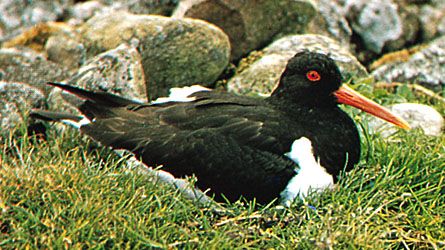
Oystercatchers are medium-sized, stout-bodied shorebirds, typically measuring between 38 and 51 cm (15 to 20 inches) in length. Their physical appearance is defined by several distinctive features:14
- Bill: They possess a long, wedge-shaped bill that is bright orange-red in color. The bill is laterally flattened, with the tips forming a vertical blade, an adaptation that assists them in feeding on mollusks.145
- Plumage: Their feathers exhibit bold patterns, ranging from black and white—often including a prominent white wing patch—to entirely black or dark brown.14
- Legs and Feet: They have moderately long, thick, pinkish legs. Their feet are characterized by having three toes.14
- Wings: These birds have long, pointed wings.1
These birds are members of the family Haematopodidae, and their anatomy, including their specialized bills and sturdy build, is well-suited for their coastal lifestyle.14
How do oystercatchers reproduce and care for their young?
Oystercatchers exhibit specific behaviors regarding their reproduction and the care of their offspring:
- Courtship: These birds are highly gregarious and engage in communal displays, such as the “piping performance,” where groups run toward a central point with their bills and necks lowered while uttering loud calls. Before mating, the male circles the female in a crouching pose with his tail and bill lowered, while the female signals her readiness by raising her tail.6
- Nesting: While pairs separate from the flock to nest, they do not exhibit strong territorial behavior and may tolerate other birds nearby. They often return to the same nesting spot with the same mate in successive years.6
- Incubation: A clutch typically consists of two or three eggs, which are incubated by both parents.6
- Care of Young: Once hatched, the downy chicks move to the water’s edge. They remain on a feeding territory for at least six weeks, during which time they are fed small worms by their parents, who forage in nearby shallow water.6
Sources
- Oystercatcher — Encyclopædia Britannica
- American oystercatcher — Merriam-Webster
- oystercatcher — Merriam-Webster
- Charadriiform - Adaptations for feeding — Encyclopædia Britannica
- Charadriiform - Annotated classification — Encyclopædia Britannica
- Charadriiform - Shorebirds (suborder Charadrii) — Encyclopædia Britannica
Published on · 2 min read