Pachyrhinosaurus
The exact function of the thickened nasal boss on the skull of Pachyrhinosaurus remains unknown to paleontologists.
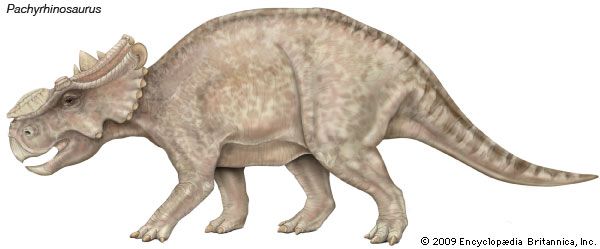
What was the function of the thickened nasal boss on Pachyrhinosaurus’s skull?
The exact function of the thickened nasal boss on the skull of Pachyrhinosaurus remains unknown to paleontologists.1
While the specific purpose of these bony knobs, along with the dinosaur’s horns and frill, has not been definitively determined, researchers have proposed several hypotheses regarding their potential roles. These structures may have been utilized for:
- Species recognition: Serving as a visual identifier for members of the same group.1
- Social competition: Acting as a tool for competition between males.1
- Defense: Providing a means of protection against predators.1
Because the fossil record for these behaviors is limited, these remain scientific possibilities rather than confirmed facts.1
How does Pachyrhinosaurus relate to other members of the Centrosaurinae subfamily?
Pachyrhinosaurus is classified within the Centrosaurinae subfamily of ceratopsid dinosaurs. This group is distinguished from the Chasmosaurinae by specific cranial features, most notably having small eye horns and large nasal horns or, in the case of Pachyrhinosaurus, thickened bony knobs known as bosses.36
Within the Centrosaurinae, Pachyrhinosaurus shares close evolutionary ties with several other genera:
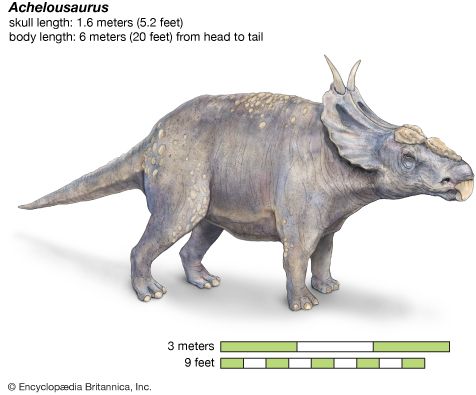
- Direct Ancestry: Evidence suggests that the genus Achelousaurus may be the direct ancestor of Pachyrhinosaurus.6
- Close Relatives: It is closely related to Styracosaurus and Centrosaurus.4
- Related Taxa: It also shares a likely relationship with Einiosaurus, a centrosaurine characterized by a downward-curving nasal horn and frill horns.6
Unlike the chasmosaurines, which typically featured long postorbital horns and elongated frills, Pachyrhinosaurus and its fellow centrosaurines relied on these distinct nasal bosses and varied frill ornamentation.46
What species of Pachyrhinosaurus have been identified, and how do they differ?
The provided search results do not contain information regarding the specific species of Pachyrhinosaurus or how they differ from one another. The available data focuses on the general characteristics, habitat, and potential behaviors of the genus Pachyrhinosaurus as a whole, rather than a breakdown of its individual species.3
How have paleontologists’ understanding of Pachyrhinosaurus changed over time since its initial discovery?
The provided search results do not contain information regarding how paleontologists’ understanding of Pachyrhinosaurus has evolved or changed over time since its initial discovery. The available documentation focuses on the genus’s physical characteristics, its classification within the Centrosaurinae subfamily, and its geographic distribution, rather than the history of scientific research or shifting interpretations of the taxon.
Sources
- Pachycephalosaurus — Encyclopædia Britannica
- dinosaur - Ceratopsia — Encyclopædia Britannica
- Pachyrhinosaurus — Encyclopædia Britannica
- Achelousaurus — Encyclopædia Britannica
- reptile - Skull and dentition — Encyclopædia Britannica
- ceratopsian — Encyclopædia Britannica
Published on · 2 min read