Achelousaurus
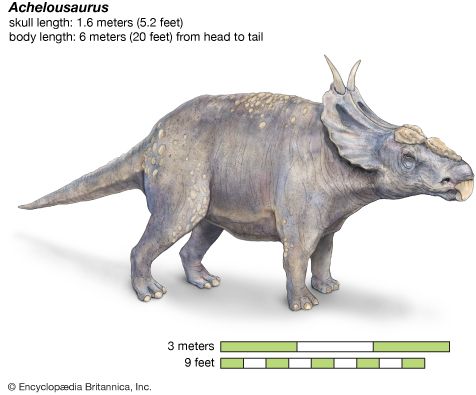
Achelousaurus (Achelousaurus horneri) was a herbivorous ceratopsian dinosaur that inhabited present-day Montana during the Late Cretaceous Period…
What is Achelousaurus?
Achelousaurus (Achelousaurus horneri) was a herbivorous ceratopsian dinosaur that inhabited present-day Montana during the Late Cretaceous Period, approximately 83 million to 70 million years ago.1
Belonging to the subfamily Centrosaurinae, this dinosaur reached lengths of about 6 meters (20 feet). Unlike many other ceratopsians, Achelousaurus lacked long horns above its eyes, possessing instead raised, bony knobs known as horn bosses. It did, however, feature two horns extending from its frill, which may have functioned for defense, thermoregulation, or mate attraction.1
The genus is named after the Greek river god Achelous, who was said to have lost a horn in a struggle with Hercules. The first skull was discovered in 1987 in the Two Medicine Formation by a team led by paleontologist Jack Horner, and the species was formally described in 1995 by Scott Sampson. Evidence suggests Achelousaurus may be a direct ancestor to the Pachyrhinosaurus.1
When and where did Achelousaurus live?
Achelousaurus lived during the Late Cretaceous Period, specifically between 83 million and 70 million years ago.1
Geographically, this ceratopsian inhabited the region of present-day Montana. Its fossils have been discovered specifically within the Two Medicine Formation in northwestern Montana, where specimens were found in the uppermost 20 meters of the rock strata.1
What did Achelousaurus look like?
Achelousaurus was a herbivorous ceratopsian dinosaur that reached approximately 6 meters (20 feet) in length. Its appearance was characterized by several distinct features:
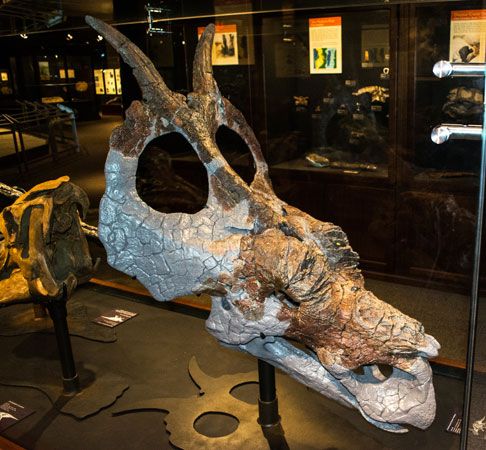
- Skull and Beak: It possessed a large skull, measuring 1.6 meters (5.2 feet) in length, and a beak similar to that of a modern parrot, which was well-suited for a plant-based diet.1
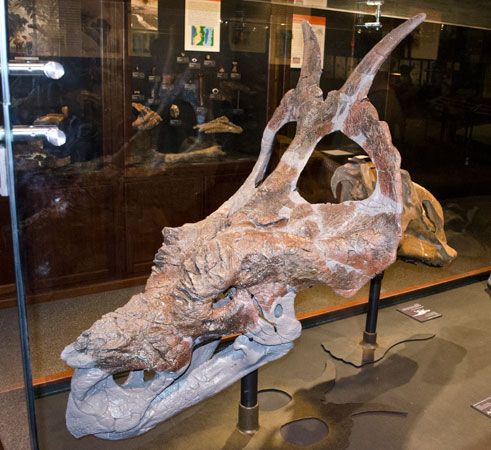
- Facial Features: Unlike many other ceratopsians, Achelousaurus lacked long horns above its eyes and a large nasal horn. Instead, it featured raised, bony knobs known as horn bosses on its face near the eyes.1
- Frill: It had a bony crest, or frill, extending from the back of its skull. This frill featured two horns that extended outward, which may have served as a defense mechanism, a way to regulate body temperature, or a means to attract mates.1
As a member of the Centrosaurinae subfamily, its physical structure reflects the group’s tendency toward shorter, ornamented frills compared to the long-frilled chasmosaurines.1
What kind of environment did Achelousaurus inhabit?
Achelousaurus inhabited an environment characterized by nonmarine sedimentary rock deposits. Its remains were discovered within the Two Medicine Formation in northwestern Montana, a geological area formed between 83 and 75 million years ago.1
The presence of these nonmarine sediments indicates that the dinosaur lived in a terrestrial landscape rather than a marine one during the Late Cretaceous Period. As a plant-eating ceratopsian, Achelousaurus would have relied on the vegetation available in this ancient, inland environment to sustain its diet.1
Sources
- Achelousaurus — Encyclopædia Britannica
- Hell Creek Formation — Encyclopædia Britannica
- dinosaur - Ceratopsia — Encyclopædia Britannica
Published on · 2 min read