Pallas’s Cat
The Pallas’s cat (Felis manul) is a small, long-haired cat native to the rocky, mountainous regions and deserts of Tibet and Siberia.
What are the unique physical characteristics of Pallas’s cat?
The Pallas’s cat (Felis manul) is a small, long-haired cat native to the rocky, mountainous regions and deserts of Tibet and Siberia.1
Its unique physical characteristics include:
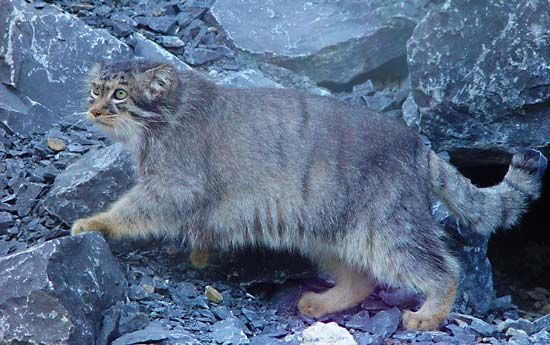
- Distinctive Fur: The cat features soft, pale silvery gray or light brown fur. Notably, the fur on its underparts is approximately twice as long as that on its upperparts, an adaptation likely intended to insulate the animal while it lies or crouches on cold ground.1
- Head Structure: It is distinguished by a broad head with high-set eyes and low-set ears. This unique positioning is thought to be an adaptation for peering over rocky ledges, allowing the cat to minimize its exposure while hunting prey such as birds and small mammals.1
- Size and Markings: Roughly the size of a house cat, it weighs between 2.5 and 3.5 kilograms (5.5 to 7.7 pounds). Its tail is ringed and tipped with black, and some individuals display vague, dark markings on their bodies.1
What is the diet and hunting behavior of Pallas’s cat?
The Pallas’s cat (Felis manul) is a specialized predator that primarily hunts small mammals, such as pikas and various rodents, as well as birds.1
Regarding its hunting behavior, the Pallas’s cat utilizes its unique physical structure to remain inconspicuous. Its broad head, featuring high-set eyes and low-set ears, is an adaptation for peering over rocky ledges. By positioning itself in this manner, the cat minimizes its exposure to potential prey while scanning its environment. As a member of the family Felidae, it shares the general anatomical traits of highly specialized carnivores, including powerful hind legs for springing and sharp teeth designed for gripping and slicing flesh rather than grinding or chewing.12
While the provided information does not detail specific stalking maneuvers beyond its ledge-peering strategy, it is known that cats generally rely on keen senses of sight and hearing to navigate and hunt. Their vertical, slit-shaped pupils further assist in judging distances accurately, a critical skill for stalking and ambushing prey.23
What role does Pallas’s cat play in its ecosystem?
The Pallas’s cat (Felis manul) functions within its ecosystem primarily as a specialized predator of small mammals and birds. By preying on species such as pikas and various rodents, it helps regulate the populations of these animals within its native range, which spans from Tibet to Siberia.1
As a member of the family Felidae, the Pallas’s cat is a dedicated carnivore. Its role is defined by its hunting strategy, which involves using its broad head and high-set eyes to peer over rocky ledges, allowing it to ambush prey while minimizing its own visibility. This behavior highlights its adaptation to the harsh, rocky, and mountainous environments it inhabits, where it must remain inconspicuous to successfully secure food.14
While the provided search results do not detail broader ecological impacts, such as its role in the food web as a source of prey for larger predators, its position as a specialized hunter is consistent with the ecological function of other small felines.14
Are there any interesting myths or cultural significance associated with Pallas’s cat in its native regions?
The provided information does not contain details regarding myths or cultural significance associated with the Pallas’s cat in its native regions. The available data focuses on the animal’s physical characteristics, such as its size, fur, and anatomical adaptations for hunting in rocky environments, as well as its naming after the naturalist Peter Simon Pallas.1
Sources
- Pallas’s cat — Encyclopædia Britannica
- Why do cats have slit pupils? — Encyclopædia Britannica
- feline - Form and function — Encyclopædia Britannica
- Eurasian lynx - Diet — Encyclopædia Britannica
- feline — Encyclopædia Britannica
Published on · 3 min read