Palm-chat
The term "Palm-chat" refers to a songbird (Dulus dominicus) native to Hispaniola and nearby Gonâve Island. This bird, which may belong to the waxwing family…
What is Palm-chat?
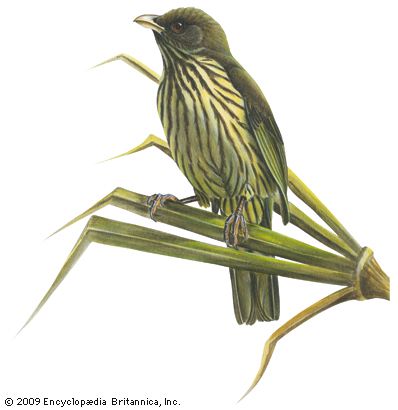
The term “Palm-chat” refers to a songbird (Dulus dominicus) native to Hispaniola and nearby Gonâve Island. This bird, which may belong to the waxwing family, is typically classified in its own family, Dulidae. It is known for its greenish-brown plumage, stout bill, and unique social behavior: these birds feed in flocks and construct large, communal nests that feature private-entrance chambers for up to 30 pairs.1
It is important to clarify that “Palm-chat” is not a reference to an artificial intelligence chatbot. While Google has developed a large language model known as PaLM 2, it is a distinct technology used for natural language processing and is unrelated to the avian species.2
What makes the communal nesting behavior of the palm-chat unique among birds?
The communal nesting behavior of the palm-chat (Dulus dominicus) is distinct because it deviates from the typical reproductive patterns of most passerines. While the majority of bird species are solitary nesters that defend a territory for all activities, or colonial nesters that defend only a small area around an individual nest, the palm-chat constructs a massive, shared structure.13
This unique architecture consists of a single, large communal nest built within a tree. Within this collective dwelling, up to 30 breeding pairs reside simultaneously. The structure is organized such that each pair maintains and defends only its own private-entrance chamber, effectively combining the benefits of colonial living with the security of individual nesting cavities.13
How does the palm-chat differ from waxwings in its classification?
The classification of the palm-chat (Dulus dominicus) remains a subject of taxonomic debate among ornithologists. While the palm-chat is frequently placed in its own distinct family, Dulidae, some authorities argue that it should be included within the waxwing family, known as Bombycillidae.14
The primary difference lies in this taxonomic separation:
- Dulidae: This family is currently reserved exclusively for the palm-chat, reflecting its unique status as a monotypic family.1
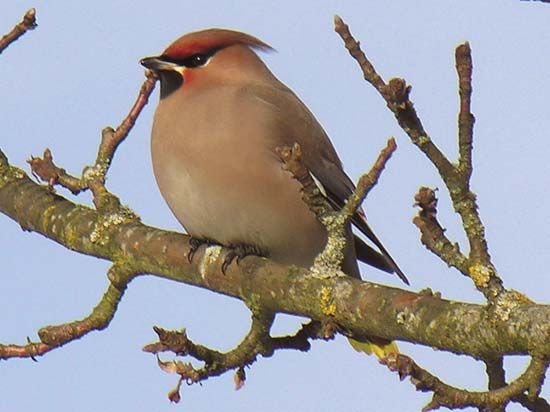
- Bombycillidae: This family typically encompasses waxwings, silky flycatchers, and the gray hypocolius. Members of this family generally share physical traits such as tapering crests, distinctive wing markings, and short, broad bills.4
Those who advocate for grouping the palm-chat with the Bombycillidae point to shared ecological and morphological similarities, such as their arboreal nature and reliance on fruit-based diets. However, because the palm-chat is usually separated into its own family, it remains distinct from the broader classification of waxwings.14
What are some other bird species native to the island of Hispaniola?
While the palm-chat is a well-known avian resident of Hispaniola, the provided search results do not contain a comprehensive list of other specific bird species native to the island.
The available information notes that a great variety of birds, including ducks, are found in the Dominican Republic, but it does not provide a detailed inventory of these species. While trogons are mentioned as occurring throughout the West Indies, the text does not explicitly confirm which specific species are native to Hispaniola.56
Sources
- Palm-chat — Encyclopædia Britannica
- artificial intelligence - Large language models and natural language processing (NLP) — Encyclopædia Britannica
- Passeriform - Territoriality and courtship — Encyclopædia Britannica
- Bombycillidae — Encyclopædia Britannica
- Dominica - Plant and animal life — Encyclopædia Britannica
- Trogon — Encyclopædia Britannica
- Dominican Republic - Plant and animal life — Encyclopædia Britannica
- Cabo Verde - Plant and animal life — Encyclopædia Britannica
Published on · 2 min read